What Is Pinchbeck?
What pinchbeck is, how Christopher Pinchbeck's gold-coloured alloy imitated gold in Georgian jewellery and watch cases, why it declined after 1854, and how it is collected today.
Pinchbeck is a copper-and-zinc alloy - a type of brass with a high proportion of copper - formulated to resemble gold closely enough to serve as a lower-cost substitute in 18th and early 19th-century jewellery, watch cases and small accessories.

Christopher Pinchbeck and His Sons
Pinchbeck takes its name from Christopher Pinchbeck (c.1670-1732), a London clockmaker and maker of musical and astronomical clocks and automata, whose shop was in Fleet Street. He is credited with developing or popularising the particular copper-zinc formulation that came to bear his name, probably in the 1710s or 1720s. The exact proportions were kept as a trade secret, though the alloy sits within the broader family of brasses long used to imitate gold’s colour.
After his death in 1732 the business passed to his sons. Edward Pinchbeck kept the Fleet Street shop and advertised that the genuine metal could be had only from him, warning customers against imitations sold under the family name - an early sign of how quickly the word was being borrowed. His brother, also Christopher Pinchbeck (1710-1783), became a well-known clock and instrument maker and worked for George III. By the middle of the 18th century “pinchbeck” was a generic term for gold-coloured alloys made by many workshops, not only the Pinchbeck family.
Similar alloys existed elsewhere under other names. “Prince’s metal”, a gold-coloured brass associated with Prince Rupert of the Rhine, was known in 17th-century England, and on the Continent comparable alloys were sold as tombac (tombak), similor or “Mannheim gold”.
What It Is Structurally
Pinchbeck is fundamentally a brass alloy. Figures quoted for it vary, but it is usually described as roughly five parts copper to one part zinc - much more copper than ordinary yellow brass - which gives a warm, reddish-gold colour and a metal that works well for casting, stamping, chasing and engraving.
Unlike gilding or electroplating, which apply a thin layer of real gold over a base-metal core, pinchbeck is solid through its thickness - the alloy itself is the gold-coloured material. This separates it from the later 19th-century methods of rolled gold and electrogilding, which achieved a similar look by different means. See Gold in Historical Jewellery for how these alternatives compare with solid gold.
Period of Use
Pinchbeck’s heyday ran through the Georgian and Regency periods and into the early Victorian era - roughly the 1720s to the 1840s. Typical uses were:
- Watch cases and chatelaines. Pinchbeck’s link to the clock and watch trade was there from the start, and pinchbeck pair-cased watches and chatelaines hung with seals, keys and étuis were standard middle-market goods.
- Buckles and seals. Shoe and knee buckles and fob seals, often set with paste or glass intaglios, were made in pinchbeck in large numbers in the later 18th century.
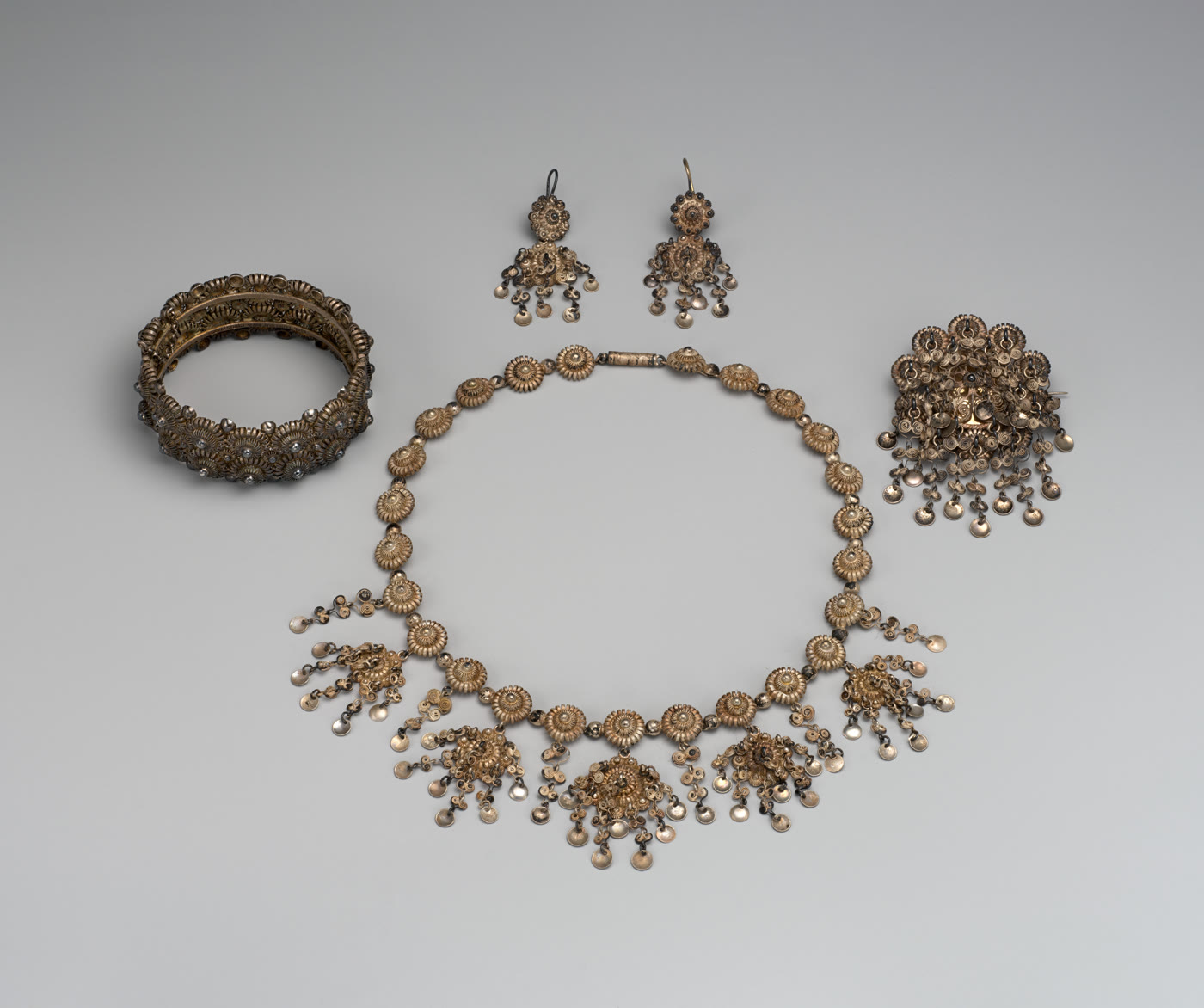
- Brooches, lockets and necklaces. In the 1820s and 1830s pinchbeck was used for brooches and necklace fronts worked in the same filigree and cannetille wirework as fine gold jewellery, often set with foiled glass, garnets or topaz, so surviving pieces can be strikingly detailed.
Decline
Several changes in the mid-19th century made pinchbeck redundant:
- Electrogilding. Elkington’s electroplating patents of 1840 in Birmingham made it cheap to coat base metal with a thin, even layer of real gold.
- Lower gold standards. In 1854 Britain legalised 15, 12 and 9 carat gold (see What Does 9ct Mean?). With new gold from the Californian and Australian gold rushes, buyers who had once bought pinchbeck could afford low-carat gold instead.
- Rolled gold. Gold bonded to a base-metal core and rolled out into sheet or wire became widespread in the later 19th century, particularly in Birmingham and in the American jewellery trade.
By the 1850s pinchbeck was no longer the leading imitation gold. The word survived in English as a figure of speech for anything sham or second-rate, and dealers continued to use it loosely for any gold-coloured base metal.
Collectibility Today
Because pinchbeck jewellery was often made with real skill, and because surviving pieces belong to a fairly specific period, genuine pinchbeck is collected on its own terms rather than dismissed as counterfeit. The name is also widely misapplied: much jewellery described as “pinchbeck” in the trade is later gilt brass, rolled gold or plated metal. A piece described as pinchbeck deserves the same careful approach as any other material claim.
How to Recognise It
Pinchbeck typically shows a warm, slightly deeper or more brassy tone than fine gold, and, being a base-metal alloy, it tarnishes in ways solid high-carat gold does not, sometimes developing a duller or greenish patina in recesses. It is solid throughout, so wear at edges and high points reveals more of the same metal rather than a different-coloured core, as happens with worn gilding or rolled gold.
It does not carry gold hallmarks, since it was never represented as gold by reputable makers. The absence of a hallmark alone does not confirm a piece is pinchbeck rather than unmarked low-carat gold - identifying the metal reliably generally requires testing by a jeweller or specialist. Style and construction help with dating: hand-made findings, cannetille or early filigree work and Georgian-style settings fit the period of genuine pinchbeck, while machine-stamped findings and later clasp types point to the second half of the 19th century or later.
Frequently Asked Questions
Was pinchbeck sold as a deliberate fake? Generally not - period pinchbeck was usually marketed openly as an affordable gold-look alternative, aimed at buyers who wanted the appearance of gold without the cost, rather than as a way of passing pieces off as gold.
Is pinchbeck the same as gold-filled or rolled gold? No - pinchbeck is a solid alloy throughout, while rolled gold and gold-filled items bond a layer of real gold to a base-metal core. Pinchbeck belongs mainly to the 18th and early 19th centuries; rolled gold to the later 19th and 20th centuries.
Read next
Eras
Georgian Jewellery
A guide to Georgian jewellery (1714-1837): Brazilian diamonds, closed-back foiled settings, rococo and Neoclassical styles, paste, cut steel and pinchbeck, sentimental miniatures, girandoles, rivières and Sévigné bows.
Eras
Regency Jewellery
A guide to Regency jewellery (c.1795-1837): Empire fashion, cameos and Neoclassical parures at Napoleon's court, coloured gold and cannetille, Berlin iron and cut steel, acrostic rings, and memorial jewellery for Nelson and Princess Charlotte.
Eras
Victorian Jewellery
A guide to Victorian jewellery (1837-1901): the Romantic, Grand and Aesthetic periods, the Great Exhibition, gold rushes and 9ct gold, mourning and Whitby jet, archaeological revival, Scottish jewellery, and how to recognise each phase.

Materials
Gold in Historical Jewellery
How gold standards, supply, colour and working methods changed from Georgian to 1940s jewellery - the 1854 standards, the gold rushes, bloomed and coloured gold, rolled gold - and gold's imitations.
Materials
What Is Paste Jewellery?
What paste jewellery is, from English lead glass and Georges Frédéric Strass in Paris to foiled closed settings, black-dot culets and later Bohemian stones, and why fine paste is collected today.
Techniques
What Is Filigree?
What filigree is, how the wire was drawn and soldered, cannetille c.1815-40, Genoese, Maltese and Portuguese filigree, Castellani revival work and die-struck 1920s 'filigree' rings.