What Is Gilt Jewellery?
What gilt jewellery is, from mercury fire gilding and silver-gilt to Elkington's 1840 electrogilding and 20th-century costume jewellery, and how it differs from pinchbeck and rolled gold.
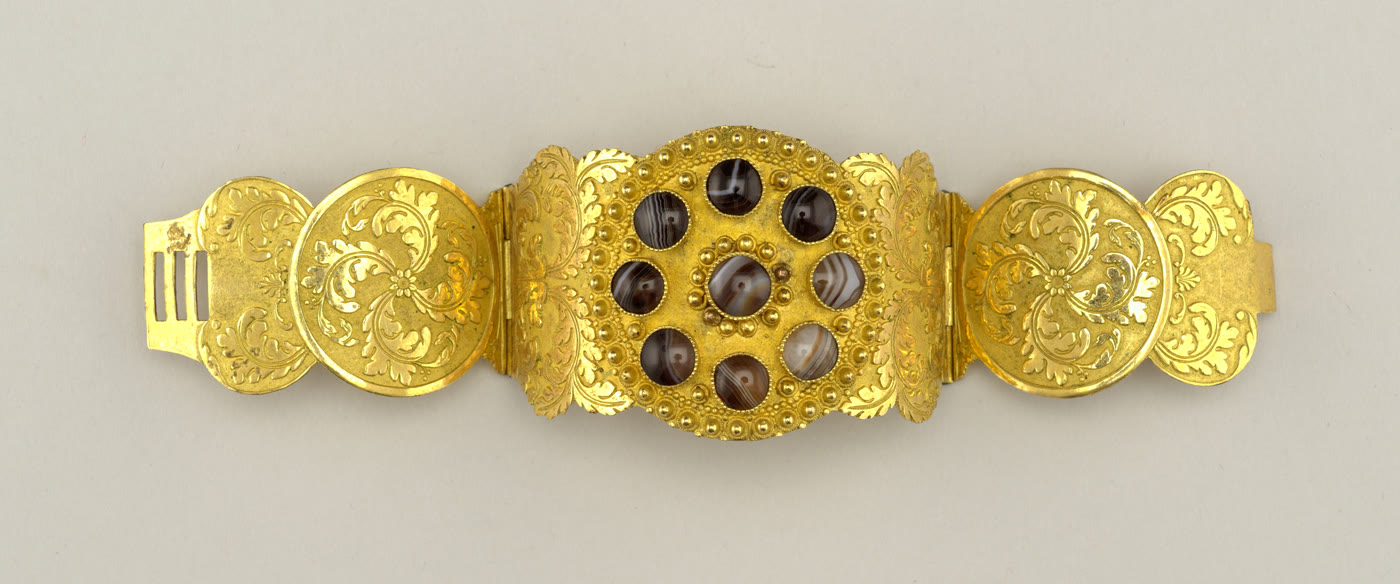
Gilt jewellery is base-metal jewellery finished with a thin surface layer of gold, giving it the colour and shine of gold jewellery at a much lower material cost.
What It Is Structurally
Unlike solid gold, and unlike a solid gold-coloured alloy such as pinchbeck, gilt jewellery is built around a core of a cheaper base metal - commonly brass, copper or a similar alloy - with only its outer surface carrying actual gold. The gold layer can be extremely thin, so the appearance, weight and even some of the working properties of the piece are governed largely by the base metal beneath, with the gold contributing colour and lustre rather than substance. This makes gilt jewellery structurally quite different from anything that is gold, or gold-coloured, all the way through.
The usual base for gilt jewellery was brass or “gilding metal”, a brass with a high proportion of copper whose warm colour shows less when the gold wears. Silver was also gilded: silver-gilt, known in French and American usage as vermeil, was used for jewellery, buckles and boxes in the 18th and 19th centuries and for much American costume jewellery in the 1940s.
How It Was Made
Two main gilding methods dominate the history of gilt jewellery.
Fire gilding (also called mercury gilding) is ancient. The gilder dissolved gold in mercury to make a paste-like amalgam, spread it over the cleaned base metal, and heated the piece over a charcoal fire so that the mercury evaporated, leaving a bonded layer of gold. The matt gold surface was then burnished with polished agate or bloodstone tools to bring up a shine, or left matt in contrast with burnished areas. Fire gilding gave a rich, durable finish - it was the method used for French ormolu (gilt bronze) and for the gilt bronze and brass ornaments that Matthew Boulton made in Birmingham in the 1760s and 1770s - but the mercury vapour poisoned gilders, who often suffered tremors and early death.
Electrogilding deposits gold from a solution onto an object connected to an electric current. Experiments in the early 19th century, including those of the Italian chemist Luigi Brugnatelli in 1805, showed that it could be done, but the commercial process came from Birmingham, where George Richards Elkington and his cousin Henry Elkington patented methods of electroplating and electrogilding using cyanide solutions in 1840. Their firm, Elkington & Co., licensed the process widely, and electrogilding soon displaced fire gilding for most commercial work, being safer, cheaper and easy to control. A very thin electroplated coat is often called “gold wash” or “gold flash”.
By the later 19th century electrogilt brass was the standard material of cheap jewellery, and Birmingham’s output was so great that “Brummagem” (an old local name for Birmingham) became a byword for showy, cheap goods.
Gilt Jewellery Through the Period
- 18th century: fire-gilt brass and copper for buckles, buttons, chatelaines and watch keys, overlapping with pinchbeck, which needed no gilding.
- 1840s-1900: electrogilt brass jewellery mass-produced in Birmingham, Paris and Pforzheim - brooches, lockets, bracelets and chains imitating fashionable gold designs, including archaeological-revival and mourning styles.
- 1900-1930s: gilt metal used for fashion and costume jewellery, set with glass stones, imitation pearls and enamel. Chanel made openly fake jewellery fashionable from the 1920s.
- 1930s-1950s: the great age of American costume jewellery. Firms such as Trifari in New York and Coro, with its factory in Providence, Rhode Island, produced gilt-metal jewellery in vast quantities, and Joseff of Hollywood used a matt “Russian gold” finish for film and retail pieces. During the Second World War many American makers worked in gilded sterling silver because base metals were restricted.
How Gilt Differs From Pinchbeck
Because pinchbeck is a solid brass alloy formulated to resemble gold, it does not have a separate coating that can wear away to reveal a different-coloured metal beneath - the alloy itself is the gold-coloured material throughout its thickness. Gilt jewellery, by contrast, has a genuine boundary between its thin gold surface and the base metal underneath, and that boundary is exactly what tends to show up as the piece ages. See What Is Pinchbeck? for more on how that alloy was formulated and used.
How Gilt Differs From Rolled Gold
Gilt jewellery is also distinct from rolled gold and gold-filled construction, even though all three involve a base metal core. Rolled gold and gold-filled items bond a comparatively thick sheet of genuine gold to a base-metal core under heat and pressure, producing a gold layer substantially thicker and more durable than a gilded or electroplated surface, though still much less gold than solid gold jewellery. Gilding, by comparison, deposits a far thinner layer of gold directly onto the surface, whether by fire gilding or electroplating. See Gold in Historical Jewellery for more on rolled gold and gold-filled construction in the context of gold jewellery generally.
Typical Wear Patterns
Because the gold layer on gilt jewellery is thin, it is prone to wearing through at points of repeated friction - the high points of a repoussé design, the inside of a ring shank, the edges of a brooch pin or clasp - revealing the different-coloured base metal underneath. This is a genuine, commonly observed characteristic of gilt jewellery rather than a sign that a piece is faulty or unusually poor quality, and it is one of the more reliable general clues that a piece is gilt rather than solid gold or a solid gold-coloured alloy.
How to Recognise It
A worn patch showing a different base-metal colour beneath the gold surface, especially at hinges, edges or high points of relief, is the clearest general sign of gilt construction, along with an overall lighter weight than a comparable piece of solid gold. Fire gilding is usually thicker, with a warm, slightly soft-looking surface that often survives in recesses, while electrogilding is thinner and very even. Marks such as “gilt”, “GP” (gold plated) or a maker’s name such as Trifari or Coro identify many 20th-century pieces. These are useful starting observations rather than certain proof, and confirming a piece’s construction with confidence generally requires examination by a jeweller experienced with historical gilding and plating.
Frequently Asked Questions
Is gilt jewellery “fake gold”? Not in the sense of being fraudulent - gilt jewellery was typically sold honestly as an affordable, gold-look alternative rather than passed off as solid gold, much like pinchbeck and rolled gold were.
Can gilding be re-applied to a worn piece? Historically and today, gilt surfaces can be re-plated, though doing so on an antique piece can affect its value as an unaltered historical object, which is a consideration worth weighing before having any antique re-gilded.
Read next
Eras
Georgian Jewellery
A guide to Georgian jewellery (1714-1837): Brazilian diamonds, closed-back foiled settings, rococo and Neoclassical styles, paste, cut steel and pinchbeck, sentimental miniatures, girandoles, rivières and Sévigné bows.
Eras
Victorian Jewellery
A guide to Victorian jewellery (1837-1901): the Romantic, Grand and Aesthetic periods, the Great Exhibition, gold rushes and 9ct gold, mourning and Whitby jet, archaeological revival, Scottish jewellery, and how to recognise each phase.
Materials
What Is Cut Steel Jewellery?
What cut steel jewellery is, from Woodstock and Matthew Boulton's Soho works to French and late Victorian work, how its faceted studs were made and set, and how to tell it from paste and marcasite.

Materials
Gold in Historical Jewellery
How gold standards, supply, colour and working methods changed from Georgian to 1940s jewellery - the 1854 standards, the gold rushes, bloomed and coloured gold, rolled gold - and gold's imitations.
Materials
What Is Paste Jewellery?
What paste jewellery is, from English lead glass and Georges Frédéric Strass in Paris to foiled closed settings, black-dot culets and later Bohemian stones, and why fine paste is collected today.

Materials
What Is Pinchbeck?
What pinchbeck is, how Christopher Pinchbeck's gold-coloured alloy imitated gold in Georgian jewellery and watch cases, why it declined after 1854, and how it is collected today.