What Is Filigree?
What filigree is, how the wire was drawn and soldered, cannetille c.1815-40, Genoese, Maltese and Portuguese filigree, Castellani revival work and die-struck 1920s 'filigree' rings.
Filigree is an ornamental metalworking technique in which fine wire, usually gold or silver, is twisted, plaited or coiled and soldered into delicate, openwork patterns, rather than the design being cast or carved from a solid piece of metal.
What Filigree Is Structurally
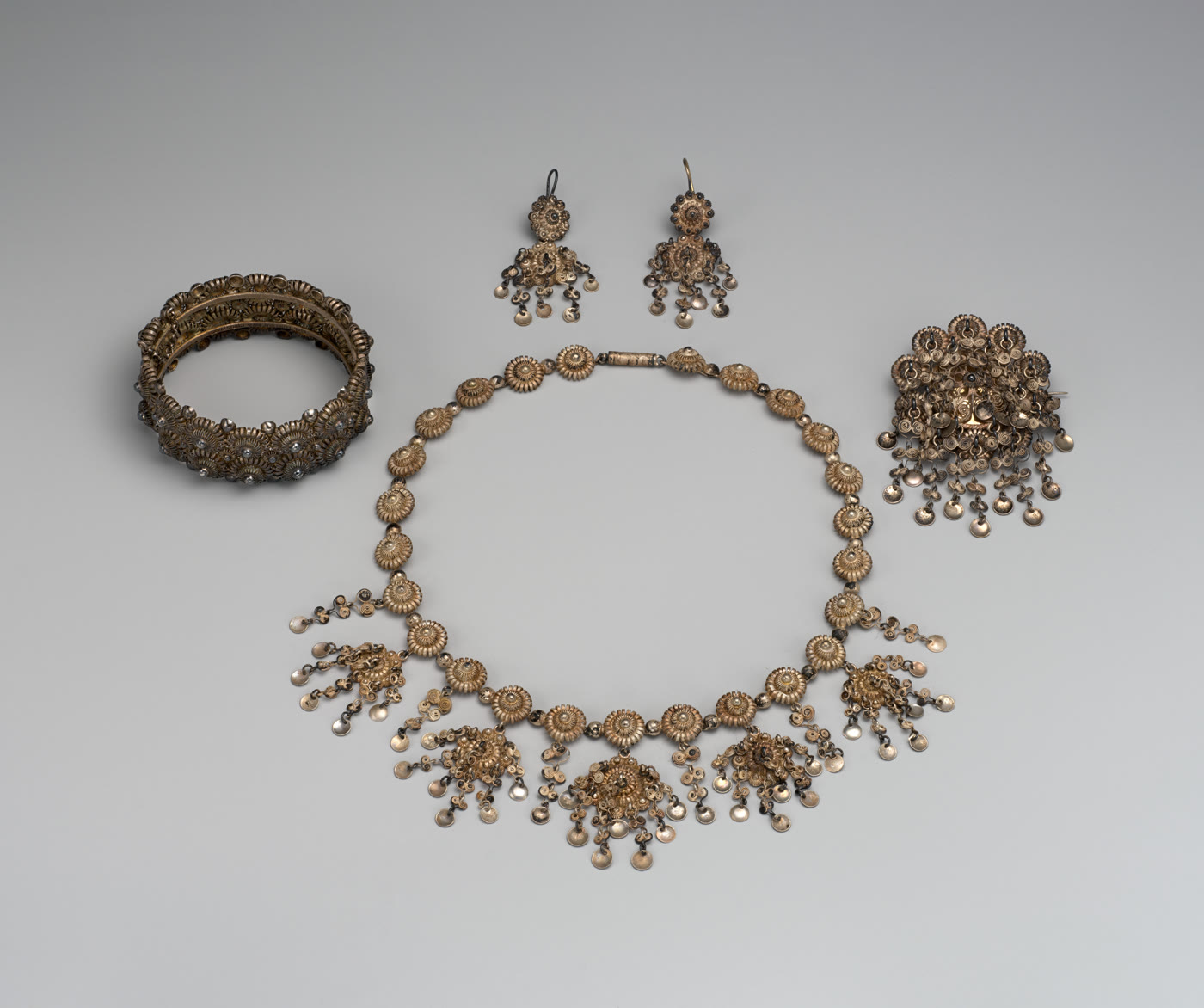
Filigree jewellery is built up piece by piece from fine wire elements - often first twisted from two or more strands, then bent, coiled or plaited into small decorative units - which are soldered together and to a supporting framework. There are two broad kinds. In openwork (sometimes called à jour) filigree the wire forms a lacy design with no backing, held within a frame of thicker wire. In applied filigree the wire pattern is soldered onto a sheet-metal ground. Because openwork filigree is mostly empty space, it is light for its apparent size.
How Filigree Was Made
The metal was first drawn into wire by pulling it through a series of progressively smaller holes in a steel drawplate, annealing it between draws so it did not become brittle. Two or more fine wires were then twisted together, and the twisted wire was often rolled or hammered flat, which turns the twist into a row of tiny beads and gives filigree its characteristic texture.
The filigree maker bent the wire with pliers and tweezers into the standard units of the craft - scrolls, S-shapes, spirals, loops and teardrops - and packed them tightly inside an outer frame of heavier wire so that they held each other in place. Powdered solder mixed with flux was then sprinkled over the work and the whole piece heated, so that all the joints flowed at once. Overheating could melt the fine wire, so control of the flame was critical. Separate filigree panels were finally shaped or domed and soldered together into a brooch, earring or pendant.
Origins
Twisted-wire ornament has ancient origins in the Near East and the Mediterranean, and Greek and Etruscan goldsmiths often combined it with granulation. Filigree then continued as a living craft in many regional traditions - in Italy, the Iberian peninsula, Scandinavia, India and China - and in Europe it has never been lost in the way that fine granulation was.
Cannetille, c.1815-1840
Cannetille takes its name from a French term for the fine coiled gold or silver thread used in embroidery. It became fashionable in Regency and late Georgian jewellery from about 1815, after the Napoleonic Wars, and remained popular into the 1830s. Cannetille work used very fine wire wound into tight spirals and coils, built up into raised rosettes, scrolls and cones over thin sheet-gold mounts that were often stamped or chased. It was usually combined with granulated beading and with coloured stones - amethyst, topaz, citrine, aquamarine and chrysoberyl - or foiled paste.
Typical cannetille pieces are large parures of necklace, earrings, brooch and bracelet clasps, and big oval or cushion-shaped brooches. The style suited a period when gold was relatively scarce and expensive after the wars, because coiled wire and thin sheet could cover a large area with little metal. Much cannetille was made in France and Britain.
Regional Filigree Traditions
Filigree was also made as a regional craft and sold as travel jewellery in the 19th century:
- Genoa. Genoa and the Ligurian town of Campo Ligure were known for fine silver and silver-gilt filigree. Genoese filigree brooches, earrings and hair ornaments in the form of flowers, butterflies and bows were common purchases for visitors to Italy.
- Malta. Maltese silver filigree, often with the eight-pointed Maltese cross as its motif, was widely bought by British service families stationed on the island while it was a British colony, and Maltese filigree brooches are common in Victorian jewellery boxes.
- Portugal. The goldsmiths of northern Portugal, around Gondomar and Póvoa de Lanhoso, made gold filigree including the heart-shaped pendant known as the coração de Viana, which is still made today.
- Scandinavia. Norwegian silver filigree, especially in traditional brooches (sølje) worn with regional dress, continued through the 19th century and was adapted by commercial silversmiths.
Revival and Machine Work
In the mid-19th century the Castellani firm in Rome and its followers, including Carlo Giuliano in London, used fine twisted and plaited wire in their archaeological-revival jewellery, copying the wirework of ancient Greek and Etruscan pieces rather than the coiled cannetille style.
From the later 19th century cheaper “filigree” effects were increasingly produced by stamping or die-striking. In the 1910s-1930s many American engagement rings in white gold and platinum were sold as “filigree” rings: most were die-struck in one piece, with the openwork pattern pressed by a die rather than built from wire.
Filigree Versus Granulation
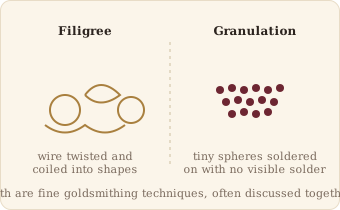
Filigree is often mentioned alongside granulation, and the two are sometimes confused because both produce intricate surfaces from small soldered elements rather than casting or engraving. Filigree is built from wire, while granulation is built from tiny spheres of metal with no wire structure. A piece can combine both, but recognising whether wire or sphere dominates a surface is the most reliable way to tell them apart.
How to Recognise It
Look for a clearly wire-based construction - individual strands, visibly twisted or beaded, forming an openwork or raised pattern - as distinct from a solid cast surface or a surface built from small round beads. Cannetille shows dense, tightly coiled spirals built up in relief, often with coloured stones, and belongs to the early 19th century. In die-struck “filigree”, the openings have crisp, flat-sided edges and the pattern is perfectly regular, with no separate wires or solder joints.
Frequently Asked Questions
Is all antique wirework jewellery cannetille? No - cannetille refers specifically to the raised, tightly coiled variant fashionable from about 1815 to 1840; flatter styles of filigree appear in other periods and traditions.
Was filigree only used in gold? No - filigree was worked in silver as well as gold, and in gilt base metals for less expensive jewellery. Much regional and souvenir filigree is silver or silver-gilt.
Read next
Eras
Georgian Jewellery
A guide to Georgian jewellery (1714-1837): Brazilian diamonds, closed-back foiled settings, rococo and Neoclassical styles, paste, cut steel and pinchbeck, sentimental miniatures, girandoles, rivières and Sévigné bows.
Eras
Regency Jewellery
A guide to Regency jewellery (c.1795-1837): Empire fashion, cameos and Neoclassical parures at Napoleon's court, coloured gold and cannetille, Berlin iron and cut steel, acrostic rings, and memorial jewellery for Nelson and Princess Charlotte.
Eras
Victorian Jewellery
A guide to Victorian jewellery (1837-1901): the Romantic, Grand and Aesthetic periods, the Great Exhibition, gold rushes and 9ct gold, mourning and Whitby jet, archaeological revival, Scottish jewellery, and how to recognise each phase.

Materials
What Is Pinchbeck?
What pinchbeck is, how Christopher Pinchbeck's gold-coloured alloy imitated gold in Georgian jewellery and watch cases, why it declined after 1854, and how it is collected today.
Techniques
What Is Granulation?
What granulation is, how granules were made and fixed, its Etruscan origins, the Castellani and Giuliano revival, and Littledale's 1930s reconstruction of the ancient method.

Techniques
What Is Micromosaic Jewellery?
How Roman micromosaic was made from smalti filati, its roots in the Vatican Mosaic Studio, the makers who led it, and how it became a Grand Tour souvenir from the 1770s to the 1870s.