What Is Casting?
What casting is, how lost-wax, sand and cuttlebone casting worked, Berlin iron, centrifugal casting and rubber moulds, and how cast jewellery differs from stamped and repoussé work.
Casting is a metalworking technique in which an object is formed by pouring molten metal into a prepared mould, where it cools and solidifies already in the shape of the finished design.
What Casting Is Structurally
Casting begins with a mould - a hollow negative form shaped to match the design - into which molten metal is poured or forced. As the metal cools within the mould it takes on the mould’s shape, so the piece emerges already formed in three dimensions rather than being built up or cut from sheet. Depending on the method, a mould or a master model can be reused, so casting allowed the same design to be reproduced many times, and it allowed fully three-dimensional and undercut shapes that are hard to make by hand from flat sheet metal.
Lost-Wax Casting
In lost-wax casting (also called by its French name, cire perdue), a design is first modelled in wax, given a sprue - a wax rod that will become the channel for the metal - and encased in a heat-resistant investment of clay, plaster or a similar material. The mould is heated until the wax melts and runs or burns out, leaving a cavity in the exact shape of the model, into which molten metal is poured. The mould is then broken away and the sprue cut off. Because the wax model is destroyed, each traditional lost-wax casting is unique.
The method is ancient, and it was described in detail by the Florentine goldsmith Benvenuto Cellini in his treatises on goldsmithing and sculpture, published in 1568. In 19th-century Britain it was used more for sculpture than for jewellery, and the sculptor Alfred Gilbert, who had learned it in Italy, was an influential advocate of it from the 1880s, including for his own goldsmith’s work.
Sand and Cuttlebone Casting
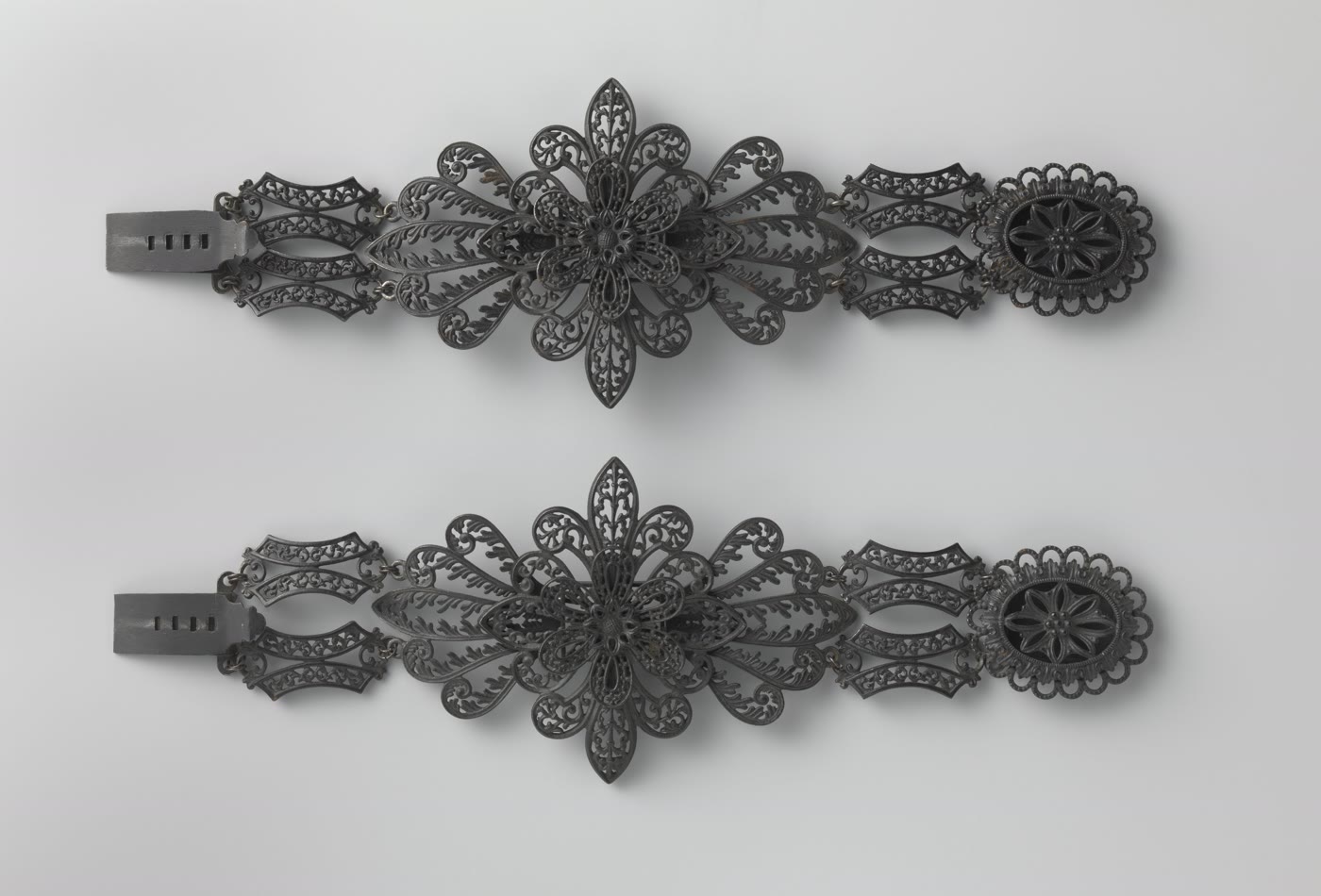
Sand casting uses a two-part frame, or flask, packed with fine, slightly moist moulding sand. A pattern is pressed into the sand of each half, removed, and the halves are clamped together to leave a cavity. It was widely used for small mounts, buckles and rings and is the method behind the delicate cast-iron jewellery made at the Royal Prussian iron foundries at Gleiwitz and Berlin in the early 19th century; see Berlin Iron Jewellery.
Cuttlebone casting is a simple workshop method for rings and small pieces: a model is pressed into the soft side of a cuttlefish bone, which is cut in half to form a two-part mould. Metal cast this way shows a characteristic fine, wavy grain on its surface where it has taken the impression of the bone’s layers.
Casting in Jewellery Production, 1700-1950
- 18th and 19th centuries. Cast work was mostly confined to solid components - ring shanks, signet rings, buckle frames, clasps, and figural mounts such as animal heads - which were then finished by hand with files, gravers and chasing tools.
- Victorian mass production. Most mass-produced gold and gilt jewellery from Birmingham and other centres was made by stamping thin sheet in steel dies rather than by casting, because stamping used less metal. Casting remained important for solid and sculptural parts.
- Early platinum. Platinum’s very high melting point made it difficult to cast with early equipment, and most Edwardian platinum jewellery was hand-fabricated or die-struck rather than cast.
- Centrifugal casting. In 1907 the American dentist William H. Taggart introduced a lost-wax casting machine for dental gold inlays. Centrifugal and pressure casting machines of this kind, which force molten metal into the mould by spinning or air pressure, were adopted by the jewellery trade in the following decades.
- Rubber moulds. From the 1930s and especially the 1940s, vulcanised rubber moulds taken from a metal master model allowed wax copies to be injected in quantity. Each wax could then be invested and cast, making lost-wax casting suitable for mass production. American costume jewellery firms of the 1930s and 1940s made large numbers of cast brooches and clips in base-metal alloys, and later in sterling silver.
Casting Versus Repoussé and Stamping
Casting is sometimes confused with repoussé, since both can produce a raised design, but they work differently. A cast design is formed from molten metal solidifying in a mould; a repoussé design starts as flat sheet metal hammered into relief from behind. Cast work tends to be solid and heavy for its apparent size, while repoussé and stamped work is hollow-backed and light, having been formed by displacing an existing sheet. Stamped pieces show the reverse of the design on the back; cast pieces generally have a flat or separately shaped back.
How to Recognise It
Cast pieces can show a slightly granular or pitted surface in recesses that were hard to polish, small areas of porosity (tiny holes caused by trapped gas), and traces where a sprue was cut off, often on the back or inside a ring shank. Sand-cast pieces may show a faint seam line where the two halves of the mould met. Fine finishing can remove most of this evidence on well-made pieces. A solid, evenly weighted feel and undercut detail that would be very difficult to achieve by hammering are broadly consistent with casting, but these are observational notes rather than an authentication method, and confirming how a specific piece was made generally requires closer specialist examination.
Frequently Asked Questions
Does casting always produce identical copies? In principle a single model or mould can produce very similar castings, but hand-finishing, wear on the mould and hand-chasing added after casting mean that historical cast pieces are not necessarily identical even when made from the same design.
Can a cast piece also be chased or engraved afterward? Yes - casting was very often followed by hand-finishing, including chasing to sharpen detail that the mould left soft, or engraving to add lettering or fine pattern.
Read next
Eras
Georgian Jewellery
A guide to Georgian jewellery (1714-1837): Brazilian diamonds, closed-back foiled settings, rococo and Neoclassical styles, paste, cut steel and pinchbeck, sentimental miniatures, girandoles, rivières and Sévigné bows.
Eras
Victorian Jewellery
A guide to Victorian jewellery (1837-1901): the Romantic, Grand and Aesthetic periods, the Great Exhibition, gold rushes and 9ct gold, mourning and Whitby jet, archaeological revival, Scottish jewellery, and how to recognise each phase.

Techniques
What Is Chasing?
What chasing is, the punches, hammer and pitch bowl a chaser used, matted gold and 18th-century chased gold, and how chasing works alongside repoussé and differs from engraving.
Techniques
What Is Granulation?
What granulation is, how granules were made and fixed, its Etruscan origins, the Castellani and Giuliano revival, and Littledale's 1930s reconstruction of the ancient method.

Techniques
What Is Repoussé?
What repoussé is, how it is hammered into relief from the reverse of a metal sheet, its use from Georgian watch cases to Arts and Crafts silver, and how it differs from stamping and casting.