What Is a Chatelaine?
What a chatelaine is, how its hanging chains of household implements combined practical use with status display, and why the handbag largely ended its everyday role.
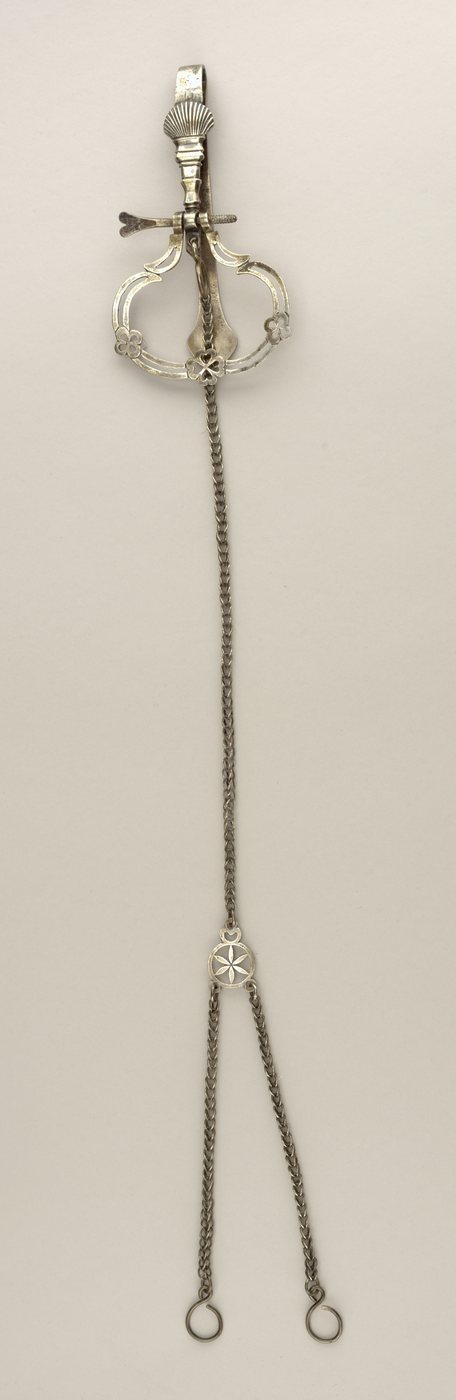
A chatelaine is a decorative hook or clasp worn at the waist, from which a set of useful implements - such as scissors, a thimble case, keys, a small notebook or a watch - hung on short chains, combining practical function with visible status.
What Is a Chatelaine?
Structurally, a chatelaine consists of a central hook or ornamental plate designed to catch over a waistband or belt, with several shorter chains suspended from it, each ending in a small tool, container or ornament suited to household or personal use. The word derives from the French “châtelaine,” referring to the mistress of a château, whose household duties traditionally required just this kind of ready access to keys and implements.
How to Recognise It
Look for a substantial hook or clasp at the top, designed to hang securely from a waistband, with multiple chains of varying length descending from it, each ending in a swivel fitting or small ring so a tool could be unclipped and used, then reattached. A chatelaine with all its original attachments intact is less common than a hook and chains alone, since the individual implements were more easily lost, damaged or separated over time.
When Was It Worn?
Chatelaines were worn at the waist over the course of the day, largely by women managing a household, throughout the 18th and 19th centuries, with a particular revival in fashionable popularity in the second half of the 19th century.
Origins
Hanging useful implements from the waist has practical origins going back centuries, but the chatelaine as a distinct, often elaborately decorated jewellery form developed strongly during the 18th century, when it served as a visible marker of a woman’s responsibility for, and authority over, a household’s stores, linen and keys.
How It Changed Over Time
Georgian chatelaines were often made in cut steel, pinchbeck or gilt metal, favoured for their bright, faceted surfaces, and typically carried keys, a watch, or a small case. The form fell somewhat out of fashion in the earlier Victorian decades before enjoying a strong mid-to-late Victorian revival as a fashion accessory in its own right, made in silver or gold and carrying an array of implements - scissors, a thimble case, a vinaigrette for smelling salts, a small notebook (an “aide-mémoire”) or a pencil - sometimes purely decorative rather than practical. By the late 19th and early 20th century, the chatelaine’s practical role was increasingly taken over by the handbag, and its decorative role faded alongside changing dress styles that made a waist-hung set of chains less compatible with fashionable silhouettes.
Materials
Silver and gold were used for finer chatelaines, particularly in the Victorian revival period, while cut steel and pinchbeck were common in the 18th century for their decorative sparkle at lower cost. Individual attachments varied in material according to their function - steel scissors, an enamelled thimble case, or a gold or silver vinaigrette.
Construction
The hook or clasp portion was typically cast or stamped from metal and finished with engraving, piercing or applied decoration, with a sturdy pin or spring mechanism on the reverse to grip a waistband securely under the weight of several hanging implements. Each dependent chain ended in a swivel clip or ring allowing its tool to be removed for use.
How It Was Worn
Hooked over a waistband or belt at the front or side, with its chains and implements hanging visibly against the skirt - a chatelaine was meant to be seen as well as used, particularly in its Victorian revival form.
Who Wore It?
Chatelaines were worn primarily by women, particularly those responsible for managing a household - a housekeeper, a mistress of a house, or a nurse, whose specialised chatelaines might carry scissors and a watch rather than domestic keys.
Notable Variations
- Household chatelaine - carrying keys, scissors, a thimble and similar domestic implements.
- Nurse’s chatelaine - a specialised late Victorian and Edwardian form carrying scissors, a watch and sometimes a small case of instruments.
- Purely decorative chatelaine - a Victorian revival form whose hanging pieces were largely ornamental rather than functional.
Terminology
“Chatelaine” is also used, confusingly, for the mistress-of-the-house role itself in older usage - the word seems to have been applied to the waist ornament only from the late 1820s - and the jewellery term is sometimes applied loosely to any decorative waist-hung chain, even a single-chain form that lacks the multiple tool attachments of a true chatelaine.
Similar Jewellery
Chatelaines are sometimes confused with long sautoir-style necklaces or watch chains worn at the waist, but the presence of a dedicated waist hook and multiple functional attachments is what distinguishes a true chatelaine from either.
Examples in Museum Collections
- Chatelaine, probably English, 1730-35. Victoria and Albert Museum, London, M.275-1975. Pinchbeck, hung with a scissors case, needle case, étui and two thimble cases - an early Georgian chatelaine in a gold-coloured alloy.
- Chatelaine, Matthew Boulton’s Soho Manufactory, with jasper plaques by Josiah Wedgwood and Sons, c.1785. Victoria and Albert Museum, London, M.25-1969. Cut steel; hung from the belt to carry seals, scissors and keys on split rings at the ends of its chains.
- Chatelaine, London, c.1850, by Joseph Banks Durham, “Cutler to H.R.H. Prince Albert”. Victoria and Albert Museum, London, M.10:1 to 9-1971. A twelve-piece cut-steel chatelaine with étui, key, tablets and almanack, praised by an exhibition jury - the Victorian chatelaine as a display piece.
Read next
Eras
Georgian Jewellery
A guide to Georgian jewellery (1714-1837): Brazilian diamonds, closed-back foiled settings, rococo and Neoclassical styles, paste, cut steel and pinchbeck, sentimental miniatures, girandoles, rivières and Sévigné bows.
Eras
Victorian Jewellery
A guide to Victorian jewellery (1837-1901): the Romantic, Grand and Aesthetic periods, the Great Exhibition, gold rushes and 9ct gold, mourning and Whitby jet, archaeological revival, Scottish jewellery, and how to recognise each phase.
Jewellery
What Is a Brooch?
What a brooch is, how its pin-and-catch fastening works, and how brooch styles moved from naturalistic Victorian sprays through mourning brooches to Art Deco geometry.
Jewellery
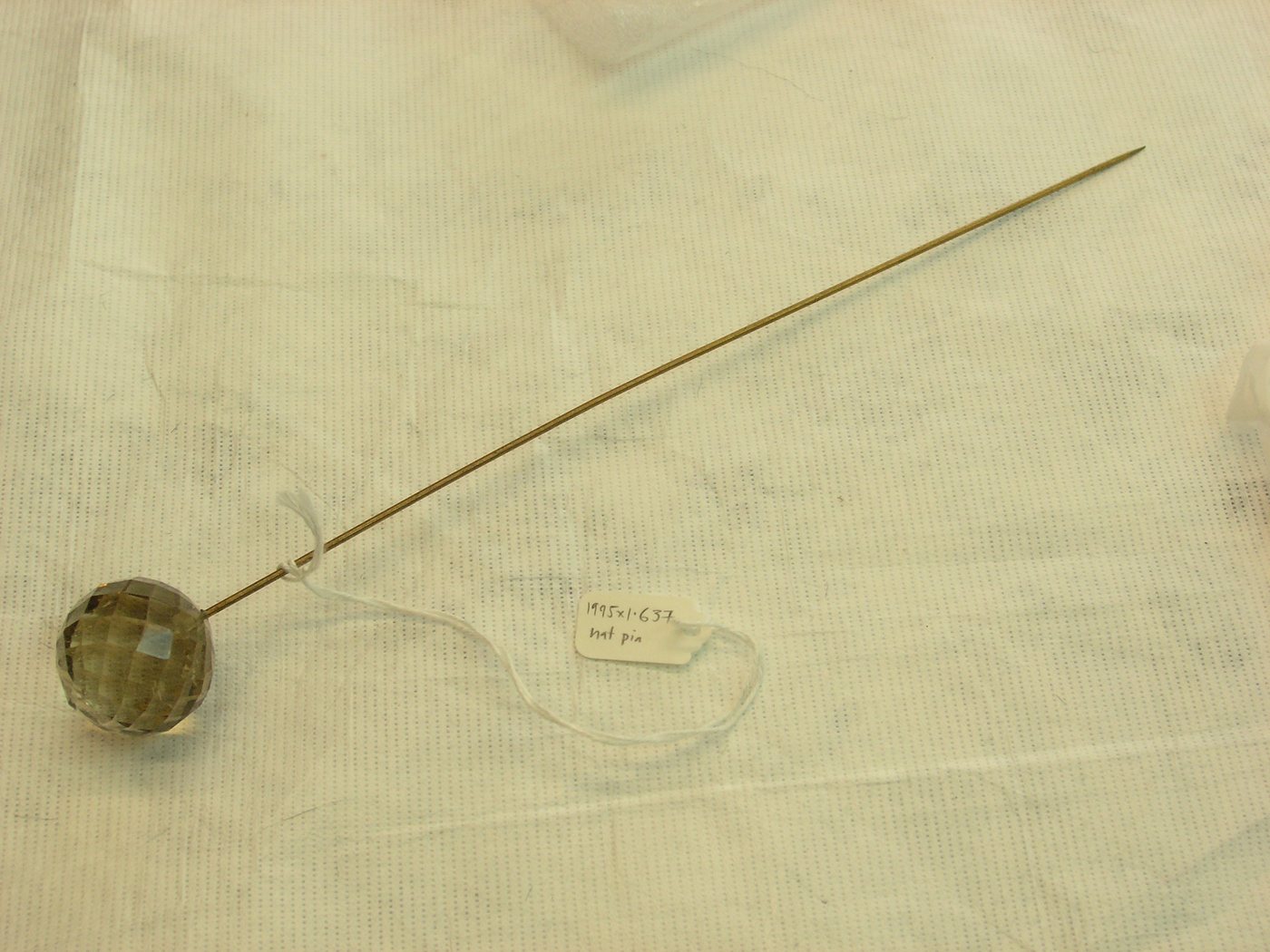
What Is a Hatpin?
What a hatpin is, how its decorative head ranged from simple to elaborate, and the surprising documented history of hatpins as a means of self-defence before their Edwardian-era decline.

Materials
What Is Pinchbeck?
What pinchbeck is, how Christopher Pinchbeck's gold-coloured alloy imitated gold in Georgian jewellery and watch cases, why it declined after 1854, and how it is collected today.