Garnets in Victorian Jewellery
Why Bohemian pyrope garnets from Třebenice, cut and set in Turnov and Prague, became a hallmark of Victorian jewellery, with carbuncles, demantoids, cluster settings and their meanings.
Garnet is a deep red gemstone with a long history of use in jewellery, but it is most closely associated with the mid-to-late Victorian period, when small, densely clustered garnets became one of the most widely worn and affordable coloured-stone jewellery styles in Britain, continental Europe and the United States. The name comes from the Latin granatum, pomegranate, whose seeds the small red crystals resemble.
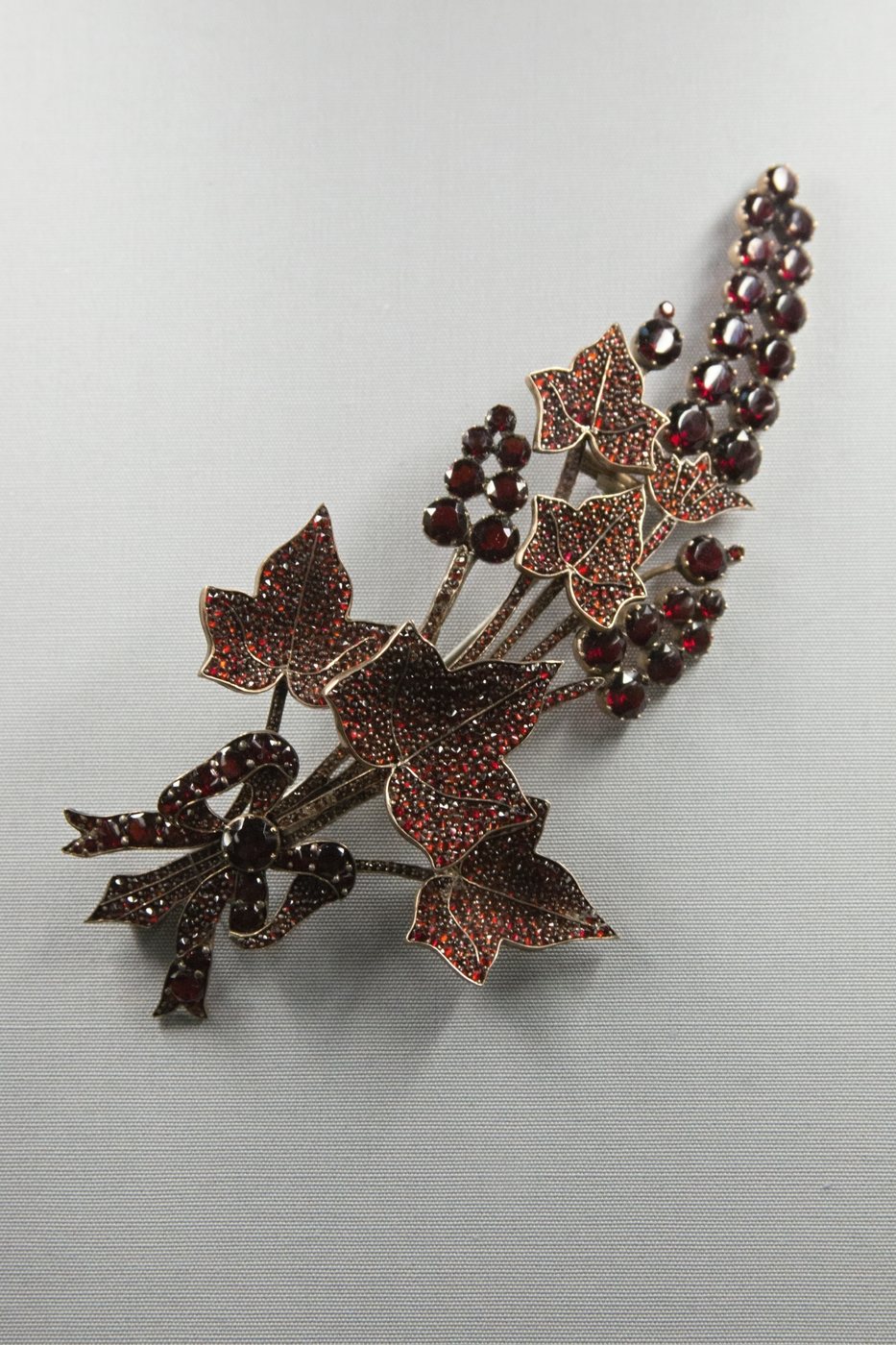
A Long History, a Victorian Peak
Garnets have been cut and set since antiquity. Anglo-Saxon goldsmiths of the 6th and 7th centuries set thin slices of garnet in gold cells, as in the shoulder clasps from the Sutton Hoo ship burial, excavated in 1939 and now in the British Museum. Georgian jewellers used flat-cut or table-cut garnets in closed, foiled settings for necklaces, earrings and rings, often in rows of matched stones. What changed in the Victorian period was scale and accessibility: garnet jewellery moved from an occasional gemstone choice to a mass-produced category, worn widely across the middle classes rather than being confined to the wealthiest buyers.
Bohemian Garnets
The garnets most associated with this Victorian boom are small, deep red-to-brownish-red pyrope garnets mined in Bohemia, then part of the Austrian Empire (Austria-Hungary from 1867) and now within the Czech Republic. They were dug from gravels in the hills of the České středohoří (Bohemian Central Uplands) north-west of Prague, around villages such as Třebenice and Podsedice. The stones were cut chiefly in and around Turnov, in north-eastern Bohemia, long a centre of stone cutting, and set by jewellers there and in Prague and Vienna.
Bohemia’s garnet deposits had been worked since at least the 16th century, but 19th-century mining and cutting expansion, combined with an efficient export trade, made “Bohemian garnet” jewellery a recognisable and affordable commercial category by the mid-Victorian period, sold in quantity in Britain and America. Production reached its height in the last decades of the 19th century. The stones themselves are typically small - often only a few millimetres across - and have a strong, slightly brownish red that does not need a large stone to show. The Museum of Bohemian Garnet in Třebenice displays a garnet set said to have belonged to Ulrike von Levetzow, whom Goethe hoped to marry in the 1820s.
Typical Forms and Settings
Bohemian garnet jewellery is most often encountered as cluster designs: many small stones, usually rose-cut or cut as low domed cabochons, set closely together edge to edge so that little or no metal shows between them. This cluster technique appears across brooches, drop and cluster earrings, rings, bracelets, hair combs and necklaces, frequently arranged into flower, star, crescent, bow or foliate outlines typical of Victorian decorative taste.
Because pyrope garnet is a naturally dark stone that can look almost black in low light, many earlier and mid-Victorian settings used closed-back mounts with metal foil behind each stone to reflect more light back through it - a technique also common with paste and other coloured stones of the period. Open, unfoiled claw settings became more common toward the end of the century as taste shifted toward lighter, more open mounts. Settings were typically low-carat gold, gilt silver, or tombac - a gilded copper-zinc alloy much used in Bohemia - rather than platinum, keeping costs down and suiting the jewellery’s role as an affordable, widely produced good. See also gilt jewellery.
Carbuncles: Almandine Cabochons
The second Victorian garnet style used large almandine garnets - a more purplish or orange-red species, imported mainly from India and Ceylon - cut as smooth, high-domed cabochons and called “carbuncles”, an old name for any red cabochon stone. To stop these big stones looking black, cutters often hollowed out the back of the cabochon, thinning the stone so that more light passed through it, and set it over a foil. Carbuncle brooches, earrings and bracelets were fashionable from about the 1850s to the 1880s, often in heavy gold mounts in the archaeological revival taste, and some have a small diamond star set into the centre of the dome.
Demantoid: the Green Garnet
Not all garnets are red. Demantoid, a brilliant green variety of andradite garnet, was found in the Ural Mountains of Russia in the mid-19th century. Its fire - greater than diamond’s - and its distinctive fibrous “horsetail” inclusions made it a favourite of Russian jewellers including Fabergé, and in the late 19th and early 20th centuries it was used across Europe in small, lively pieces: insect and lizard brooches, frogs, and leaf and flower sprays, often with diamonds.
Symbolism
Within Victorian sentimental jewellery, garnets carried a general association with constancy, loyalty and friendship - fitting meanings for a stone so often given as an affectionate but not extravagant gift between friends or family, as well as between romantic partners. This symbolism sat within the same broader Victorian habit of assigning specific meanings to gemstones and flowers that produced acrostic jewellery (garnet supplies the G of REGARD) and the language of flowers. Dark garnets were also acceptable in mourning and memorial jewellery. Garnet jewellery, however, was worn primarily for its own decorative and sentimental appeal rather than as part of a coded message.
Beyond Bohemia
Garnets from other sources and in other varieties and colours, including the almandine described above and orange spessartine, were used across the period. The small, deep-red cluster style remains the form most strongly identified with popular Victorian garnet jewellery.
A common late 19th- and early 20th-century imitation was the garnet-topped doublet: a thin slice of garnet fused onto a piece of coloured glass, which gave the hardness and lustre of garnet on the table facet and the desired colour from the glass beneath. These were used to imitate many coloured stones, not only garnet.
Identifying Bohemian Garnet Jewellery
The combination of small size, dense cluster setting, deep red colour and low-carat gold, gilt or tombac mounts is the strongest general indicator of the style, though similar cluster techniques were also applied to other small coloured stones, so colour and stone identification are still the primary distinguishing features. Bohemian garnet jewellery continued to be made in the same style throughout the 20th century, so the style alone does not date a piece to the Victorian period. No attempt is made here to determine from a description or photograph whether an individual stone is pyrope garnet, treated, or a simulant - that requires physical examination by a qualified gemmologist.
Read next
Compare
Georgian vs Victorian Jewellery
How Georgian and Victorian jewellery differ in settings, techniques and motifs, and why Victorian jewellery itself spans several distinct phases.
Eras
Victorian Jewellery
A guide to Victorian jewellery (1837-1901): the Romantic, Grand and Aesthetic periods, the Great Exhibition, gold rushes and 9ct gold, mourning and Whitby jet, archaeological revival, Scottish jewellery, and how to recognise each phase.

Gemstones
Pearls in Jewellery History
Natural pearls from the Gulf and Ceylon, seed-pearl work, Edwardian chokers and ropes, Mikimoto's cultured pearls of the 1910s-20s, imitation pearls, and pearls' bridal and mourning meanings.

Gemstones
Turquoise in Victorian Jewellery
Persian turquoise from Nishapur in Victorian jewellery: forget-me-not clusters, pavé snakes, Queen Victoria's bridesmaids' brooches, Arts and Crafts 'matrix', imitations and colour change.

Materials
What Is Pinchbeck?
What pinchbeck is, how Christopher Pinchbeck's gold-coloured alloy imitated gold in Georgian jewellery and watch cases, why it declined after 1854, and how it is collected today.
Mourning & Sentimental
What Is Mourning Jewellery?
What mourning jewellery is, how it developed from Stuart and Georgian memorial rings, why it peaked in Victorian Britain after Prince Albert's death in 1861, and the etiquette and materials behind it.