How to Date a Diamond by Its Cut
How diamond cutting changed from the rose cut and old mine cut to the old European and modern brilliant, the step cuts of Art Deco, and how to read a stone's outline, table, culet and facets as dating evidence.
Diamond cutting has changed steadily over three centuries as cutters learned more about how light behaves in a diamond and as tools improved from hand-turned wheels to powered bruting machines. Because each period favoured particular cuts, the cut of a diamond is one of the most useful clues to the date of a piece of jewellery - often more useful than its style. This page explains the main historical cuts and what to look for. For the wider story of diamonds, see Diamonds in Jewellery History.
Why Cuts Changed
Early cutters were working with very hard material and limited tools, and they aimed to preserve as much weight as possible. Later cutters, with better wheels and, from the late 19th century, powered machinery, could sacrifice weight for brilliance and symmetry. The general direction of travel over 1700-1950 is from flat, glittering, weight-saving cuts towards round, deeper, more precisely proportioned cuts designed to return the maximum light to the eye.
The Rose Cut
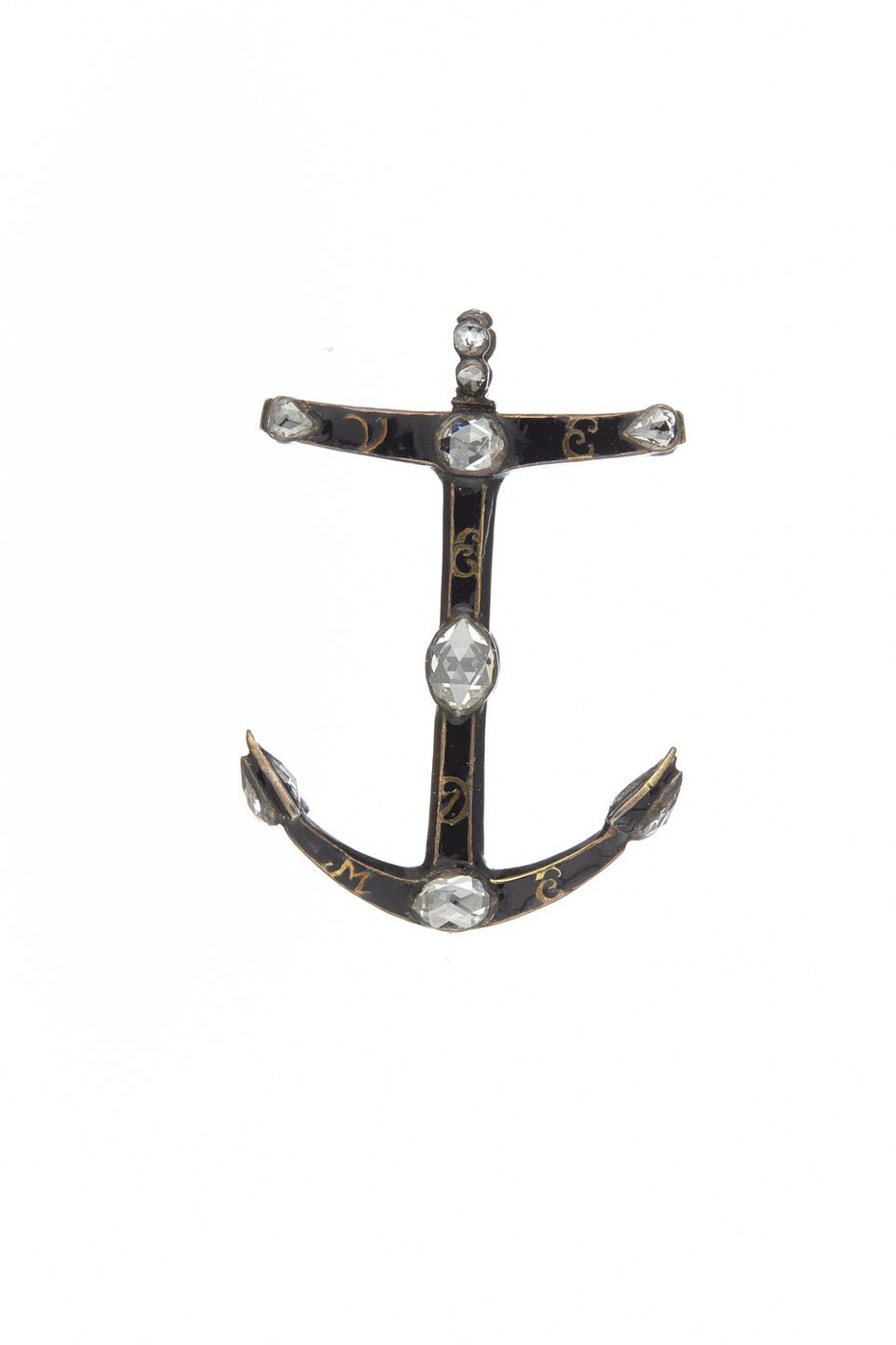
A rose-cut diamond has a flat base and a dome of triangular facets rising to a point, like an opening rosebud. It has no pavilion beneath, so it shows a soft, glittering surface rather than the flashes of a brilliant. Rose cuts were developed in the 16th century and were the dominant cut in 18th-century jewellery. They remained in use for small stones throughout the 19th century and are often found around the borders of Victorian and even Edwardian pieces.
In Georgian jewellery, rose-cut diamonds were usually set in closed-back silver collets, often backed with foil to improve their brightness. See Stone Setting Styles.
The Old Mine Cut
The old mine cut is the early form of the brilliant: a cushion-shaped outline (a softened square), a high crown, a small table, a deep pavilion and a large culet - a flat facet at the bottom of the stone, which shows through the table as a small dark or bright circle. Because it was cut by eye on hand-turned wheels, its facets are often slightly irregular. Old mine cuts were the standard brilliant of the late 18th and most of the 19th century, so they are typical of later Georgian and Victorian diamond jewellery. The name is usually said to refer to the “old mines” of India and Brazil - Brazil being the main source in the 18th century - as opposed to the South African mines of the later 19th century.
The Old European Cut
From the late 19th century, mechanical bruting - grinding the girdle round on a powered lathe - made it practical to cut diamonds with a round outline. The old European cut keeps the old mine cut’s small table, high crown and visible culet, but in a circular stone. It is the characteristic diamond of late Victorian, Edwardian and early Art Deco jewellery, from roughly the 1890s to the 1930s.
The Modern Round Brilliant
In 1919 the mathematician and engineer Marcel Tolkowsky published Diamond Design, which calculated proportions for a round brilliant that would balance brilliance and fire. Over the following decades, cutters moved towards these proportions: a larger table, a lower crown, and a culet so small it is pointed or invisible. Stones cut in the 1930s and 1940s, with features between the old European and modern brilliant, are often called transitional cuts. A modern round brilliant with a large table and no visible culet in a piece that looks Georgian or Victorian is therefore a warning sign - either a replacement stone or a later piece.
Step Cuts and Fancy Shapes
Art Deco design needed stones cut to geometric shapes. Step cuts have rows of parallel, rectangular facets rather than triangular ones:
- Emerald cut - a rectangle with cut corners.
- Baguette - a small, narrow rectangle, used in lines and blocks.
- Asscher cut - a square step cut with cut corners, patented by the Asscher company of Amsterdam in 1902.
- Calibré - small stones cut to fit a particular setting exactly.
Step cuts in quantity strongly suggest the 1920s or later. Older fancy shapes - the pear or pendeloque and the marquise or navette - were used from the 18th century onward, often for drops and the centres of clusters.
Small Stones: Single Cuts and Eight Cuts
The small diamonds used in borders and pavé work are worth checking too. Before modern full-cut melee became standard, small stones were often single cut or eight cut, with only about 17 facets. Single-cut stones are typical of jewellery from about 1900 to the mid-20th century, especially in milgrain-edged platinum work; see Milgrain.
Summary
| Cut | Outline | Key features | Typical period |
|---|---|---|---|
| Rose cut | Round, oval or pear | Flat base, domed triangular facets, no pavilion | 16th century-c.1900 (small stones later) |
| Old mine cut | Cushion | High crown, small table, large culet, irregular facets | c.1700-c.1890 |
| Old European cut | Round | High crown, small table, visible culet | c.1890-c.1930 |
| Transitional cut | Round | Larger table, smaller culet | c.1930-c.1950 |
| Modern round brilliant | Round | Large table, low crown, pointed culet | Mid-20th century onward |
| Step cuts (emerald, baguette, Asscher) | Rectangular or square | Parallel stepped facets | c.1900 onward, especially 1920s-30s |
Reading a Cut in Practice
- Look at the outline. Cushion or round? Is the girdle perfectly circular, or slightly irregular?
- Look straight down through the table with a loupe. Can you see a culet as a small circle at the centre? How large is the table compared with the stone?
- Look from the side, if the setting allows. A high crown and deep pavilion suggest an older cut.
- Check the small stones as well as the centre stone; they are less often replaced.
Read next
Compare
Edwardian vs Art Deco Jewellery
Edwardian and Art Deco jewellery both favoured platinum, but one is soft and curved and the other hard-edged and geometric - here's how to tell the garland style from Deco.
Compare
Georgian vs Victorian Jewellery
How Georgian and Victorian jewellery differ in settings, techniques and motifs, and why Victorian jewellery itself spans several distinct phases.
Compare
Natural vs Synthetic Gemstones: What's the Difference?
The conceptual difference between natural, synthetic and simulant gemstones, and the historical turning point that made synthetic corundum widely available.
Gemstones
Diamonds in Jewellery History
From Indian and Brazilian diamonds to the 1867 South African discoveries and Kimberley, famous stones such as the Regent, Hope and Cullinan, and how diamond cutting and setting changed 1700-1950.
Identify
How to Research an Inherited Piece of Jewellery
A practical starting process for researching an inherited piece of jewellery, from family history and construction clues to when to consult a specialist.

Techniques
Stone-Setting Styles Explained
Historical stone-setting styles from foiled closed-back collets to open claws, coronet, gypsy, millegrain, platinum knife-edge, channel, illusion and mystery settings - and roughly when each was used.