Platinum in Jewellery History
Why platinum only became practical for jewellery around 1900, Cartier and the Edwardian garland style, Art Deco settings, Russian and South African supply, wartime restrictions and platinum marks.
Platinum arrived comparatively late to fine jewellery, held back not by a lack of appreciation for the metal but by the simple difficulty of working it with the tools available before around 1900.
Why Platinum Came Late
Platinum melts at about 1,770°C, roughly 700°C higher than gold, which made it extremely difficult for 19th-century jewellers to melt, cast, solder and finish with the blowpipes and furnaces then in common workshop use.
Europeans first learned of the metal in the mid-18th century from Spanish colonial South America, where it turned up in the gold workings of the Chocó region of present-day Colombia; the Spanish called it platina, “little silver”. Through the 19th century chemists and refiners - including William Hyde Wollaston in London in the early 1800s, and later the London refiners Johnson Matthey - found ways to purify it and make it malleable, and in the 1850s the French chemists Henri Sainte-Claire Deville and Jules Henri Debray melted it in quantity with an oxy-hydrogen flame. Platinum was used for laboratory ware, scientific instruments and, in Russia, for coins struck between 1828 and 1845 from Ural metal. In jewellery and decorative objects it appeared only rarely.
It became practical as a routine jewellery metal around 1900, when the oxy-hydrogen and then the oxy-acetylene torch, developed in France in the first years of the 20th century, gave workshops a flame hot enough to solder and work it. That technological threshold, rather than any change in platinum’s desirability, is why platinum jewellery is essentially absent from earlier periods and then appears comparatively suddenly.
Before Pure Platinum: Platinum-Topped Gold
In the 1890s and 1900s some jewellers set diamonds in a thin layer of platinum fused onto a gold backing. This replaced the older practice of silver-topped gold, in which silver held the diamonds and gold formed the back: platinum gave the same white setting without silver’s tendency to tarnish and blacken the skin and clothes. Platinum-topped gold is a useful sign of work from about 1890 to 1915, before solid platinum mounts became standard.
Platinum and Edwardian Garland Style
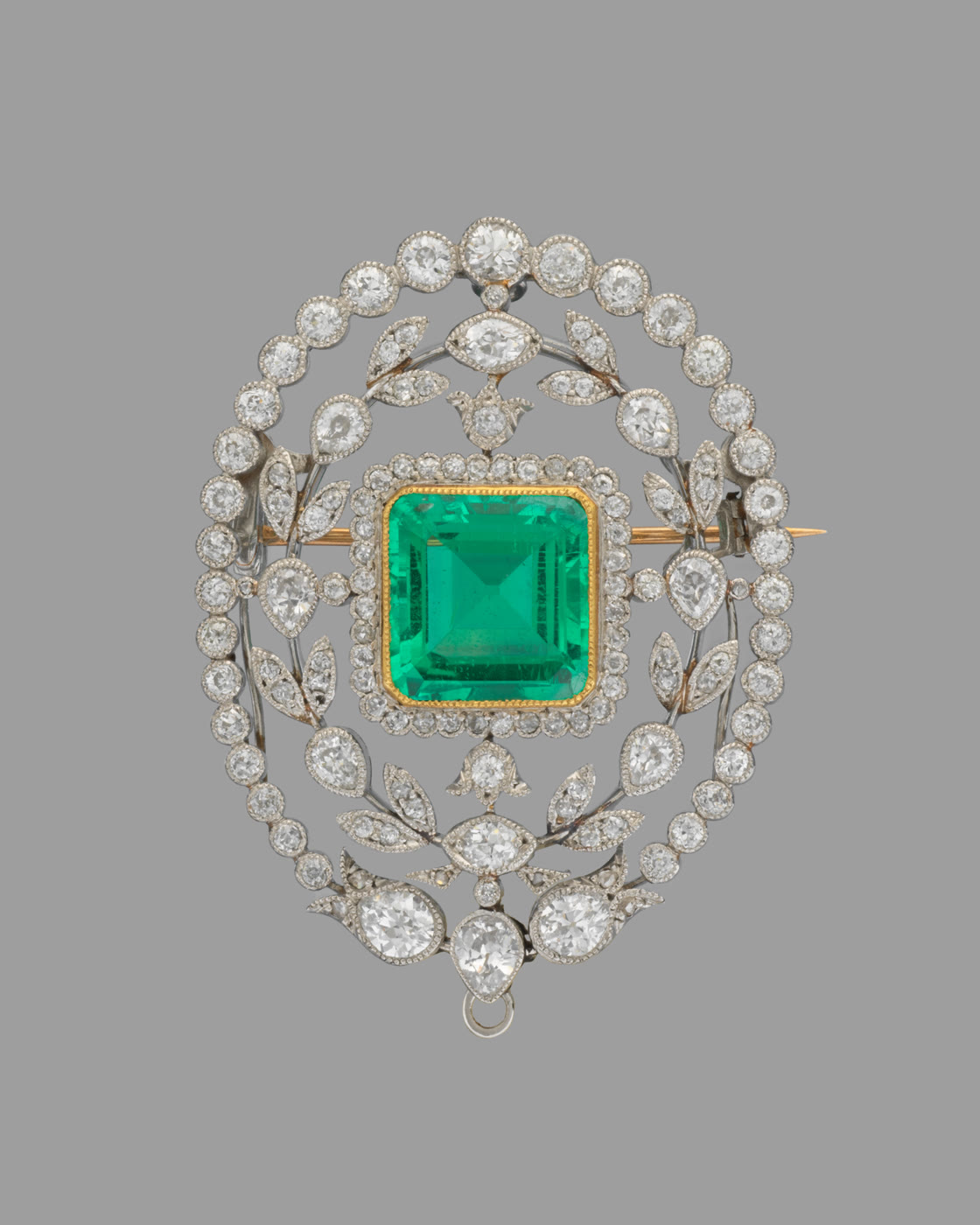
Once workable, platinum’s combination of strength, durability and a bright white colour that would not tarnish or discolour made it especially suited to the delicate, lace-inspired designs fashionable in Edwardian jewellery. Because platinum is strong relative to its weight, jewellers could construct settings, millegrain edges and openwork frameworks that were both extremely fine in appearance and structurally sound, producing the light, airy “garland style” pierced and swagged designs closely associated with the period. Garlands, bows, tassels and laurel wreaths were borrowed from 18th-century French ornament of the Louis XVI period.
Cartier, under Louis Cartier, led the garland style in Paris in the early 1900s and took it to London (1902) and New York (1909); Boucheron and Chaumet in Paris and many London firms worked in the same manner. The open millegrain-edged settings, knife-edge wires (thin platinum bars set edge-on so they almost vanish from the front) and pierced galleries of these pieces were possible only in platinum. Edwardian platinum was usually alloyed with a small proportion of iridium for hardness. Gold or silver settings built as delicately would generally have been far more fragile at the same scale, which is a large part of why this particular aesthetic became possible only once platinum was workable.
Platinum in Art Deco Jewellery
Platinum’s structural advantages carried directly into Art Deco jewellery of the following decades, where its strength allowed for very fine, secure claw and channel settings that used noticeably less visible metal than a gold setting built to the same strength. This let diamonds and other stones appear to sit with minimal visible metal around them, producing the crisp, almost weightless “floating” look prized in Art Deco design, and supporting the era’s characteristic geometric, closely set stonework. Platinum’s neutral white tone also suited Art Deco’s preference for cool, monochrome colour palettes of white metal, diamonds and coloured gemstones over the warmer tones of gold.
Supply: Russia, the Revolution and South Africa
Before the First World War most of the world’s platinum came from the Ural Mountains in Russia, with smaller amounts from Colombia. The war and the Russian Revolution of 1917 disrupted this supply, and platinum was treated as a strategic metal in the First World War as well as the Second. New sources followed: Canada produced platinum as a by-product of nickel mining at Sudbury, Ontario, and in 1924 the geologist Hans Merensky found the platinum-bearing Merensky Reef in the Bushveld of South Africa, which became the world’s main source.
Platinum was expensive throughout the 1910s and 1920s. White gold, developed in the 1910s as a cheaper white metal, was widely used as an alternative from the 1920s.
Wartime Requisition in the 1940s
Platinum’s civilian jewellery use effectively halted during the Second World War, when the metal’s industrial and military applications - including its use in certain munitions and electrical components - led to its requisition for wartime purposes in Britain, the United States and elsewhere, sharply restricting its availability for civilian jewellery manufacture. This shortage is a significant part of why platinum jewellery becomes comparatively scarce in pieces datable to the 1940s, with white gold and other substitute white metals taking over much of the role platinum had played in the preceding decades. Platinum jewellery production resumed only once wartime restrictions eased after the war.
How to Recognise Platinum Jewellery’s Period
Because platinum jewellery is essentially unknown before around 1900, a piece convincingly identified as platinum can generally be dated no earlier than the early 20th century, with the fine, openwork garland style pointing toward the Edwardian period and geometric, close-set stonework pointing toward the Art Deco years. A gap or scarcity of platinum pieces datable to the 1940s reflects wartime requisition rather than a change in taste.
Marks help too. Before 1975 platinum could not be hallmarked in Britain, so British and much European platinum jewellery of 1900-1975 carries at most a maker’s stamp such as “PLAT” or “PT”, often alongside “18ct” on a gold shank. American pieces of the 1920s and 1930s are sometimes stamped “IRIDPLAT” or “10% IRID” for iridium-platinum. An official British platinum hallmark, an orb, was introduced only in 1975; see How to Use Hallmarks to Date Jewellery. These are useful general indicators rather than certain proof, and confirming a metal’s identity and a piece’s date reliably requires examination by a qualified jeweller.
Frequently Asked Questions
Why is there so little platinum jewellery from before 1900? Platinum’s very high melting point made it impractical to work reliably with the tools and torches jewellers had before around the turn of the 20th century, so it saw little routine use in fine jewellery until then.
Did platinum jewellery stop being made entirely during the Second World War? Civilian platinum jewellery production dropped sharply because the metal was requisitioned for wartime industrial and military use, though this was a temporary wartime restriction rather than a permanent end to platinum’s use in jewellery.
Read next

Eras
Jewellery in the 1940s
A guide to 1940s jewellery: wartime platinum bans and the rose-gold Retro style, Cartier's caged bird, Van Cleef & Arpels and Verdura in New York, American costume jewellery in sterling and Lucite, British Utility rings, sweetheart badges and the New Look.

Eras
Art Deco Jewellery
A guide to Art Deco jewellery (c.1915-1935): geometric symmetry, the 1925 Paris Exposition, Cartier's Tutti Frutti and Van Cleef & Arpels' Mystery Set, the modernist jewellers, new stone cuts, Egyptian and Indian influences, and costume jewellery.

Eras
Edwardian Jewellery
A guide to Edwardian jewellery (1901-1915): platinum and the garland style, Queen Alexandra's dog collars, Cartier, Boucheron and Fabergé in London, the Cullinan diamond, lavaliers, milgrain settings and day jewellery.
Gemstones
Diamonds in Jewellery History
From Indian and Brazilian diamonds to the 1867 South African discoveries and Kimberley, famous stones such as the Regent, Hope and Cullinan, and how diamond cutting and setting changed 1700-1950.

Gemstones
Peridot in Edwardian Jewellery
Peridot from the Red Sea island of Zabargad and Burma, its older name 'chrysolite', and why its yellow-green colour was fashionable in Edwardian gold and platinum jewellery and Arts and Crafts work.
Jewellery
What Is a Rivière Necklace?
What a riviere necklace is, why its unbroken line of individually set stones made it one of the most enduring necklace forms, and how it differs from a festoon or fringe necklace.