Star and Moon Jewellery
Star and crescent-moon motifs in jewellery: Diana's crescent, Nelson's Ottoman chelengk, Empress Elisabeth's diamond stars and the late-Victorian diamond crescent brooch.
Celestial motifs - stars, with five, six or more points, and the crescent moon - are recurring subjects in jewellery between 1700 and 1950, often paired in a single design and especially fashionable in the later Victorian and Edwardian periods.

A Diffuse Symbolism
Unlike the anchor, whose meaning of hope traces to a specific Christian tradition, or the forget-me-not, whose meaning of remembrance is consistent across the language of flowers, star and moon motifs carry a diffuse set of associations - guidance, aspiration, night, romance - without one settled meaning. Their popularity is better explained by fashion and the visual drama of a diamond-set crescent or star catching the light than by any fixed symbolic programme. Several specific sources fed into the fashion, however, and they are described below.
Diana’s Crescent
The crescent moon was the attribute of Diana, the Roman goddess of the moon and the hunt (the Greek Artemis), who is shown in classical art and its later imitations with a crescent above her brow. Diane de Poitiers, mistress of Henri II of France in the 16th century, took the crescent as her emblem, and it recurs throughout French court ornament. In neoclassical and Empire jewellery around 1800, small crescents were worn in the hair as a direct allusion to Diana, and the crescent hair ornament remained associated with the goddess - and with a fashionable, youthful look - through the 19th century.
The Ottoman Crescent and the Order of the Crescent
The crescent and star was also the emblem of the Ottoman Empire, and this gave the motif a specific meaning in British jewellery at the turn of the 19th century. After Nelson’s victory over the French fleet at the Battle of the Nile in 1798, Sultan Selim III sent him a chelengk - a diamond plume ornament for the hat, its rays said to represent the French ships taken or destroyed - which Nelson wore in his hat. The Sultan then founded the Order of the Crescent in 1799, later given to other British officers who had helped the Ottoman cause against the French in Egypt; Nelson was its first recipient, and the order’s insignia combined a crescent with a star. Nelson’s chelengk was later held by the National Maritime Museum at Greenwich, from which it was stolen in 1951. These are rare and specific jewels, but they helped make the crescent and star a recognised emblem in Britain.
Stars of Orders and Empresses
The most prestigious star-shaped jewels of the 18th and 19th centuries were the breast stars of orders of chivalry, such as the Order of the Garter, worn on the coat and made by court jewellers in silver set with diamonds or paste. In women’s jewellery, the decisive example was the set of diamond stars made for Empress Elisabeth of Austria, usually attributed to the Vienna court jeweller A. E. Köchert, which she wore scattered through her hair in Franz Xaver Winterhalter’s celebrated portrait of 1865. Copies and variations were made in great numbers, and star hair ornaments that could also be worn as brooches became a standard piece of evening jewellery.
The Late Victorian Diamond Crescent
Star and crescent jewellery became most fashionable in the later Victorian period, from about 1880, and remained popular into the Edwardian period. The plentiful supply of South African diamonds from the 1870s made it possible to set a crescent with a line of graduated old-cut diamonds at a price within reach of the middle classes, and the diamond crescent brooch - often with a small star set beside or within it - became one of the commonest jewels of the 1880s and 1890s. Many were fitted so that they could be worn as a brooch, on a hair pin or as a pendant. A crescent combined with a bee is sometimes called a “honeymoon” brooch, a pun on its two parts.
Typical Forms
The crescent-and-star brooch is the most recognisable form, set with diamonds or other faceted stones tracing the curve of the crescent and the points of the star. Star brooches with a central larger stone, sometimes a pearl or opal, were also common. Stars appear as hair ornaments, including as the mount for an aigrette, where a jewelled star provided a base from which a feather or plume could rise. Crescents appear in hair ornaments and, less often, as pendants and earrings. In the 1880s and 1890s cheaper crescents were also made in half-pearls, garnets and moonstones set in gold.
Materials and Construction
Late-Victorian star and moon jewellery was made predominantly in diamonds set in silver-topped gold - silver on the face so the stones looked white, gold behind so it would not tarnish skin or clothing - and after about 1900 in platinum, whose strength allowed finer settings. Less costly versions used paste in silver or gilt metal, following the same designs and making the fashionable silhouette available at many price points.
Related Forms
Star and moon jewellery sits alongside other later Victorian and Edwardian jewelled hair and evening ornaments, including the aigrette and the bandeau tiara, into which a celestial motif could be incorporated as one design among several.
Reading Star and Moon Motifs Today
A diamond crescent, with or without a star, set in silver-topped gold with old-cut diamonds, is a strong indicator of a date between about 1880 and 1910. A star hair ornament with a detachable pin points to the same decades, or to the fashion that followed Empress Elisabeth’s portrait. Celestial motifs are not exclusive to these years, and given their diffuse meaning, a crescent or star is best read as evidence of fashion rather than of a specific intended message - unless, as with Diana’s crescent or the Ottoman crescent and star, the context points to a particular source.
Read next

Eras
Edwardian Jewellery
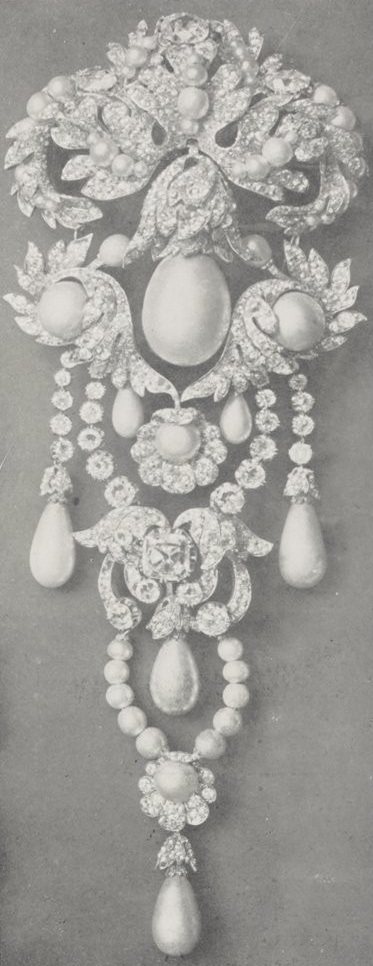
A guide to Edwardian jewellery (1901-1915): platinum and the garland style, Queen Alexandra's dog collars, Cartier, Boucheron and Fabergé in London, the Cullinan diamond, lavaliers, milgrain settings and day jewellery.
Eras
Victorian Jewellery
A guide to Victorian jewellery (1837-1901): the Romantic, Grand and Aesthetic periods, the Great Exhibition, gold rushes and 9ct gold, mourning and Whitby jet, archaeological revival, Scottish jewellery, and how to recognise each phase.
Gemstones
Diamonds in Jewellery History
From Indian and Brazilian diamonds to the 1867 South African discoveries and Kimberley, famous stones such as the Regent, Hope and Cullinan, and how diamond cutting and setting changed 1700-1950.
Jewellery
What Is an Aigrette?
What an aigrette is, how it held a spray of feathers in the hair or on a headdress, and why the plume trade behind it became a documented early conservation issue.

Jewellery
What Is a Bandeau Tiara?
What a bandeau tiara is, why it sits low across the forehead rather than up over the crown, and how bobbed hair and cloche hats made the form fashionable in the 1910s and 1920s.
Jewellery
What Is a Brooch?
What a brooch is, how its pin-and-catch fastening works, and how brooch styles moved from naturalistic Victorian sprays through mourning brooches to Art Deco geometry.