What Is Cut Steel Jewellery?
What cut steel jewellery is, from Woodstock and Matthew Boulton's Soho works to French and late Victorian work, how its faceted studs were made and set, and how to tell it from paste and marcasite.
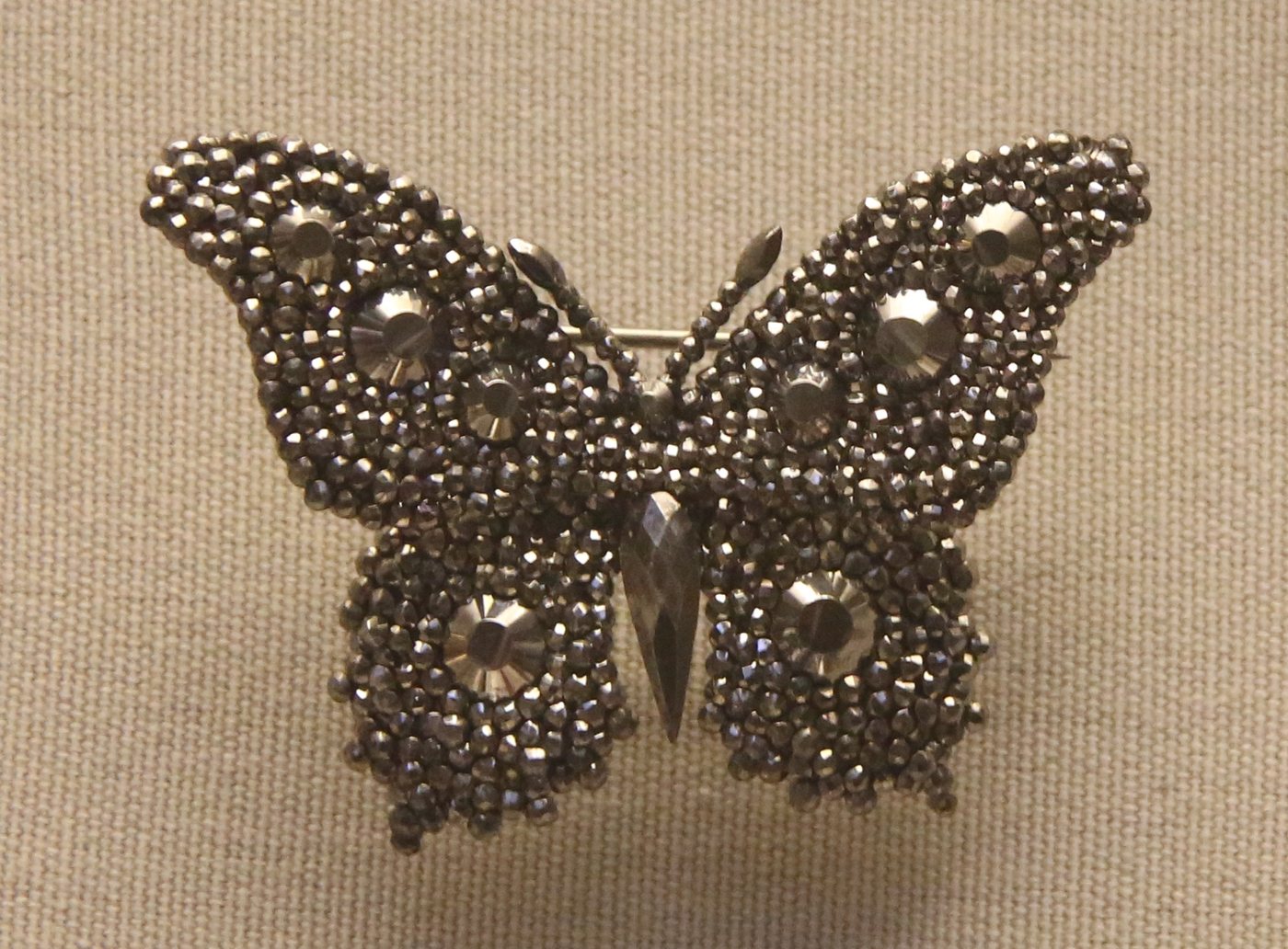
Cut steel jewellery is made from small, individually faceted steel studs, cut and polished to catch the light, then riveted in patterns onto a metal backing plate to produce a sparkling effect at a fraction of the cost of diamonds.
What It Is Structurally
Each cut steel “stone” is a tiny faceted stud of hardened steel, cut with multiple flat facets much like a gem, then polished to a bright, silvery brilliance. Rather than being set individually in claws the way a genuine gemstone would be, the studs were riveted through small holes in a shaped backing plate, so that a brooch, buckle or shoe clip might be built up from dozens or even hundreds of tiny riveted points, their combined facets throwing light across the whole surface. The construction is essentially a metalworking and tooling process rather than a lapidary one - each stud faceted by hand or with the aid of simple cutting jigs, then polished before riveting.
Where It Was Made
Woodstock, Oxfordshire. The small town of Woodstock, next to Blenheim Palace, was the earliest English centre of polished steel work, making watch chains, buckles, sword hilts and small ornaments in the 18th century. Tradition holds that the Woodstock smiths worked their steel from old horseshoe nails, whose iron was already well worked and fine-grained. The trade dwindled as Birmingham and Wolverhampton makers undercut it.
Birmingham and Wolverhampton. Birmingham’s “toy” trade - the 18th-century term for small metal goods such as buckles, buttons, seals and chatelaines - took up cut steel on a large scale. Matthew Boulton’s Soho Manufactory, opened on the edge of Birmingham in the 1760s, made cut steel buckles, buttons, chatelaines, watch chains and sword hilts, applying factory organisation and division of labour to what had been a workshop craft. Josiah Wedgwood’s jasperware cameos were set in cut steel frames from the 1770s and 1780s - many such mounts are traditionally attributed to Boulton, though Wedgwood also supplied other Birmingham and Wolverhampton mounters - combining blue-and-white classical reliefs with faceted borders in brooches, buttons and chatelaine plaques. Wolverhampton was another important centre for steel buckles and toys.
France. Cut steel was made in France from the later 18th century, and French makers dominated the market in the 19th century. Much of the cut steel found today - belt and shoe buckles, combs, hair ornaments, purse frames and beaded bags of the 1860s to the 1910s - is French.
How It Was Made and Used
In the best 18th-century work each stud was cut and polished individually. A small steel blank was formed with a stem on its underside, its head was ground into facets, and it was polished to a mirror finish. The stem was then passed through a hole drilled in the backing plate and riveted over at the back. Studs were graded in size and packed closely so that their facets merged into a single glittering surface. Early studs were often given a dozen or more facets, which is why good Georgian cut steel can rival the sparkle of rose-cut diamonds by candlelight.
Buckles were the largest single product. Shoe buckles were a central part of men’s and women’s dress until the 1790s, when shoe laces and changing fashions after the French Revolution ended the fashion, and the buckle makers of Birmingham and Wolverhampton suffered badly. Cut steel was also used for buttons, chatelaines, sword hilts, brooches, tiaras, combs and necklaces, and its brilliance made it popular for evening wear among buyers who wanted sparkle without the expense of gemstones. Because each stud had to be cut and polished individually, fine cut steel represented a great deal of skilled labour even though the metal itself was cheap.
Period of Popularity
- c.1760-1800: the height of English cut steel in the Georgian period, led by Boulton and the Birmingham buckle and button trade, with Woodstock still active. Neoclassical designs, Wedgwood-set pieces and large shoe buckles.
- c.1800-1840: steel combined with Berlin iron and used in Regency parures, combs and tiaras; French production grows.
- c.1840-1880: less fashionable in mid-Victorian jewellery, though still made for buckles and accessories.
- c.1880-1914: a revival, mostly French, for belt buckles, shoe buckles, hat ornaments, purse frames and bags. In this later work the studs are usually stamped out with fewer facets, and sometimes several studs are pressed from a single strip, rather than each being riveted separately.
After the First World War cut steel faded, and the glittering metal look passed to marcasite set in silver.
A Practical Note on Care
This tendency to rust is a genuine, practical property of the material rather than a sign of poor manufacture, and it is one of the more useful things to know when handling or storing an antique cut steel piece.
How Cut Steel Compares to Paste and Marcasite
Cut steel is often confused with two other faceted, diamond-imitating materials from later periods. Paste achieves its brilliance through cut and often foil-backed glass rather than faceted metal, giving it a different weight, a colder feel, and a more glassy, less metallic sparkle. Marcasite jewellery, made from the 18th century but most fashionable in the 1920s and 1930s, uses small faceted pieces of iron pyrite, usually set in silver, rather than cut steel or glass - a related but distinct material with its own separate tradition, though the general visual effect of small glittering facets set close together can look superficially similar across all three.
| Property | Cut Steel | Paste |
|---|---|---|
| Material | Faceted, polished steel studs | Cut and often foil-backed glass |
| Weight | Noticeably heavy for its size | Lighter, though foiled settings add some weight |
| Feel to touch | Cold, metallic | Cold, but with a smoother, glassier surface |
| Construction | Studs riveted to a backing plate | Stones set in claws or closed-back mounts |
| Vulnerability | Can rust if kept damp | Foil backing can tarnish or degrade if exposed to moisture |
How to Recognise It
Cut steel is generally identifiable by its riveted construction - turn a piece over and the back of the plate shows rows of small rivet heads, one for each stud - along with its metallic weight, cold touch, and a tendency toward rust spots or pitting on less well-preserved pieces. The number of facets and the way studs are fixed also help with dating: densely packed, many-faceted studs each riveted separately suggest 18th or early 19th-century work, while studs with only a few facets, or several fixed by a single rivet or stamped as a strip, are typical of the late 19th and early 20th centuries. A magnet will be attracted to cut steel, unlike paste or marcasite in silver. These are useful starting observations rather than proof, and a piece of real interest is best assessed by a specialist familiar with historical metalwork.
Frequently Asked Questions
Is cut steel the same as marcasite? No - cut steel uses faceted steel studs, while marcasite jewellery uses faceted iron pyrite; the two traditions are related in appearance and purpose but distinct in material, and marcasite became especially fashionable somewhat later than cut steel’s main period.
Why does antique cut steel jewellery sometimes look dull or spotted? This is most often surface rust or corrosion, a genuine vulnerability of steel when exposed to moisture over long periods, rather than necessarily a sign that a piece is a later or lower-quality reproduction.
Read next
Eras
Georgian Jewellery
A guide to Georgian jewellery (1714-1837): Brazilian diamonds, closed-back foiled settings, rococo and Neoclassical styles, paste, cut steel and pinchbeck, sentimental miniatures, girandoles, rivières and Sévigné bows.
Eras
Regency Jewellery
A guide to Regency jewellery (c.1795-1837): Empire fashion, cameos and Neoclassical parures at Napoleon's court, coloured gold and cannetille, Berlin iron and cut steel, acrostic rings, and memorial jewellery for Nelson and Princess Charlotte.
Eras
Victorian Jewellery
A guide to Victorian jewellery (1837-1901): the Romantic, Grand and Aesthetic periods, the Great Exhibition, gold rushes and 9ct gold, mourning and Whitby jet, archaeological revival, Scottish jewellery, and how to recognise each phase.
Materials
What Is Gilt Jewellery?
What gilt jewellery is, from mercury fire gilding and silver-gilt to Elkington's 1840 electrogilding and 20th-century costume jewellery, and how it differs from pinchbeck and rolled gold.
Materials
What Is Paste Jewellery?
What paste jewellery is, from English lead glass and Georges Frédéric Strass in Paris to foiled closed settings, black-dot culets and later Bohemian stones, and why fine paste is collected today.

Materials
What Is Pinchbeck?
What pinchbeck is, how Christopher Pinchbeck's gold-coloured alloy imitated gold in Georgian jewellery and watch cases, why it declined after 1854, and how it is collected today.