What Is a Rivière Necklace?
What a riviere necklace is, why its unbroken line of individually set stones made it one of the most enduring necklace forms, and how it differs from a festoon or fringe necklace.
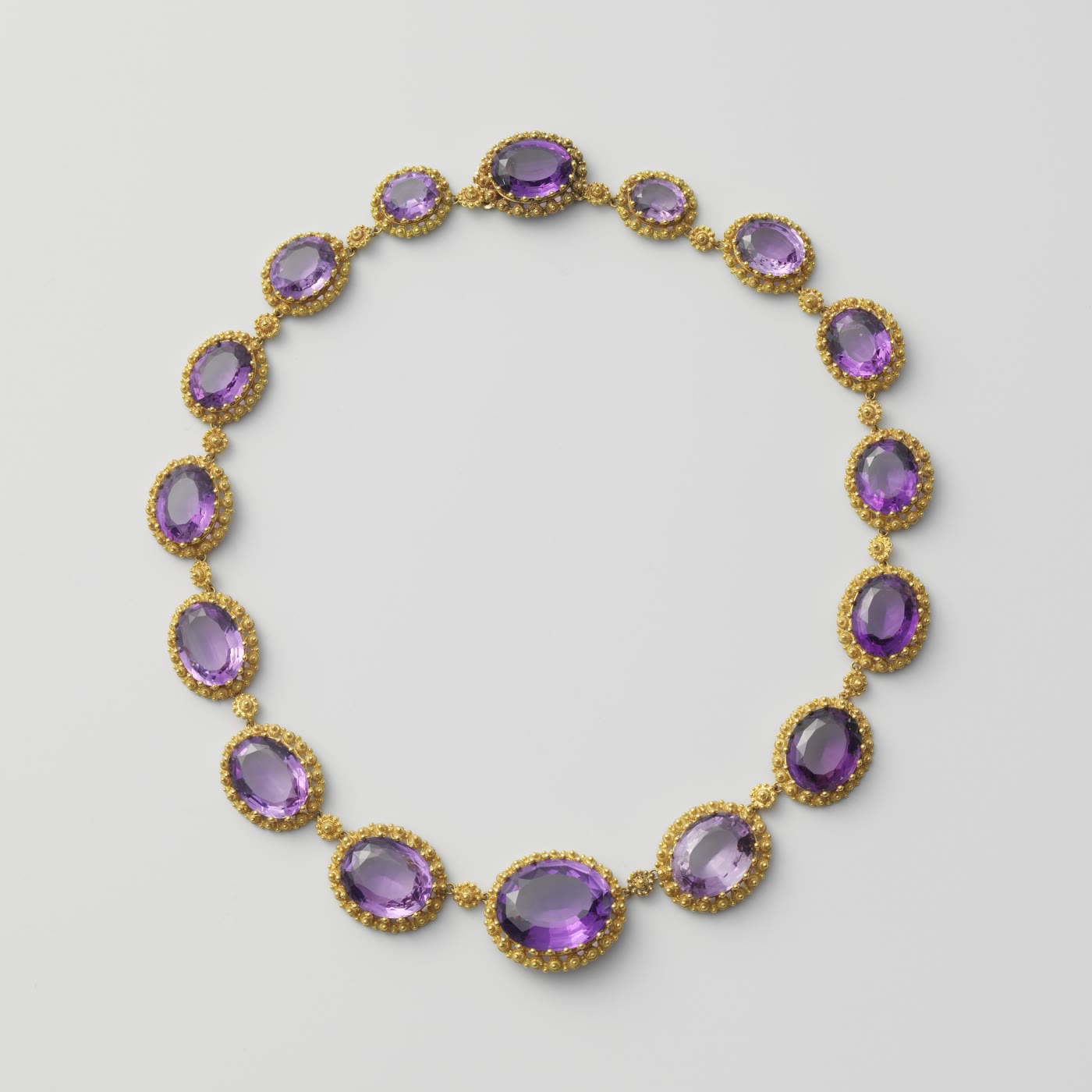
A rivière necklace is a necklace made of individually set gemstones, usually of similar or gradually increasing size toward the centre, linked together in a single continuous line with as little metal as possible showing between them.
What Is a Rivière Necklace?
The name comes from the French “rivière,” meaning river, evoking an unbroken flow of stones along the length of the necklace. Structurally, each stone sits in its own individual setting - typically a simple collet or claw mount - joined directly to the next by a small link or shared claw, rather than being grouped into clusters, festoons or drops. The effect, when well made, is a continuous line of light with minimal visible metalwork.
How to Recognise It
Look for a single, unbroken row of similarly cut and similarly sized stones (or stones that increase gradually in size from the sides toward the centre) with minimal metal visible between each setting; the absence of clusters, drops, festoons or a separate pendant centrepiece is what distinguishes a true rivière from other gemstone necklace styles.
When Was It Worn?
Rivière necklaces were, and remain, formal jewellery, worn at the neckline for evening and formal occasions from 1700 to 1950, from the 18th century through the mid-20th century and beyond.
Origins
The rivière form developed in the 18th century alongside advances in gemstone cutting and the growing availability of diamonds and coloured gemstones for fashionable jewellery, and it has remained in production, largely unchanged in basic concept, ever since.
How It Changed Over Time
Georgian rivière necklaces typically used closed-back, foiled settings to enhance the colour and brilliance of diamonds and coloured stones, reflecting the cutting and setting techniques of the period. As open, claw-set mounts became more common through the 19th century, allowing more light through the stone, rivière necklaces increasingly used this lighter setting style, particularly for diamonds, whose quality by the Victorian period reduced the need for foiling. Platinum became a favoured setting metal for fine diamond rivières from the Edwardian period onward, prized for its strength in the small, refined claw settings the style called for.
Materials
Diamonds were, and remain, the classic rivière stone, though rivière necklaces were also made with coloured gemstones such as garnets, amethysts or topaz, particularly for less formal or less expensive versions. Gold and silver were standard setting metals through the 18th and 19th centuries, with platinum becoming increasingly common for fine diamond rivières from the early 20th century.
Construction
Each stone is set individually, most often in a collet (a simple surrounding metal band) or a claw setting, with adjoining settings linked directly or by a small connecting link so the stones read as a continuous line rather than a series of separate elements. A rivière is typically finished with a box or similar secure clasp positioned at the back or side of the neck.
How It Was Worn
Worn closely around the neck, sitting at or just below the throat, as formal evening jewellery; unlike a pendant or lavalier necklace, a rivière has no single hanging drop or centrepiece, so its effect depends on the continuous line of stones rather than a focal point.
Who Wore It?
The rivière necklace was, and remains, women’s formal jewellery, worn across the wealthiest tiers of society in fine diamonds and by a broader market in coloured gemstone or less costly metal versions.
Notable Variations
- Graduated rivière - stones increasing gradually in size toward the centre of the necklace, the most classic form.
- Uniform rivière - stones of consistent size throughout, a simpler and often less costly variant.
- Lavalier necklace - a related but distinct Edwardian form built around a single hanging drop rather than a continuous line of stones.
Terminology
The accented French spelling “rivière” and the unaccented “riviere” are both used in English-language jewellery writing and refer to the same form; neither spelling implies a different date or origin.
Similar Jewellery
A rivière necklace is most often confused with a festoon or fringe necklace, both of which use multiple stones but arrange them in draped swags or hanging drops rather than a single continuous line - the presence or absence of that unbroken line of individually set stones is the clearest way to distinguish a true rivière from these related forms.
Examples in Museum Collections
- The Sutherland Diamonds. Victoria and Albert Museum, London, M.10:1 to 3-2022. Twenty large old brilliant-cut diamonds in silver-topped gold collets, with two extension lengths. The diamonds were worn by successive Duchesses of Sutherland from the early 19th century, and the museum’s record traces how the separable, numbered collets were rearranged - as a headband in 1838, a choker with a drop in 1902 and a sautoir in 1937. It shows both the rivière’s construction and how easily it could be reworked. See How to Date a Diamond by Its Cut.
Paste rivières of the late 18th century, which imitated diamond versions at a fraction of the cost, are also found in many decorative arts collections; see What Is Paste Jewellery?.
Read next
Compare
Georgian vs Victorian Jewellery
How Georgian and Victorian jewellery differ in settings, techniques and motifs, and why Victorian jewellery itself spans several distinct phases.
Gemstones
Garnets in Victorian Jewellery
Why Bohemian pyrope garnets from Třebenice, cut and set in Turnov and Prague, became a hallmark of Victorian jewellery, with carbuncles, demantoids, cluster settings and their meanings.

Gemstones
Pearls in Jewellery History
Natural pearls from the Gulf and Ceylon, seed-pearl work, Edwardian chokers and ropes, Mikimoto's cultured pearls of the 1910s-20s, imitation pearls, and pearls' bridal and mourning meanings.
Jewellery
What Is a Lavalier Necklace?
What a lavalier necklace is, how its single fine-chain drop defined Edwardian and Belle Epoque style, and how it differs from a plain pendant, negligee necklace or sautoir.

Materials
Gold in Historical Jewellery
How gold standards, supply, colour and working methods changed from Georgian to 1940s jewellery - the 1854 standards, the gold rushes, bloomed and coloured gold, rolled gold - and gold's imitations.
Identify
How to Date a Diamond by Its Cut
How diamond cutting changed from the rose cut and old mine cut to the old European and modern brilliant, the step cuts of Art Deco, and how to read a stone's outline, table, culet and facets as dating evidence.