How to Use Hallmarks to Date Jewellery
A step-by-step method for reading a British hallmark on jewellery, a quick-reference list of marks that fix a date range, and worked examples showing how to combine marks with style and construction.
A British hallmark can date a piece of jewellery more precisely than almost any other evidence - sometimes to a single year. Even a partial or worn hallmark usually narrows the date to a few decades. This page sets out a practical method, a list of marks that fix a date range on their own, and two worked examples. For the basics, start with What Is a Hallmark?.
Step 1: Find the Marks
Look in the usual places:
- Rings - inside the shank, usually at the base opposite the head.
- Brooches - on the back, near the hinge or catch, or along the pin bar.
- Necklaces and bracelets - on the clasp, the tongue of a box clasp, or a tag or jump ring near it.
- Lockets - inside the bezel or on the bail.
- Earrings - on the hook, post or back plate.
Use a 10x loupe and light from a low angle, which throws struck marks into relief. Clean dirt from the marks gently with a soft brush rather than by polishing, which wears them further.
Step 2: Separate the Marks
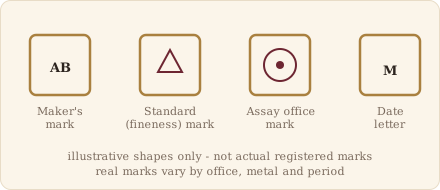
Identify each punch individually: sponsor’s mark (initials in a shield), standard mark (lion, crown, number), office mark (anchor, leopard’s head and so on) and date letter (a single letter in a shield). Write down or photograph each one, including its shield shape. Not every piece will have all four, and many antique pieces have none - see Why So Much Antique Jewellery Is Unmarked.
Step 3: Date Range From the Standard and Office Marks
Before looking at the date letter, use the marks that fix a range by themselves:
| Mark | Date range it indicates |
|---|---|
| Crown with “18” (no decimal) | 1798-1975 |
| Crown with “22” | 1844-1975 |
| “15 .625” or “12 .5” | 1854-1932 |
| “14 .585” | 1932-1975 |
| “9 .375” | 1854-1975 |
| Crown with “375”, “585”, “750” or “916” in a shield | 1975 or later |
| “925” in an oval on British silver | 1999 or later |
| The orb platinum hallmark | 1975 or later (a “PLAT” stamp without an orb is a maker’s mark, common from about 1900) |
| Sovereign’s head duty mark | 1784-1890 |
| Crowned leopard’s head (London) | Before about 1821 |
| Edinburgh thistle | 1759-1975 |
| Chester office mark | Before 1962 |
| Sheffield rose | 1975 or later |
| Britannia figure with lion’s head erased | 1697-1720 (or later Britannia-standard pieces) |
See British Gold Hallmarks Explained and British Silver Hallmarks Explained for detail.
Step 4: Read the Date Letter
With the office and a date range established, look up the date letter in a reference such as Bradbury’s Book of Hallmarks, matching the letter, typeface and shield shape together. The date range from Step 3 should contain the year you find. If it doesn’t, one of the readings is wrong. See Understanding Hallmark Date Letters.
Step 5: Check the Result Against the Piece
A hallmark dates the marked part. Ask whether the rest of the piece agrees:
- Does the style fit the date? An Art Deco design with an 1870s date letter suggests a remodelled piece.
- Does the construction fit? A modern safety catch on a brooch with a Georgian mark suggests a replacement fitting - see How to Date an Antique Brooch by Its Clasp.
- Is the marked part original? Rings are resized and re-shanked; clasps are swapped. See How to Recognise Repaired or Altered Jewellery.
Worked Example 1: A Gold Bar Brooch
A slim bar brooch with a row of half pearls is marked on the pin bar with initials in a rectangle, an anchor, “15” and “.625”, and a letter. The anchor means Birmingham. “15 .625” places it between 1854 and 1932. The design - a narrow bar with pearls - fits the late Victorian and Edwardian period. Looking up the letter in Birmingham’s tables within that range then gives a specific year. All the evidence agrees, so the date can be given with reasonable confidence. See What Is a Bar Brooch?.
Worked Example 2: A Ring With Mixed Signals
A diamond cluster ring has a shank marked with a crown and “18”, a leopard’s head and a date letter that reads as 1912. The cluster, however, has the closed, foiled collets of the early 19th century. The shank date is probably correct, but the head is about a century older. The most likely explanation is a Georgian cluster re-mounted on a new shank in 1912 - a common practice. The ring should be described as “Georgian cluster, re-shanked c.1912”, not as a 1912 ring.
Read next
Identify
Understanding Hallmark Date Letters
How British hallmark date letters work: cycles, typefaces and shield shapes, why London letters span two calendar years, the 1975 uniform cycle, and how to avoid the common misreadings.
Identify
How to Research an Inherited Piece of Jewellery
A practical starting process for researching an inherited piece of jewellery, from family history and construction clues to when to consult a specialist.
Identify
What Is a Hallmark?
What a British hallmark is, the four marks that make up a traditional set, how the system developed from 1300 to the 1973 Hallmarking Act, and why so much antique jewellery is unmarked.
Identify
What Is a Maker's Mark?
What a maker's or sponsor's mark identifies, how British makers' marks changed from 1363 to the present, why the mark often names a retailer rather than a craftsman, and how to research one.
Identify
What Is an Assay Office Mark?
What the assay office mark shows, the marks of London, Birmingham, Sheffield, Edinburgh, Chester, Glasgow, Dublin and the closed offices, and how the office mark helps date jewellery.

Materials
Gold in Historical Jewellery
How gold standards, supply, colour and working methods changed from Georgian to 1940s jewellery - the 1854 standards, the gold rushes, bloomed and coloured gold, rolled gold - and gold's imitations.