How to Date an Antique Brooch by Its Clasp
What clasp and catch styles can suggest about a brooch's likely period, and why the catch alone can never confirm a date.
The catch and hinge mechanism on the reverse of a brooch is one of the more useful features for suggesting a likely period, since catch design changed fairly consistently over time as safety-conscious engineering improved - but it is also one of the most commonly repaired or replaced parts of any brooch, which limits how much weight it can bear on its own.
What to Look At
Turn the brooch over and look closely at the reverse: the shape and mechanism of the catch, the construction of the hinge, whether the pin’s length matches the width of the piece, any solder marks or mismatched metal colour suggesting a repair, wear patterns consistent with the catch’s apparent age, and any maker’s marks or hallmarks. Each of these is a clue toward a likely period, not proof of one, and the clasp is best read alongside the brooch’s style, material and construction rather than in isolation.
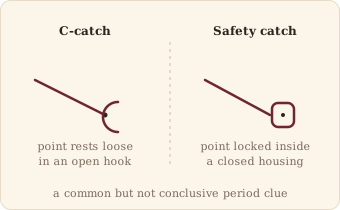
The C-Catch
The simple C-catch is an open hook, shaped like the letter C, that the pin’s point rests against without being fully enclosed. It is the earliest and simplest catch type commonly seen on brooches from 1700-1950, appearing throughout the Georgian era and remaining common well into the Victorian period even after safer alternatives existed. Because the pin’s point sits exposed rather than locked in, a C-catch can work loose during wear, allowing the pin to swing free, snag fabric, or scratch the wearer - a practical drawback that eventually drove the development of safer designs. A C-catch is suggestive of an earlier date, particularly Georgian or early-to-mid Victorian, but its long period of continued use means it cannot rule out a later piece made in a deliberately old-fashioned style, nor can it rule out an old catch surviving unaltered on an older brooch of any date within that long span.
The Safety Catch and Trombone Catch
From the later 19th century onward, catch designs increasingly enclosed the pin’s point to prevent it working loose. The trombone catch, a sliding tube mechanism that locks the pin in place, and various forms of hinged or spring-loaded safety catch that fold down over the point, became increasingly common through the late Victorian and into the Edwardian period. A fully enclosed rotating or spring safety catch, of the kind still standard on brooches made today, becoming more common from the early 20th century onward, is suggestive of a later date - late Victorian, Edwardian, or Art Deco - when found as an original, unaltered part of the piece.
Tube Hinges and Soldered Hinges
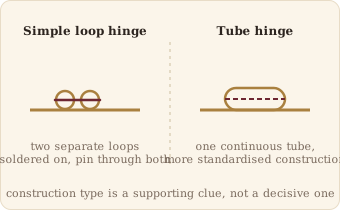
The hinge, which allows the pin to swing outward from the body of the brooch, also varies in construction. A simple hinge formed from two soldered metal loops with a pin passed through them is an older, more basic construction method, while a manufactured tube hinge, using a continuous metal tube set into the brooch and a fitted pin, reflects more standardised, later production. As with catches, hinge construction is a useful supporting clue rather than a decisive one, since both simple and more refined hinge types were used across long, overlapping spans of time.
Pin Length and Fit
Compare the pin’s length to the width of the brooch it belongs to. A pin noticeably shorter or longer than the piece, or one that does not sit flush against the catch when closed, can suggest that the pin, and possibly the whole fastening assembly, has been replaced at some point since the brooch was originally made - a repair that may have happened decades or even a century after the brooch itself.
Why This Isn’t Enough on Its Own
Catch and hinge style is useful as one data point among several, but brooches are small, well-used objects that were often repaired by local jewellers using whatever fittings were available at the time, sometimes with little regard for stylistic consistency with the original piece. A brooch’s front - its stones, metal, motifs and overall design - together with any hallmarks, is generally a stronger combined indicator of period than the catch considered on its own, and even that combination narrows a likely range rather than fixing a certain date.
Where to Go From Here
If you want a firmer sense of a specific brooch’s period, start by comparing its overall style, materials and construction against this site’s era guides and the brooch entry, then consult a qualified antique jewellery dealer, appraiser or auction house specialist for physical examination - particularly before any decision involving insurance, sale or restoration. Museum reference collections, many with searchable online catalogues, are also a useful way to compare dated, provenanced examples against your own piece.
Read next
Compare
Georgian vs Victorian Jewellery
How Georgian and Victorian jewellery differ in settings, techniques and motifs, and why Victorian jewellery itself spans several distinct phases.

Eras
Art Deco Jewellery
A guide to Art Deco jewellery (c.1915-1935): geometric symmetry, the 1925 Paris Exposition, Cartier's Tutti Frutti and Van Cleef & Arpels' Mystery Set, the modernist jewellers, new stone cuts, Egyptian and Indian influences, and costume jewellery.

Eras
Edwardian Jewellery
A guide to Edwardian jewellery (1901-1915): platinum and the garland style, Queen Alexandra's dog collars, Cartier, Boucheron and Fabergé in London, the Cullinan diamond, lavaliers, milgrain settings and day jewellery.
Identify
How to Research an Inherited Piece of Jewellery
A practical starting process for researching an inherited piece of jewellery, from family history and construction clues to when to consult a specialist.
Identify
Understanding Pin and Hinge Construction
How pin-and-hinge mechanisms work across brooches, hatpins and stickpins, and why the presence or absence of a catch is a useful structural distinction.
Jewellery
What Is a Brooch?
What a brooch is, how its pin-and-catch fastening works, and how brooch styles moved from naturalistic Victorian sprays through mourning brooches to Art Deco geometry.