British Silver Hallmarks Explained
The sterling and Britannia standards, the lion passant, lion's head erased, Scottish thistle and lion rampant, Irish harp, the 925 mark, and why so much antique silver jewellery carries no hallmark.
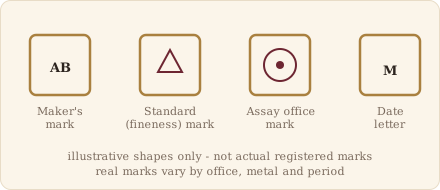
In a British silver hallmark, the standard mark shows which legal silver alloy a piece was tested against. For most of history there have been only two: sterling and the higher Britannia standard. What changed over time, and between England, Scotland and Ireland, is the symbol used to mark them. For how the standard mark sits with the other marks, see What Is a Hallmark?.
The Sterling Standard (925)
Sterling silver is 92.5% pure silver, usually alloyed with copper. It has been the legal standard in England since the statute of 1300, and nearly all British silver jewellery from 1700 to 1950 is sterling or intended to be.
| Where marked | Sterling mark | In use |
|---|---|---|
| England (London, Birmingham, Sheffield, Chester and others) | Lion passant - a lion walking left, one forepaw raised | From 1544 |
| Edinburgh | Thistle | 1759-1975 |
| Glasgow | Lion rampant | 1819-1964 (office closed) |
| Scotland, from 1975 | Lion rampant | From 1975 |
| Dublin | Crowned harp | From the 17th century |
| All UK offices, from 1999 | “925” in an oval, with the traditional symbol optional | From 1999 |
The Britannia Standard (958)
Between 1697 and 1720 the minimum standard for English silver was raised to 95.8%, partly to stop people melting down coins of sterling silver to make plate. Britannia silver is marked with a seated figure of Britannia, and the London leopard’s head was replaced during this period by a lion’s head erased - a lion’s head in profile with a jagged, torn-off neck. Sterling was restored in 1720, but Britannia has remained an optional higher standard ever since and turns up occasionally on later pieces, especially Arts and Crafts silver.
The Duty Mark, 1784-1890
From 1 December 1784 a tax was charged on silver and gold wares, and the sovereign’s head in profile was struck to show it had been paid. George III’s head appears first, followed by George IV, William IV and Victoria. The duty was abolished in 1890, so a head mark beside the lion passant places a piece between those dates. Don’t confuse it with the optional commemorative heads struck for the 1935 Silver Jubilee (George V and Queen Mary together) and the 1953 Coronation.
Why Antique Silver Jewellery Is So Often Unmarked
Silver jewellery is much less consistently hallmarked than silver tableware. Small and light items were exempt from compulsory marking for long periods, and today any silver item under 7.78 grams is still exempt. Many Victorian silver brooches, lockets and bangles therefore carry no hallmark at all, or only a maker’s “STERLING” or “SILVER” stamp.
A fully hallmarked Victorian silver brooch is the exception. When one does turn up, the Birmingham anchor is the most common office mark, because Birmingham’s Jewellery Quarter produced a large share of Britain’s silver jewellery.
Imported Silver
From 1867 imported silver assayed in Britain was additionally struck with a letter “F” in an oval. From 1904 imported wares received their own distinct office symbols, with the standard shown as a decimal (.925). These marks are common on continental silver jewellery and watch cases sold in Britain in the early 20th century, and they mean the piece was made abroad, not that it is British.
Silver Marks That Aren’t Hallmarks
“STERLING”, “STER”, “925” on its own, “800” or “SILVER” stamped without an office mark and date letter are makers’ or retailers’ claims, not British hallmarks. “800” and “835” in particular usually indicate continental silver, made to lower standards than British sterling. “EPNS” (electroplated nickel silver) and “A1” mean silver-plated base metal. See Silver in Historical Jewellery for the wider history.
What the Mark Covers
As with gold, a silver hallmark describes the marked part only. On a bracelet or necklace this is often the clasp or a single link, and replacement fittings are common. Read the mark together with the style and construction of the whole piece; see How to Use Hallmarks to Date Jewellery.
Read next
Identify
British Gold Hallmarks Explained
Every British gold standard from 22ct to 9ct, when each was legal, how each was marked before and after 1975, and how to read a gold standard mark as a dating clue.
Identify
Understanding Hallmark Date Letters
How British hallmark date letters work: cycles, typefaces and shield shapes, why London letters span two calendar years, the 1975 uniform cycle, and how to avoid the common misreadings.
Identify
What Is a Hallmark?
What a British hallmark is, the four marks that make up a traditional set, how the system developed from 1300 to the 1973 Hallmarking Act, and why so much antique jewellery is unmarked.
Identify
What Is a Maker's Mark?
What a maker's or sponsor's mark identifies, how British makers' marks changed from 1363 to the present, why the mark often names a retailer rather than a craftsman, and how to research one.
Identify
What Is an Assay Office Mark?
What the assay office mark shows, the marks of London, Birmingham, Sheffield, Edinburgh, Chester, Glasgow, Dublin and the closed offices, and how the office mark helps date jewellery.

Materials
Silver in Historical Jewellery
Silver as gold's cheaper alternative, silver-topped gold settings, the Victorian silver fashion of the 1870s-80s, Birmingham's Jewellery Quarter, and Arts and Crafts silver from Ashbee to Liberty and Jensen.