What Is a Maker's Mark?
What a maker's or sponsor's mark identifies, how British makers' marks changed from 1363 to the present, why the mark often names a retailer rather than a craftsman, and how to research one.
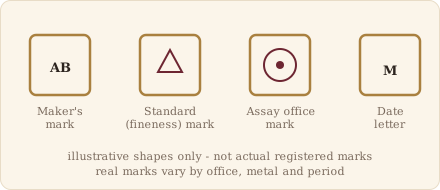
A maker’s mark - officially a sponsor’s mark since the Hallmarking Act 1973 - identifies the person or firm that submitted a piece for hallmarking and took legal responsibility for it. It is usually a set of initials inside a shaped outline, registered with an assay office. It’s the most personal part of a hallmark and, when it can be identified, often the most interesting, but it doesn’t always name the person who made the piece.
A Short History
- 1363 - A statute requires every goldsmith in England to have a mark of his own, registered with the wardens.
- Medieval to 17th century - Marks are often symbols or rebuses (a fish, a bell, a pair of initials with a device), many of which can’t now be matched to a name.
- 1697-1720 - During the Britannia-standard period, makers must use the first two letters of their surname.
- From 1720 - Makers begin to revert to the initials of their first name and surname, and an Act of 1739 makes all makers register new initial marks - the form that has lasted to the present.
- From 1973 - The term “sponsor’s mark” becomes official. A modern sponsor’s mark normally consists of at least two letters inside a shield shape.
The shape of the shield around the initials is part of the registered mark. Two firms with the same initials could be told apart by their shields.
Maker, Retailer or Manufacturer?
The mark identifies the sponsor, which could be:
- The craftsman who made the piece - more common in the 18th century and in Arts and Crafts work.
- A manufacturing firm, which by the later 19th century might employ dozens of specialist workers.
- A retailer that commissioned the piece from a trade workshop and registered its own mark - many fashionable West End and high-street jewellers did this.
- An importer, for foreign pieces assayed in Britain.
A famous retailer’s mark on a piece of Victorian jewellery tells you who sold it and stood behind it, but the actual work may have been done by an outworker in Birmingham or Clerkenwell. Some pieces carry both a sponsor’s mark and a separate retailer’s name stamped elsewhere, or a retailer’s name on the fitted case.
What the Mark Looks Like
A maker’s mark is usually a compact punch of two or three letters and is often the most worn mark in the set, especially on ring shanks. On pieces exempt from hallmarking, a maker’s mark sometimes appears on its own, with or without a carat or “STERLING” stamp - which tells you who made or sold the piece but nothing independently tested about its metal.
Researching a Specific Mark
Because marks were registered, they can sometimes be traced:
- Identify the assay office and approximate date from the rest of the hallmark. Registers were kept office by office, so you need both.
- Consult a published directory. For London, Arthur Grimwade’s London Goldsmiths 1697-1837 covers the Georgian period, and John Culme’s Directory of Gold & Silversmiths, Jewellers & Allied Traders 1838-1914 covers the Victorian and Edwardian trade. Jackson’s Silver & Gold Marks includes a large selection of makers’ marks for every office.
- Approach the assay office. The London, Birmingham, Sheffield and Edinburgh offices hold historical registers, and some provide research services.
- Check the shield shape and spacing, not just the initials. Common initial pairs were registered by many different makers.
Even when a mark can’t be traced to a name, it can still be useful: matching marks on two pieces suggests the same workshop or retailer.
What a Maker’s Mark Doesn’t Tell You
The mark identifies the sponsor of the marked part at the time of hallmarking. It doesn’t establish the date (that’s the date letter’s job), the metal (the standard mark) or the originality of every component. A maker’s mark on a ring shank says nothing about whether the stones or setting are original.
Read next
Identify
British Gold Hallmarks Explained
Every British gold standard from 22ct to 9ct, when each was legal, how each was marked before and after 1975, and how to read a gold standard mark as a dating clue.
Identify
British Silver Hallmarks Explained
The sterling and Britannia standards, the lion passant, lion's head erased, Scottish thistle and lion rampant, Irish harp, the 925 mark, and why so much antique silver jewellery carries no hallmark.
Identify
Understanding Hallmark Date Letters
How British hallmark date letters work: cycles, typefaces and shield shapes, why London letters span two calendar years, the 1975 uniform cycle, and how to avoid the common misreadings.
Identify
How to Research an Inherited Piece of Jewellery
A practical starting process for researching an inherited piece of jewellery, from family history and construction clues to when to consult a specialist.
Identify
What Is a Hallmark?
What a British hallmark is, the four marks that make up a traditional set, how the system developed from 1300 to the 1973 Hallmarking Act, and why so much antique jewellery is unmarked.
Identify
What Is an Assay Office Mark?
What the assay office mark shows, the marks of London, Birmingham, Sheffield, Edinburgh, Chester, Glasgow, Dublin and the closed offices, and how the office mark helps date jewellery.