British Gold Hallmarks Explained
Every British gold standard from 22ct to 9ct, when each was legal, how each was marked before and after 1975, and how to read a gold standard mark as a dating clue.
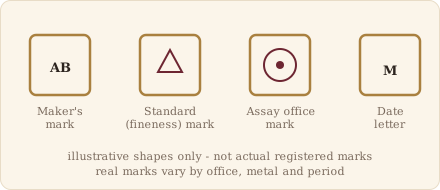
In a British gold hallmark, the standard mark records how much pure gold the alloy contains. Because the legal standards and the way they were marked changed at known dates, the standard mark is often the quickest way to put a gold piece into a date range - even before you look for a date letter. For the overall structure of a hallmark, see What Is a Hallmark?.
Carats and Millesimal Fineness
Gold fineness has traditionally been expressed in carats: parts of pure gold out of 24. Since 1975 British marks have shown the same thing in parts per thousand (millesimal fineness), so 18 carat (18/24) appears as 750, and 9 carat (9/24) as 375. Older marks often show both systems together - “9” alongside “.375” - which is itself a dating clue.
The British Gold Standards
| Standard | Legal for hallmarking | Marked before 1975 | Marked from 1975 |
|---|---|---|---|
| 22ct (916) | Throughout the period | Lion passant until 1844; then a crown and “22” | Crown and “916” |
| 18ct (750) | From 1798 | Crown and “18” | Crown and “750” |
| 15ct (625) | 1854-1932 only | “15” and “.625” | - |
| 14ct (585) | From 1932 | “14” and “.585” | Crown and “585” |
| 12ct (500) | 1854-1932 only | “12” and “.5” | - |
| 9ct (375) | From 1854 | “9” and “.375” | Crown and “375” |
The crown appeared only with 22ct and 18ct gold before 1975. Since 1975 it has accompanied every gold standard, struck beside the fineness number in a shaped shield.
Reading the Standard Mark as a Dating Clue
- Crown with “22” or “18” and no decimal - made between 1798 (or 1844 for the 22ct crown) and 1975.
- “15 .625” or “12 .5” - a closed window, 1854 to 1932. Fifteen-carat gold was widely used for good-quality Victorian and Edwardian jewellery, so this is one of the most useful marks on antique pieces.
- “14 .585” - 1932 to 1975.
- “9 .375” - 1854 to 1975. The same standard with a crown and “375” in a shield means 1975 or later.
- A three-digit number with no carat figure - the 1975 system or later, or a foreign mark (see below).
Carat Stamps That Aren’t Hallmarks
A great deal of Victorian and Edwardian jewellery was exempt from compulsory hallmarking, and makers often stamped a carat figure - “15ct”, “18c”, “9ct” - without sending the piece for assay. These stamps are the maker’s own claim rather than an independently tested mark. They are usually honest, but they are not a hallmark, and they come without the assay office mark and date letter that would fix a place and year.
Marks using a “K” - “14K”, “18K” - are usually continental European or American rather than British. “Rolled gold”, “RG”, “gold filled” or a fraction such as “1/20 12K” indicate a thin layer of gold over base metal, not solid gold; see What Is Gilt Jewellery?.
Scotland and Ireland
Edinburgh, Glasgow and Dublin marked gold to the same legal standards but with their own office marks and, at times, their own standard symbols. A Scottish or Irish gold piece that doesn’t match the English pattern above is not necessarily irregular. See What Is an Assay Office Mark?.
What the Mark Covers
A gold standard mark describes the alloy of the marked part only. On a ring, the shank is usually the marked part, and a later head or new stones may have been added since. See How to Recognise Ring Alterations and Resizing.
Read next
Identify
Understanding Hallmark Date Letters
How British hallmark date letters work: cycles, typefaces and shield shapes, why London letters span two calendar years, the 1975 uniform cycle, and how to avoid the common misreadings.
Identify
What Does 18ct Mean?
What an 18ct or 750 gold mark means, when the British 18 carat standard was introduced in 1798, how it was marked before and after 1975, and why 18ct dominated fine jewellery.
Identify
What Does 9ct Mean?
What a 9ct or 375 gold mark means, why the 1854 introduction of 9 carat gold transformed British jewellery, how 9ct marks changed over time, and what 9ct looks and feels like.
Identify
What Is a Hallmark?
What a British hallmark is, the four marks that make up a traditional set, how the system developed from 1300 to the 1973 Hallmarking Act, and why so much antique jewellery is unmarked.
Identify
What Is an Assay Office Mark?
What the assay office mark shows, the marks of London, Birmingham, Sheffield, Edinburgh, Chester, Glasgow, Dublin and the closed offices, and how the office mark helps date jewellery.

Materials
Gold in Historical Jewellery
How gold standards, supply, colour and working methods changed from Georgian to 1940s jewellery - the 1854 standards, the gold rushes, bloomed and coloured gold, rolled gold - and gold's imitations.