Edwardian Jewellery
A guide to Edwardian jewellery (1901-1915): platinum and the garland style, Queen Alexandra's dog collars, Cartier, Boucheron and Fabergé in London, the Cullinan diamond, lavaliers, milgrain settings and day jewellery.
Edwardian jewellery is, above all, platinum jewellery - a newly workable metal that let jewellers build settings so fine and lace-like they could hardly have been made in gold, giving the whole period its characteristic airy, white-on-white look.

Overview
Named for Edward VII, whose reign ran from 1901 to 1910, the Edwardian style in jewellery continued in much the same form until the outbreak of the First World War in 1914 disrupted fashionable society and its jewellery trade. The style is sometimes called “Belle Époque” jewellery, especially in French contexts, reflecting the same broadly optimistic, elegant pre-war sensibility expressed slightly differently on either side of the Channel.
Platinum and the Garland Style
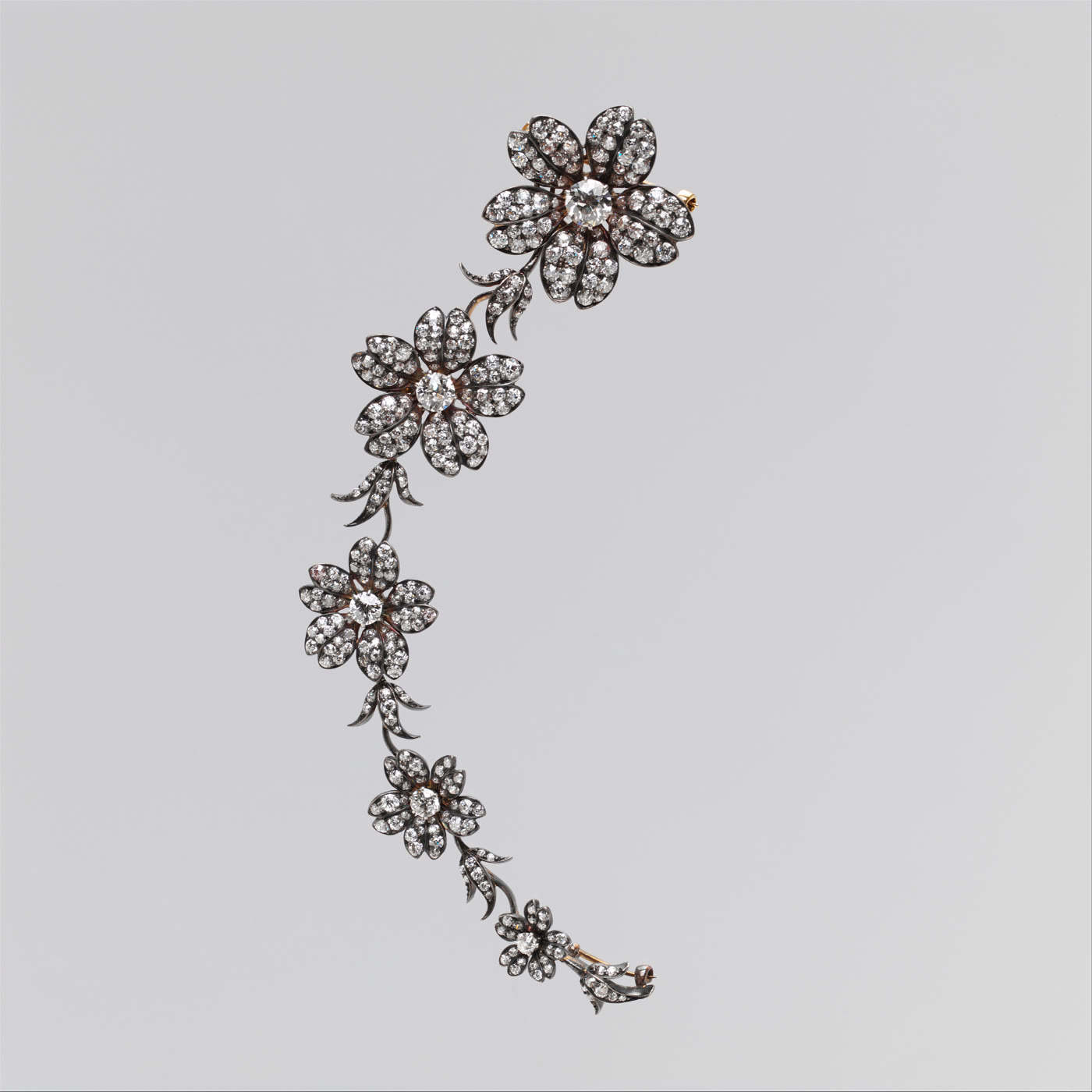
Platinum had been known for centuries but was extremely difficult to work with the soldering and casting methods available before the late 19th century, since it requires much higher temperatures than gold or silver. Improved high-temperature torches and techniques around the turn of the century finally made platinum practical for fine jewellery settings. Because platinum is strong even in very thin sections, jewellers could build settings far more delicate than gold allowed, producing the airy, openwork “garland style” - named for its recurring swags, ribbon bows, laurel wreaths and floral garlands rendered in fine platinum lace rather than solid metal.
Diamonds and Milgrain Detail
Diamond supply from South African mines, developed from the 1870s onward, continued to grow through the turn of the century, and Edwardian fashion made diamonds more central to fine jewellery than at almost any earlier point. Stones were typically set in fine claw or millegrain mounts - a millegrain (or milgrain) edge, a row of tiny beaded metal, both secured the stone and gave the setting a soft, textured finish well suited to the style’s lace-like character. Small diamonds were often used in quantity to build up flowing linear patterns, rather than relying on a single large stone as the piece’s focus.
Queen Alexandra and Court Fashion
Edward VII’s queen, Alexandra, was the period’s most influential wearer of jewellery. Her taste for high, multi-strand pearl and diamond dog-collar necklaces made the choker one of the defining Edwardian forms; it is often said that she wore them to hide a small scar on her neck, though the story is not well documented. The coronation of 1902 and the Delhi Durbars of 1903 and 1911 created demand for tiaras, stomachers and parures on a scale not seen for decades. The London Season - court presentations, balls and the opera - required a tiara and important jewels for every married woman of standing.
In 1905 the Cullinan diamond, the largest gem-quality rough diamond ever found, was discovered in South Africa. It was presented to Edward VII and cut in Amsterdam in 1908 by the Asscher firm; its two largest stones were set in the British Crown Jewels.
The Great Houses
- Cartier, under Louis Cartier, was the leading exponent of the platinum garland style. The firm opened in London in 1902 and in New York in 1909, and its early experiments with geometric design in the 1910s anticipated Art Deco.
- Boucheron, Chaumet and Lacloche in Paris made garland-style tiaras, corsage ornaments and sautoirs for an international clientele.
- Fabergé opened a London branch in 1903, selling enamelled objects, flowers and jewellery to Edward VII’s circle until 1917; see What Is Guilloché Enamel?.
- In London, Garrard (the Crown Jewellers), Hancocks, Carrington and the Goldsmiths & Silversmiths Company on Regent Street supplied British society.
Day Jewellery
Edwardian daytime dress, with its high boned collars, called for small, practical jewels: bar brooches and lace pins to fix collars and blouses, hatpins to secure ever-larger hats, fob or brooch watches, and lightweight 9ct and 15ct gold bracelets. Peridot, amethyst, aquamarine and demantoid garnet were popular coloured stones, often with seed pearls or small diamonds. See Peridot in Edwardian Jewellery.
Common Jewellery Types
The lavalier necklace, with one or two drops suspended from a fine chain, and the closely related “negligee” necklace, with two unevenly matched drops, were especially characteristic of the period, alongside the riviere necklace of graduated diamonds, delicate bow and garland brooches, and diamond dog-collar necklaces worn high on the throat. Long diamond chains, drop earrings and fine platinum bracelets were also fashionable.
Materials and Gemstones
Platinum, sometimes backed with a small amount of gold for structural reasons, largely replaced silver-topped gold as the setting metal of choice for fine work. Diamonds dominate the period’s gemstone use, though pearls - both natural pearls and, increasingly toward the end of the period, early cultured pearls - were also highly prized and frequently combined with diamonds.
Contrast With Victorian Jewellery
Edwardian jewellery reads as a deliberate reaction against the heavier, more colourful and more symbolically loaded jewellery of the mid- and late Victorian period. Where Victorian pieces were often solid gold, richly coloured or laden with sentimental or mourning symbolism, Edwardian jewellery favoured white-on-white restraint - platinum and diamonds - and pattern over narrative content, suiting the lighter, more clearly ornamental fashion of the early 20th century.
How to Recognise Edwardian Jewellery
Fine platinum settings, millegrain edges, garland, bow and laurel-wreath motifs, an abundance of small diamonds arranged in flowing linear patterns, and an overall white, lace-like appearance are all strong indicators, particularly when combined with a lavalier or negligee necklace form.
Transition to Art Deco
The First World War interrupted fashionable jewellery production and display across Europe, and by the time peacetime fashion re-established itself in the early 1920s, taste had turned decisively toward the bolder geometric symmetry of Art Deco jewellery, which retained platinum as its preferred setting metal but abandoned the Edwardian garland style’s soft curves for hard-edged pattern.
Read next
Compare
Edwardian vs Art Deco Jewellery
Edwardian and Art Deco jewellery both favoured platinum, but one is soft and curved and the other hard-edged and geometric - here's how to tell the garland style from Deco.
Compare
Victorian vs Edwardian Jewellery
How Victorian jewellery's heavier gold work and mourning materials gave way to the light, platinum-set, diamond-and-pearl style of the Edwardian era.

Eras
A Guide to Jewellery Through History
A chronological guide to jewellery history from the Georgian era to the 1940s - how style, materials and meaning changed decade by decade across Britain, France and the United States.
Eras
American Jewellery in the Gilded Age
How enormous new industrial wealth fuelled American fine jewellery in the decades after the Civil War, Tiffany & Co.'s major historical role, and the period's close ties to European style.

Eras
Art Deco Jewellery
A guide to Art Deco jewellery (c.1915-1935): geometric symmetry, the 1925 Paris Exposition, Cartier's Tutti Frutti and Van Cleef & Arpels' Mystery Set, the modernist jewellers, new stone cuts, Egyptian and Indian influences, and costume jewellery.
Eras
Art Nouveau Jewellery
A guide to Art Nouveau jewellery (c.1890-1910): René Lalique and Gulbenkian, Fouquet and Mucha, Vever and Gaillard, plique-à-jour and horn, Jugendstil, Liberty's Cymric range, Tiffany, and the mass-produced silver that spread the style.