What Is Hair Jewellery?
What hair jewellery is, how table-work and palette-work hairwork were made, the hairworkers and manuals behind the craft, and why it served sentimental as well as mourning purposes.
Hair jewellery is jewellery incorporating a loved one’s hair, either kept visible behind glass in a small compartment or worked directly into the piece’s structure through a specialist plaiting technique known as hairwork.

Two Forms, Two Purposes
Hair jewellery took two distinct physical forms. The simpler form set a lock of hair, sometimes plaited or arranged decoratively, behind a glazed compartment in a locket, brooch or ring - the hair is present but not structural. The more elaborate form, hairwork proper, used the hair itself as the working material, plaited or woven into cords or flat patterns strong enough to form a whole bracelet, necklace or watch-chain, typically finished with gold clasps, fittings or beads. Both forms could be either sentimental or memorial. Hair jewellery was exchanged between living friends, lovers and family members as a token of affection - a lock kept as a keepsake carried no implication of death - and it was equally used to commemorate someone who had died, in which case it functions as one branch of mourning jewellery. The material and technique alone rarely tell you which purpose a surviving piece served; an inscription or the wider context of the piece usually settles the question.
Palette-Work
The older of the two hairworking methods, palette-work, produced flat designs to be set under glass or crystal in brooches, rings, lockets and the backs of miniatures. The hair was washed to remove grease, laid out on a flat palette (often a piece of porcelain or glass), smoothed with a palette knife and stiffened with gum. Once dry it could be cut like paper into shapes - curls, feathers, wheatsheaves, willow fronds and the Prince of Wales’s feathers were favourites - and the pieces were bound with fine gold wire, sometimes trimmed with tiny seed pearls, and arranged on an opaline glass or ivory ground.
Palette-work was at its most elaborate in the late 18th and early 19th centuries, when neoclassical mourning scenes - a woman weeping at an urn under a willow - were painted in sepia on ivory, with the deceased’s hair used for the tree or laid in as part of the composition. Some miniatures are said to have used chopped hair mixed into the paint itself. By the mid-19th century palette-work survived mainly as the neatly arranged plaits and feather-shaped plumes seen behind glass in memorial brooches and ring bezels.
Table-Work
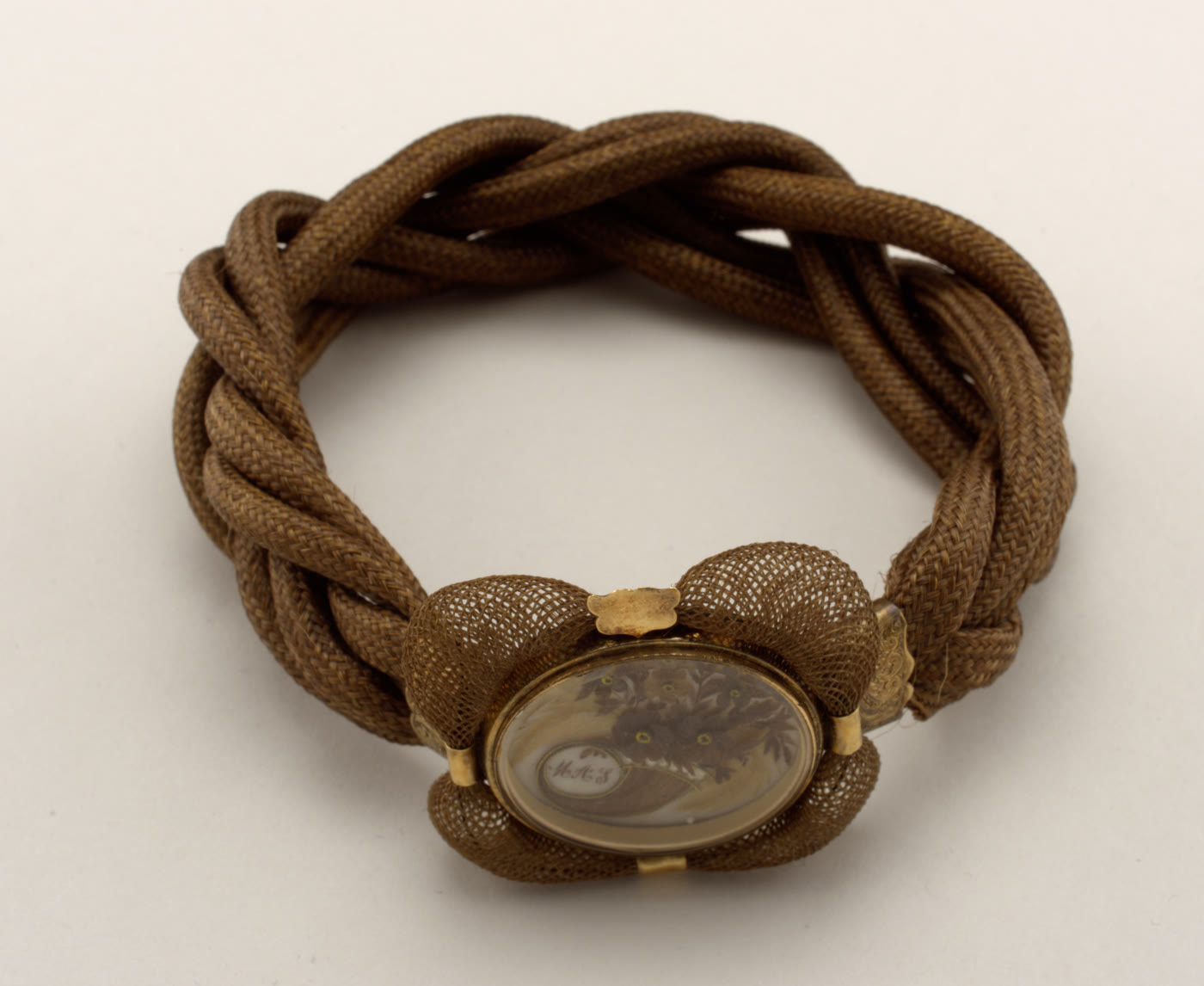
Table-work produced the woven hair chains, bracelets and earrings most associated with Victorian hairwork. The worker used a round work table with a hole in the centre. Strands of hair, sorted by length and boiled to clean them, were tied in small bundles to weighted bobbins hanging over the edge of the table; a central weight pulled the work down through the hole. Working the bobbins over and across one another in a fixed order - much as in bobbin lace or Japanese braiding - produced an even, tubular braid. For hollow chains and beads the hair was braided around a mould of wood or wire, which was removed afterwards, and the finished work was boiled again and dried to set its shape.
The finished braid was then fitted with gold end-caps, clasps or barrel fittings, often by a jeweller working separately from whoever prepared the plait. Pattern books named dozens of braids - spiral, twisted, square, serpentine - and different patterns could be combined in one bracelet or watch-chain.
Who Made It
Hairwork was produced both commercially and domestically. In London, hairworkers advertised to jewellers and the public, and hairwork was shown at the Great Exhibition of 1851, where the London hairworker Antoni Forrer is recorded among the exhibitors.
Alongside the professionals, hairwork was taught as a home accomplishment. Two instruction books were particularly influential: Mark Campbell’s Self-Instructor in the Art of Hair Work, published in New York in 1867, which set out table-work braids step by step with illustrations of the table and bobbins; and Alexanna Speight’s The Lock of Hair, published in London in the early 1870s, which combined the history of hair keepsakes with practical instructions. Both encouraged readers to do the work themselves, partly because of a frequently voiced worry that commercial hairworkers did not always use the hair they had been sent. This dual production, professional and domestic, means surviving quality varies considerably, from finely even commercial work to looser amateur plaiting.
The Victorian Peak
Hairwork reached its widest popularity in Britain and the United States in the mid-19th century, from about the 1840s to the 1870s. In Britain this overlapped with the mourning-jewellery boom that followed Prince Albert’s death in 1861, and Queen Victoria herself owned and gave jewellery containing Albert’s hair. In the United States the Civil War (1861-65) produced a similar demand for memorial hairwork. The underlying practice of keeping a loved one’s hair long predates that period; see Victorian Jewellery for the wider social conventions that made sentimental and mourning jewellery so central to the period’s fashion.
Materials Beyond Hair
The hair itself was the defining material, but the gold or gilt fittings that finished a piece ranged from solid gold for wealthier commissions to pinchbeck and other gilt base metals for less expensive work, reflecting the same range seen across other Victorian jewellery types. Black enamel on the clasp, with “In Memory Of” in gold letters, usually signals a memorial purpose; a plain or gem-set clasp is more typical of a sentimental gift.
Decline
Hairwork’s popularity faded from the 1880s and declined further with the relaxation of Victorian mourning customs in the early 20th century. Changing fashion, the decline of domestic hairwork as an expected accomplishment, and the same social shifts that reduced demand for formal mourning jewellery generally all contributed to its disappearance as a mainstream craft by the interwar period.
Collecting Hair Jewellery Today
Hairwork has a dedicated collector following today, valued both as a distinctive Victorian decorative craft and as a personal survival from the period. Condition varies with age and handling - table-work braids can fray or lose their shape if crushed - and identifying a piece’s original purpose often depends on accompanying inscriptions or family history rather than the hairwork itself.
Frequently Asked Questions
Is all hair jewellery mourning jewellery? No - hair was exchanged between living friends, family and lovers as a sentimental keepsake as well as used to commemorate the dead, so hair alone does not indicate a memorial purpose.
How can I tell professional hairwork from an amateur piece? Commercial hairwork tends to show very even, tight, regular plaiting and well-finished gold fittings; looser or irregular plaiting can indicate domestic work, though this is a general tendency rather than a reliable test on its own.
Read next
Eras
Victorian Jewellery
A guide to Victorian jewellery (1837-1901): the Romantic, Grand and Aesthetic periods, the Great Exhibition, gold rushes and 9ct gold, mourning and Whitby jet, archaeological revival, Scottish jewellery, and how to recognise each phase.

Materials
What Is Pinchbeck?
What pinchbeck is, how Christopher Pinchbeck's gold-coloured alloy imitated gold in Georgian jewellery and watch cases, why it declined after 1854, and how it is collected today.
Mourning & Sentimental
What Is Acrostic Jewellery?
What acrostic jewellery is, how REGARD and DEAREST rings spell words in gemstones, the Paris jewellers who popularised it, and why it is sentimental rather than mourning jewellery.
Mourning & Sentimental
What Is a Friendship Bracelet, Historically?
The Georgian and Victorian sentimental bracelet tradition behind the term 'friendship bracelet' - hair bracelets, inscribed clasps and gate bracelets, a different practice from today's woven thread bands.
Mourning & Sentimental
What Is Lover's Eye Jewellery?
What lover's eye jewellery is, the Prince of Wales, Maria Fitzherbert and Richard Cosway story behind it, how eye miniatures were painted and mounted c.1785-1830, and why they are rare.

Mourning & Sentimental
What Is a Memorial Brooch?
What a memorial brooch is, how its design changed from Georgian sepia-and-hair brooches to Victorian black-enamel and photographic brooches, and how it differs from general mourning jewellery.