What Is a Memorial Brooch?
What a memorial brooch is, how its design changed from Georgian sepia-and-hair brooches to Victorian black-enamel and photographic brooches, and how it differs from general mourning jewellery.
A memorial brooch is a brooch made or adapted to commemorate a specific death - typically the most elaborate and personalised form of mourning jewellery, built around an individual name, date or portrait rather than simply signalling that the wearer was in mourning.

Commemorating One Person, Specifically
The defining feature of a memorial brooch is that it names or represents a specific individual, distinguishing it from mourning jewellery worn more generally to observe mourning etiquette - a plain jet brooch worn because convention called for black jewellery during a mourning period commemorates no one in particular, while a memorial brooch was made or personalised for one death. In practice the two categories overlap heavily, since a memorial brooch was also worn during the period of formal mourning, but the presence of a name, date, hair compartment or portrait is what marks a brooch as memorial rather than simply mourning-appropriate.
Typical Construction
A memorial brooch commonly combines several elements around a jet, black-enamelled gold or gilt-metal setting: a small glazed compartment holding a lock of the deceased’s hair, often plaited or arranged decoratively behind the glass; an enamelled or engraved inscription giving the person’s name and dates, sometimes with a short epitaph; and mourning motifs such as an urn, willow, forget-me-not, ivy or a simple cross worked into the surrounding design. Not every memorial brooch includes all of these elements - a hair compartment alone, or an inscription alone, was sufficient to personalise the piece to one individual. The compartment is often on the reverse, behind a hinged or fixed glazed panel, so that the hair was worn against the body and out of sight.
How the Design Changed
- c.1770-1810 (neoclassical): oval or navette-shaped brooches and pendants with a painted ivory panel showing a mourning woman beside an urn or tomb under a weeping willow, often in sepia, with the deceased’s hair worked into the scene. Mottoes such as “Not lost but gone before” or “Sacred to the memory of” appear on the tomb or round the border, and the frame may be set with seed pearls or bordered in blue or white enamel.
- c.1810-1850: larger plaques of palette-worked hair under glass, framed in gold with black enamel, chased scrollwork or a border of half pearls; the name and date are often engraved on the back.
- c.1850-1880: the high Victorian brooch, with the words “In Memory Of” in gold Gothic letters standing out from a black enamel ground. The lettering was often produced by taille d’épargne, in which the design is engraved into the gold and the recesses filled with black enamel. Hair sits in a central glazed compartment or on the back.
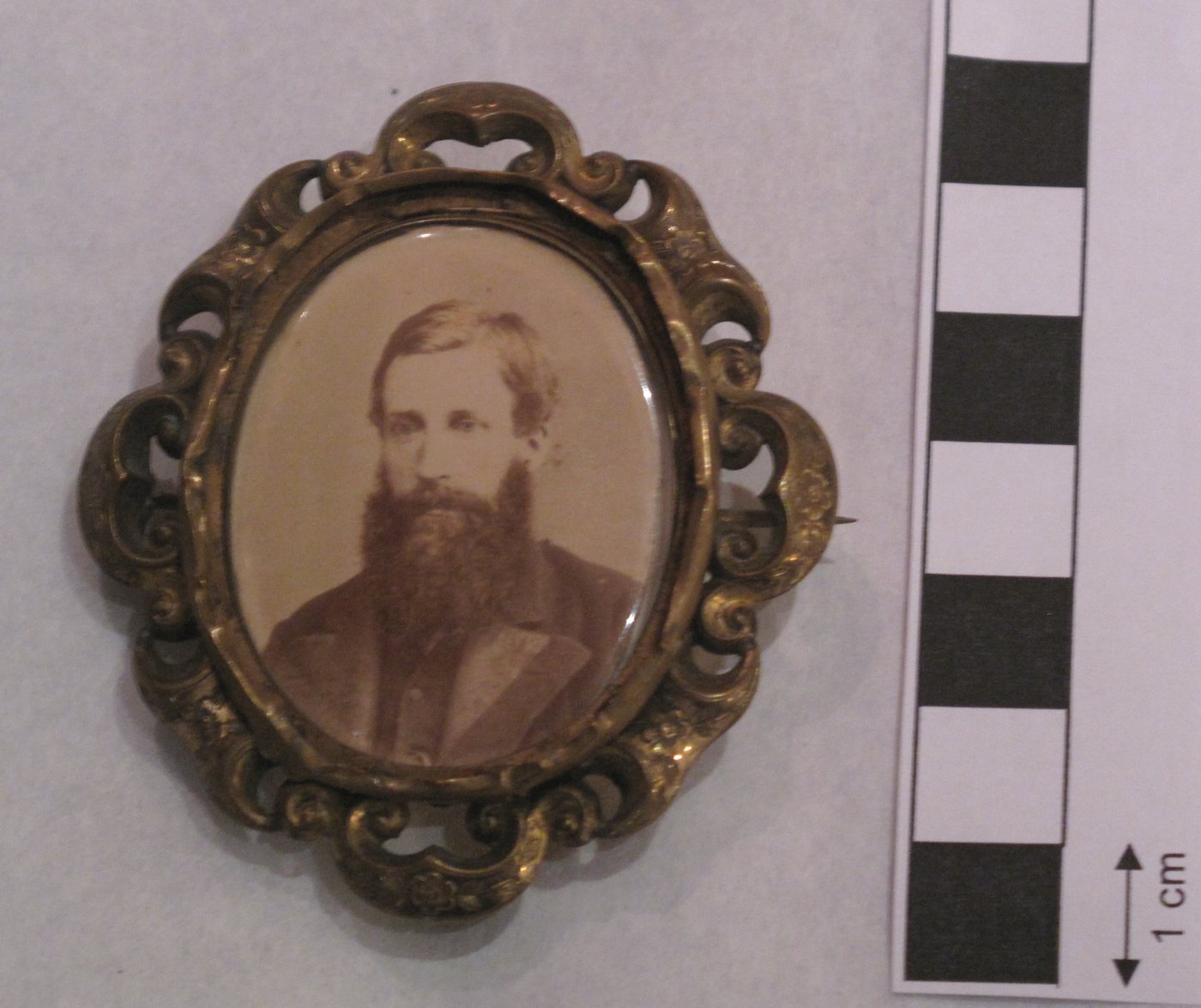
- c.1860 onwards: photographs set behind glass, often in a two-sided mount with hair on one side and the portrait on the other.
Materials
Jet and its imitations - black glass (“French jet”), vulcanite and bog oak from Ireland - were the dominant materials for mourning-appropriate memorial brooches, particularly during the mid-Victorian period following Prince Albert’s death in 1861. Carved Whitby jet brooches sometimes have a glazed hair compartment set into the centre or the back. Black-enamelled gold was more common among wealthier commissions and continued a tradition going back to 17th- and 18th-century mourning jewellery. White enamel was often used, in the brooches as in mourning rings, to commemorate a child or an unmarried person, and pearls were associated with tears. See Victorian Jewellery for the wider social context that drove demand for these materials.
Photographic Memorial Brooches
As photography became more affordable from the mid-19th century onward, memorial brooches increasingly incorporated a small photographic portrait of the deceased. Early examples might use a daguerreotype or ambrotype, both single images on metal or glass; from the 1860s, small albumen paper prints, of the kind sold as cartes de visite, could be trimmed to fit a brooch, and later tintypes and gelatin silver prints were used in the same way. The photographic brooch continued the personalising function of the hair-and-inscription brooch, substituting a likeness for, or adding one to, a physical relic, and it remained in use into the early 20th century, including for men killed in the First World War.
Royal and Public Memorial Brooches
Public deaths created demand for memorial jewellery bought by people who had never known the dead. The death of Princess Charlotte in childbirth in 1817 produced a wave of memorial brooches and rings, and after Prince Albert’s death Queen Victoria commissioned memorial jewellery containing his portrait or hair, which she wore herself and gave to members of her family and household.
How to Recognise One
Look for a small glazed compartment on the brooch’s front or reverse, an inscription (sometimes on the reverse, out of immediate view when worn), or a photographic portrait, rather than relying on the black colour of the material alone, since plain jet and vulcanite brooches were also worn simply as fashionable mourning-period jewellery without commemorating anyone specific.
Frequently Asked Questions
Does a jet brooch have to be a memorial brooch? No - jet and its imitations were widely worn as general mourning-appropriate fashion jewellery, so a plain jet brooch without a hair compartment, inscription or portrait is more likely to be general mourning jewellery than a memorial piece for one individual.
Can a memorial brooch be dated from its inscription alone? An inscription giving a death date provides an earliest possible date for the piece, since it could only have been made afterward, but the brooch’s actual manufacture could postdate the death by some time - and an older brooch was sometimes re-engraved for a later death - so the inscription indicates the commemorated event rather than confirming the exact date the brooch itself was made.
Read next
Compare
Mourning Ring vs Memorial Brooch: What's the Difference?
How the centuries-old, often bequeathed mourning ring compares with the more elaborate, personally chosen Victorian memorial brooch.
Eras
Victorian Jewellery
A guide to Victorian jewellery (1837-1901): the Romantic, Grand and Aesthetic periods, the Great Exhibition, gold rushes and 9ct gold, mourning and Whitby jet, archaeological revival, Scottish jewellery, and how to recognise each phase.
Jewellery
What Is a Brooch?
What a brooch is, how its pin-and-catch fastening works, and how brooch styles moved from naturalistic Victorian sprays through mourning brooches to Art Deco geometry.

Materials
What Is Jet Jewellery?
What jet is, where it came from - Whitby, Asturias, southern France - its use from the Bronze Age to the Victorian mourning boom, and how to tell genuine jet from vulcanite and French jet.

Mourning & Sentimental
What Is Hair Jewellery?
What hair jewellery is, how table-work and palette-work hairwork were made, the hairworkers and manuals behind the craft, and why it served sentimental as well as mourning purposes.
Mourning & Sentimental
What Is Mourning Jewellery?
What mourning jewellery is, how it developed from Stuart and Georgian memorial rings, why it peaked in Victorian Britain after Prince Albert's death in 1861, and the etiquette and materials behind it.