What Is Lover's Eye Jewellery?
What lover's eye jewellery is, the Prince of Wales, Maria Fitzherbert and Richard Cosway story behind it, how eye miniatures were painted and mounted c.1785-1830, and why they are rare.
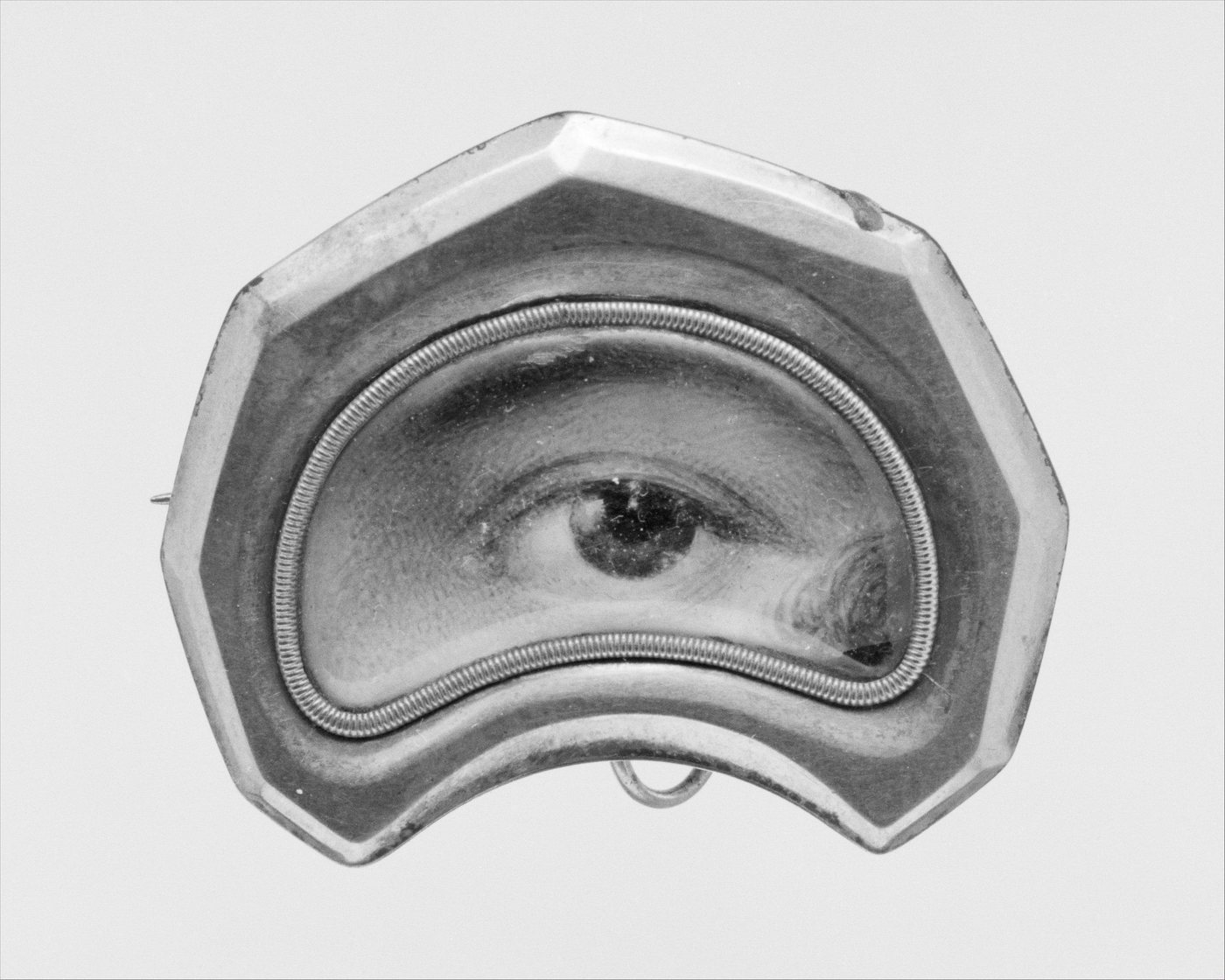
Lover’s eye jewellery sets a miniature portrait of a single eye - occasionally a pair - usually painted in watercolour on ivory or vellum, into a brooch, ring, pendant or locket. It was a short-lived fashion of the late Georgian and Regency period, at its height from about 1785 to 1830.
A Fashion Built on Discretion
What sets lover’s eye jewellery apart from an ordinary portrait miniature is its deliberate anonymity. A conventional miniature portrait identified its sitter; a single painted eye, isolated from the rest of the face, generally could not - the wearer could carry an intimate token of a specific person without anyone else being able to recognise who it depicted. This made the form especially suited to secret or illicit romantic attachments, where an identifiable portrait would have been risky to wear or exchange openly.
Origins: The Prince of Wales and Mrs Fitzherbert
The fashion is traditionally traced to George, Prince of Wales, later George IV, and Maria Fitzherbert, a twice-widowed Roman Catholic whom he met in 1784. Under the Royal Marriages Act of 1772 the prince could not marry without the King’s consent, and marriage to a Catholic would have barred him from the throne. Mrs Fitzherbert left England for the Continent in 1784 to escape his attentions; he pursued her with letters, and in late 1785 she returned and they were married in secret on 15 December 1785, a marriage that was invalid in English law.
The prince’s letter to her of 3 November 1785 mentions that he was sending her “an Eye”. Tradition holds that the miniature was painted by Richard Cosway (1742-1821), the most fashionable miniaturist in London and a favourite of the prince, and that she sent one of her own eye in return. The story is repeated in most histories of the form and fits its timing, but the Cosway attribution, and the idea that this exchange started the fashion, rest largely on later accounts, and should be read as the traditional explanation rather than an established fact. Whatever its precise origin, the fashion spread among fashionable society in Britain from the late 1780s and remained popular into the 1820s, with examples also made in France and elsewhere in Europe and, in smaller numbers, in the United States.
The Painters
Most eye miniatures are unsigned, and attributions to named artists should be treated with caution. Cosway’s name is attached to the form by tradition, and the leading miniaturists of the period, such as George Engleheart, are known to have painted eyes alongside their full-face portraits. Many surviving eyes, however, are by less well-known or unidentified painters working for jewellers, and their quality ranges from fine, precise work to fairly summary painting.
Materials and Construction
Lover’s eye miniatures were typically painted in watercolour on a thin sheet of ivory or vellum, then mounted under glass or rock crystal. The eye itself was shown close-up, usually with the eyebrow and sometimes a curl of hair, part of the nose or a cheek, to give it context without identifying the sitter. Miniatures were often under an inch across.
Common settings include:
- Brooches and pendants in gold, oval, round, heart- or almond-shaped, often bordered with seed pearls, small rose-cut diamonds, garnets or paste.
- Rings with the eye set in the bezel, sometimes framed in pearls or brilliants.
- Reverses with a glazed compartment holding a lock of hair, or engraved initials, a date or a short motto.
From Secrecy to Sentimental Convention
As the fashion continued, eye miniatures increasingly became a general sentimental keepsake rather than a specifically secretive one - later examples share the anonymous, isolated-eye format but were more often exchanged openly between family members or acknowledged lovers. Some were made as mourning pieces: the eye is painted with a tear on the cheek, surrounded by clouds, or set in a border of black or white enamel, sometimes with a memorial inscription on the reverse. The physical convention persisted even after the original motive for anonymity had largely faded, and the fashion was overtaken in the 1830s and 1840s by other sentimental forms and, from the 1840s, by photography.
Rarity and Collecting Today
Lover’s eye pieces are relatively rare survivals - the format was fashionable for a comparatively narrow window and each miniature was a one-off painting rather than a mass-produced design. Collections in museums including the Victoria and Albert Museum and the Metropolitan Museum of Art hold examples, and the large private Skier Collection has been exhibited at the Birmingham Museum of Art in Alabama. Because so few identifying details survive on most pieces by design, dating and attributing a specific lover’s eye miniature is often difficult, reproductions have been made since the fashion’s revival among collectors, and any attribution to a named sitter or artist should generally be treated as speculative unless supported by strong independent documentation or provenance.
Frequently Asked Questions
Does every eye miniature count as “lover’s eye” jewellery? In practice the term is used broadly for any isolated eye portrait mounted in jewellery from this period, though the strictest sense of the term refers to the earlier, deliberately anonymous examples rather than the later, more openly sentimental ones.
Can a lover’s eye miniature be identified as depicting a specific historical person? Almost never with confidence - the format was designed to prevent identification, so unless a piece carries separate documentation or provenance connecting it to a named individual, the sitter’s identity should be treated as unknown rather than inferred from the image alone.
Read next
Eras
Georgian Jewellery
A guide to Georgian jewellery (1714-1837): Brazilian diamonds, closed-back foiled settings, rococo and Neoclassical styles, paste, cut steel and pinchbeck, sentimental miniatures, girandoles, rivières and Sévigné bows.
Eras
Regency Jewellery
A guide to Regency jewellery (c.1795-1837): Empire fashion, cameos and Neoclassical parures at Napoleon's court, coloured gold and cannetille, Berlin iron and cut steel, acrostic rings, and memorial jewellery for Nelson and Princess Charlotte.
Jewellery
What Is a Pendant?
What a pendant is, how it differs from an integrated necklace centrepiece, and how forms like the locket, lavalier and negligee pendant developed within the broader category.
Mourning & Sentimental
What Is Acrostic Jewellery?
What acrostic jewellery is, how REGARD and DEAREST rings spell words in gemstones, the Paris jewellers who popularised it, and why it is sentimental rather than mourning jewellery.

Mourning & Sentimental
What Is Hair Jewellery?
What hair jewellery is, how table-work and palette-work hairwork were made, the hairworkers and manuals behind the craft, and why it served sentimental as well as mourning purposes.
Mourning & Sentimental
What Is Mourning Jewellery?
What mourning jewellery is, how it developed from Stuart and Georgian memorial rings, why it peaked in Victorian Britain after Prince Albert's death in 1861, and the etiquette and materials behind it.