What Is a Diadem?
What a diadem is in the strict sense, its classical and ceremonial associations, and how the term is used alongside - and often interchangeably with - tiara.
A diadem, in its strict sense, is a full closed circlet worn around the head, carrying older ceremonial and regal associations that reach back to the headbands worn by rulers in the ancient world.
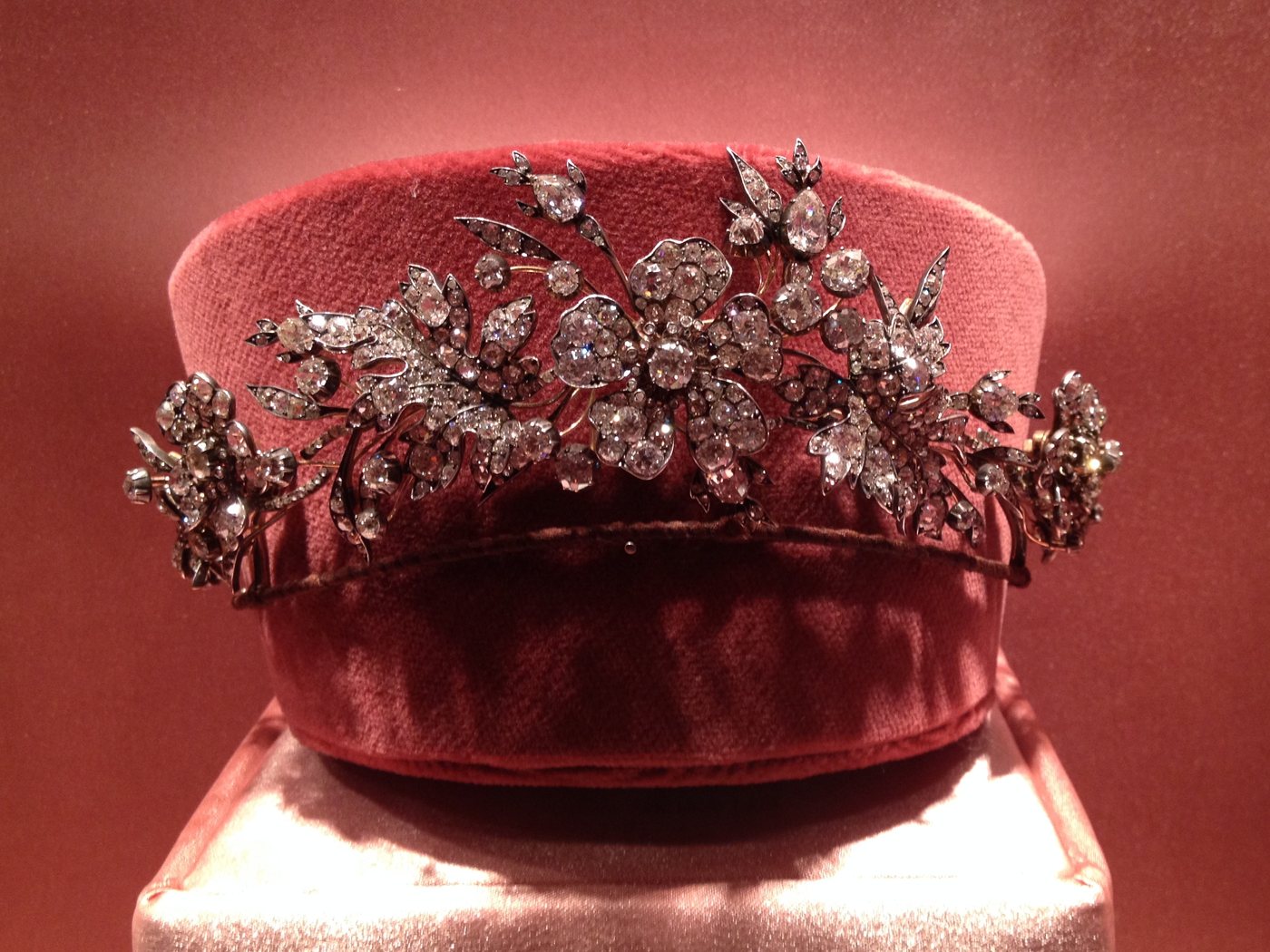
What Is a Diadem?
The defining feature of a true diadem is that it forms a complete, or near-complete, circle around the head, rather than spanning only the front and sides as a tiara does. In practice, “diadem” and “tiara” have long been used loosely and interchangeably, including by jewellers themselves and in period sources, and a piece sold or described as a diadem may in fact be tiara-shaped. See Tiara vs Diadem for a full comparison of the two terms.
How to Recognise It
Look at the overall shape: a genuine diadem encircles the head completely or very nearly so, while a tiara typically rises to a peak or pattern across the front and leaves the back of the head bare. Because a full circlet is a demanding and costly form to make securely wearable, surviving fine diadems in the strict sense are considerably less common than tiaras, and many pieces marketed historically as “diadems” are, on close inspection, tiara-shaped arcs.
When Was It Worn?
Like the tiara, the diadem was formal evening and ceremonial jewellery, worn at court, for state occasions, and for the most formal evening dress, rather than in daytime wear.
Origins
The headband or circlet as a mark of rulership and status is ancient and cross-cultural, worn by rulers and deities across classical Greek, Roman and other ancient civilisations. The diadem as a form of Western fine jewellery re-emerged strongly during the Neoclassical revival of the late 18th and early 19th centuries, when jewellers and their wealthy clients deliberately drew on classical imagery to signal taste, learning and, in some cases, explicit claims to authority.
How It Changed Over Time
Early 19th-century diadems favoured laurel wreaths, Greek key patterns and other overtly classical motifs, reflecting the Neoclassical taste of the period and often made to be worn with the high-waisted, classically inspired dress fashionable at the time. Through the Victorian period, the diadem’s strict, full-circlet sense became less common in everyday fashionable jewellery, with the tiara’s open arc form dominating both aristocratic and, later, wealthy fashionable wear, while “diadem” persisted as a grander or more literary name for a variety of head ornaments regardless of their exact shape.
Materials
Gold and silver were the traditional metals for a fine diadem, set with diamonds, pearls and coloured gemstones for the wealthiest wearers. As with tiaras, paste and cut steel offered a visually similar alternative at far lower cost, though the diadem’s strong ceremonial associations meant it remained, more than the everyday tiara, a form reserved largely for the most formal and highest-status jewellery.
Construction
A true diadem is built as a complete or near-complete band, shaped to sit securely around the head, with gemstones or decorative metalwork set along its length. Because a full circlet must fit closely and comfortably all the way round, rather than simply resting against the front of the head as a tiara can, fine diadems were often more demanding to construct and fit than an open tiara of similar grandeur.
How It Was Worn
Positioned around the head as a complete or near-complete circlet, secured into the hair, and reserved for the most formal ceremonial and evening occasions.
Who Wore It?
The diadem was almost exclusively women’s jewellery in its fashionable form, historically strongest among royal and aristocratic wearers, reflecting its ceremonial and regal associations more directly than the more broadly fashionable tiara.
Notable Variations
- Tiara - the far more common open, arc-shaped head ornament, frequently confused with, and named interchangeably alongside, the diadem.
- Bandeau Tiara - a narrow band worn low across the forehead, a distinct later form associated with early 20th-century fashion.
- Laurel-wreath diadem - an early 19th-century Neoclassical form explicitly modelled on the classical laurel wreath.
Terminology
“Diadem” and “tiara” are used interchangeably in much period and modern jewellery writing, and the strict arc-versus-circle distinction, while useful for description, should not be treated as a firm rule when reading historical sources or sale descriptions. See Tiara vs Diadem for more detail on where the terms diverge.
Similar Jewellery
The diadem is most easily confused with the tiara, given their overlapping use of the name and shared ceremonial function; whether the piece encircles the head fully is the clearest distinguishing feature, though this site does not offer authentication of any specific piece.
Examples in Museum Collections
- Diadem, maker’s mark “E.A.”, c.1795-97. Metropolitan Museum of Art, New York, 1990.139. Silver-gilt with seed pearls, from the Neoclassical revival that brought the diadem back into fashion.
- Tiara or “Spartan diadem”, c.1810. Victoria and Albert Museum, London, M.10:1, 2-1955. Gilded metal set with white glass cameos of classical heads on carnelian and chalcedony, in front and back sections - catalogued as a tiara but described as a “Spartan diadem”, a reminder of how loosely the two words are used. See Tiara vs Diadem.
- Diadem, Castellani, c.1860. Metropolitan Museum of Art, New York, 2014.713.2. Gold, agate, glass, pearls and enamel, in the archaeological-revival style; see Archaeological Revival Jewellery.
Read next
Compare
Georgian vs Victorian Jewellery
How Georgian and Victorian jewellery differ in settings, techniques and motifs, and why Victorian jewellery itself spans several distinct phases.
Compare
Tiara vs Diadem: What's the Difference?
The strict distinction between a tiara and a diadem, and why the two words are used so interchangeably in practice.

Jewellery
What Is a Bandeau Tiara?
What a bandeau tiara is, why it sits low across the forehead rather than up over the crown, and how bobbed hair and cloche hats made the form fashionable in the 1910s and 1920s.
Jewellery
What Is a Coronet?
What a coronet is, its documented heraldic role indicating rank in the British peerage, and its broader use as a general term for a small, low, crown-shaped head ornament.
Jewellery
What Is a Tiara?
What a tiara is, how it differs from a full diadem, and how bandeau and convertible tiara styles developed alongside aristocratic and fashionable wear.

Materials
Gold in Historical Jewellery
How gold standards, supply, colour and working methods changed from Georgian to 1940s jewellery - the 1854 standards, the gold rushes, bloomed and coloured gold, rolled gold - and gold's imitations.