What Is a Bracelet?
An overview of bracelets as a broad jewellery category, how wrist fashion shifted with sleeve length across the period, and how a bracelet differs from a bangle.
A bracelet is a jewellery item worn around the wrist or lower arm, covering a wide range of specific forms - from rigid bangles to flexible chain and gem-set links - that shared the wrist as their place of wear while differing considerably in construction.
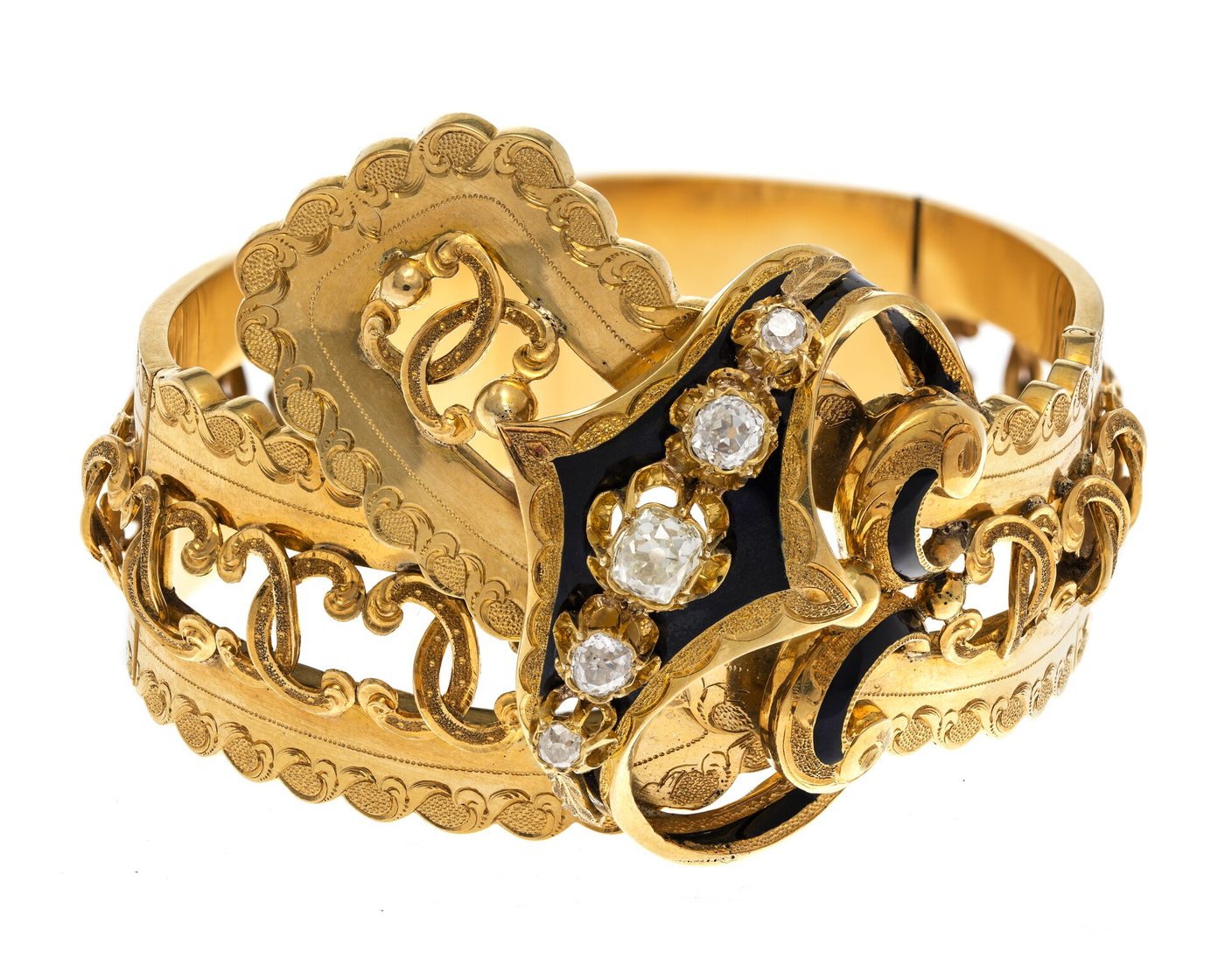
What Is a Bracelet?
“Bracelet” functions as a broad category rather than a single, specific form. It covers hinged bangles, flexible link and chain bracelets, gem-set straight-line bracelets, charm bracelets, and wide cuff-style bracelets, among others, unified mainly by their placement on the wrist rather than by any one method of construction or fastening. This page gives an overview of the category and how it changed across the period; where a specific sub-form has its own dedicated history, it is covered more fully on its own page.
How to Recognise It
Look first at whether the piece is rigid or flexible - a rigid, typically clasp-free or simply hinged form is generally a bangle, while a flexible bracelet made of linked sections, a chain, or a continuous line of set stones is a bracelet in the narrower, more specific sense. See Bangle vs Bracelet for a closer, side-by-side look at that distinction.
When Was It Worn?
Bracelets were worn from 1700 to 1950, though how visibly and how many at once shifted considerably with fashion - worn singly or as a pair on a bare Georgian or Regency forearm exposed by short sleeves, and often worn stacked, several at a time, on the bare arms fashionable with 1920s and 1930s evening dress.
Origins
Wrist ornaments are ancient and found across many cultures well before 1700. Within Georgian and Regency fashion specifically, the bracelet’s prominence grew alongside the fashion for short sleeves, which left the forearm visible and gave a bracelet a clear, decorative place to be seen.
How It Changed Over Time
Georgian and Regency bracelets were often worn in pairs, one on each wrist, in gold set with paste, garnets or other coloured stones, sometimes fastened with a clasp bearing a miniature, a lock of hair, or a sentimental motif. Victorian bracelets ranged enormously, from wide, sculptural gold bangles to charm bracelets carrying sentimental lockets and pendants, and mourning bracelets incorporating jet or hairwork. The Edwardian period favoured lighter, more delicate platinum and diamond bracelets in keeping with the era’s lace-like taste, while the Art Deco period produced strong, geometric straight-line bracelets set with calibré-cut stones, frequently worn stacked in multiples on bare arms as part of 1920s and 1930s eveningwear.
Materials
Gold was the standard base metal across most of the period, with silver-topped gold used for stone-set pieces before the wider adoption of platinum in the late 19th and early 20th centuries. Paste, garnets, coral, pearls and diamonds all appear regularly depending on era and cost, and jet and other mourning materials were used for bracelets made or adapted for mourning wear.
Construction
Flexible bracelets were built from linked sections, a woven or mesh chain, or a row of individually set stones joined by hinges or articulated links, allowing the piece to follow the movement of the wrist. Gem-set straight-line bracelets in particular relied on closely fitted, often nearly invisible, articulated settings to give the impression of a continuous line of stones.
How It Was Worn
Worn around the wrist, singly, in a matched pair, or - especially in the 1920s and 1930s - stacked several at a time on the same arm, a fashion made possible by the bare-armed silhouette of contemporary eveningwear.
Who Wore It?
Bracelets were worn overwhelmingly by women through most of this period, though men also wore certain bracelet forms, including some mourning and memorial bracelets and, later, plainer identity or link bracelets.
Notable Variations
- Bangle - a rigid, typically clasp-free or simply hinged bracelet form; see that page for a full treatment.
- Charm bracelet - a chain bracelet hung with small decorative or sentimental charms.
- Straight-line bracelet - a flexible line of individually set gemstones, especially associated with Edwardian and Art Deco design.
- Cuff bracelet - a wide, rigid band worn over the wrist rather than a narrower chain or bangle form.
Terminology
“Bracelet” is sometimes used loosely to cover bangles as well, though collectors and jewellery historians generally reserve “bangle” for the rigid, typically clasp-free form; see Bangle vs Bracelet for the fuller distinction.
Similar Jewellery
Because “bracelet” covers such a wide range of forms, individual pieces are most often confused with each other across sub-types - a wide cuff bracelet with a bangle, or a fine chain bracelet with a watch chain repurposed for the wrist - making construction and fastening the most reliable way to tell related forms apart.
Examples in Museum Collections
- Bracelet with locket clasp, possibly English, c.1820. Victoria and Albert Museum, London, M.119-1951. A light mesh of two colours of gold, fastened with a ruby and diamond clasp that opens as a locket.
- Bracelet, Phillips Brothers, London, c.1870. Victoria and Albert Museum, London, M.111-1978. Silver, made in narrow panels so that it could be rolled up into its case. The record notes that by the 1850s several bracelets might be worn at once between wrist and elbow.
- Bracelet, French, 1920-30. Victoria and Albert Museum, London, M.179-2007. Square links in gold, alternating frosted rock crystal and black enamel - the geometric Art Deco link bracelet.
Read next
Compare
Bangle vs Bracelet: What's the Difference?
Why every bangle is a bracelet, but not every bracelet is a bangle - the rigid, clasp-free construction that sets bangles apart.
Compare
Georgian vs Victorian Jewellery
How Georgian and Victorian jewellery differ in settings, techniques and motifs, and why Victorian jewellery itself spans several distinct phases.

Eras
Art Deco Jewellery
A guide to Art Deco jewellery (c.1915-1935): geometric symmetry, the 1925 Paris Exposition, Cartier's Tutti Frutti and Van Cleef & Arpels' Mystery Set, the modernist jewellers, new stone cuts, Egyptian and Indian influences, and costume jewellery.

Jewellery
What Is a Bangle?
What a bangle is, how its rigid, typically clasp-free form differs from a flexible chain bracelet, and why it was often worn stacked in multiples.
Jewellery
What Is a Rivière Necklace?
What a riviere necklace is, why its unbroken line of individually set stones made it one of the most enduring necklace forms, and how it differs from a festoon or fringe necklace.
Mourning & Sentimental
What Is a Friendship Bracelet, Historically?
The Georgian and Victorian sentimental bracelet tradition behind the term 'friendship bracelet' - hair bracelets, inscribed clasps and gate bracelets, a different practice from today's woven thread bands.