Bangle vs Bracelet: What's the Difference?
Why every bangle is a bracelet, but not every bracelet is a bangle - the rigid, clasp-free construction that sets bangles apart.
A bangle is a specific type of bracelet, so the two terms aren’t strictly opposites - the real question is one of specificity: “bracelet” is the broad umbrella term, and “bangle” names one particular, rigid form within it.
Short Answer
A bangle is a rigid, usually circular or oval band, typically worn by slipping it over the hand or opening it via a simple hinge, without a flexible clasp mechanism. “Bracelet” is the broader category covering bangles as well as flexible chain and link bracelets, gem-set line bracelets, charm bracelets, and cuffs - so every bangle is a bracelet, but most bracelets are not bangles.
What Is a Bangle?
A bangle is defined by its rigidity and its typically closed or near-closed circular form. Solid bangles are slipped directly over the hand, while hinged bangles open at one point to be fitted around the wrist and closed with a simple catch rather than a chain-style clasp. Because a bangle holds its shape on its own, it can be worn stacked in multiples, a wearing style with a long history across several of the regions and periods this site covers.
What Is a Bracelet?
A bracelet is any ornament worn around the wrist, and the word covers considerably more structural variety than “bangle.” Flexible link and chain bracelets, gem-set line bracelets fastened with a box or spring clasp, charm bracelets hung with small decorative pendants, and wide, shaped cuff bracelets are all bracelets, but none of them are bangles in the strict sense, since they either flex, use a distinct clasp mechanism, or, like the open-ended cuff, do not close into a circle.
Key Differences
| Property | Bangle | Bracelet (general) |
|---|---|---|
| Structure | Rigid, holds its own circular or oval shape | Ranges from rigid to fully flexible |
| Fastening | Slipped over the hand, or opened via a simple hinge and catch | Often a separate clasp mechanism - box, spring, or lobster clasp |
| Category relationship | A specific, rigid subtype of bracelet | The broad umbrella term covering bangles and all other wrist ornaments |
| Typical wearing style | Frequently worn stacked in multiples | Style varies widely by type - often worn singly |
| Examples | Solid gold bangle, hinged bangle | Line bracelet, charm bracelet, cuff, chain bracelet |
Historical Usage
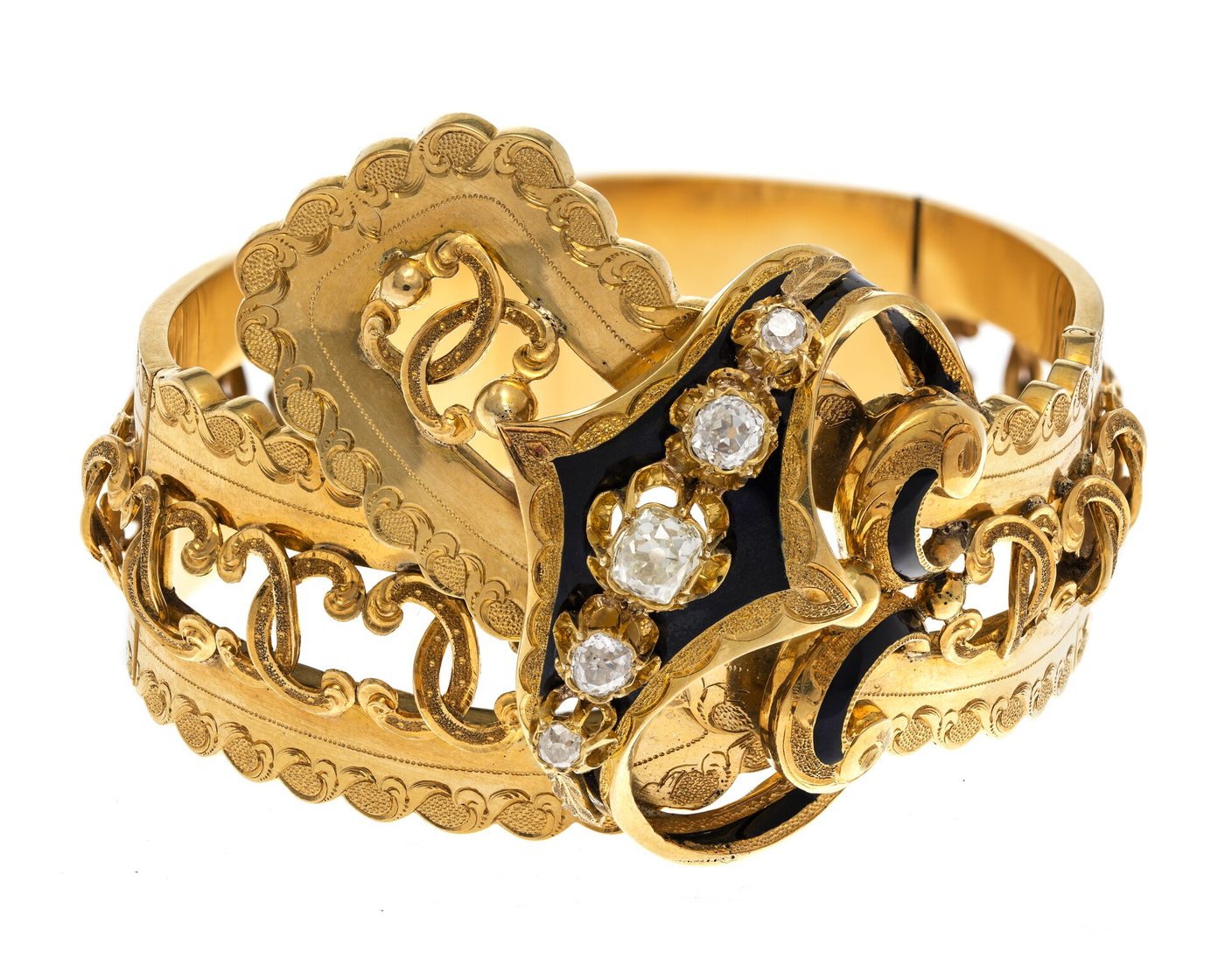
Bangles have a long history across many cultures and were worn in the West throughout the Georgian, Victorian and Edwardian periods, often in gold, sometimes hinged and set with gemstones at the front, and frequently worn in pairs or stacked sets - a fashion particularly associated with the Victorian period. Flexible bracelet forms were equally prominent across the same span: gem-set line bracelets, chain bracelets with a decorative clasp, and later, charm bracelets that grew especially popular from the early to mid-20th century as a way of accumulating small personal or sentimental charms over time. Both forms coexisted from 1700 to 1950 rather than one succeeding the other.
Where the Terms Overlap
Because a bangle is a type of bracelet, the two words aren’t always used as a strict either/or choice - a jewellery description might call a piece “a bangle bracelet” without contradiction, and general usage often uses “bracelet” to include bangles without further distinction. The distinction becomes useful specifically when construction matters - for identification, dating, or simply clarity - since a bangle’s rigid, clasp-free construction is a different piece of engineering from a hinged-clasp chain or line bracelet, even though both sit comfortably under the same broad “bracelet” umbrella.
Related Reading
For the dedicated entry on the rigid form, see What Is a Bangle?; for the broader category entry, see What Is a Bracelet?.
Read next
Compare
Georgian vs Victorian Jewellery
How Georgian and Victorian jewellery differ in settings, techniques and motifs, and why Victorian jewellery itself spans several distinct phases.
Eras
Victorian Jewellery
A guide to Victorian jewellery (1837-1901): the Romantic, Grand and Aesthetic periods, the Great Exhibition, gold rushes and 9ct gold, mourning and Whitby jet, archaeological revival, Scottish jewellery, and how to recognise each phase.

Jewellery
What Is a Bangle?
What a bangle is, how its rigid, typically clasp-free form differs from a flexible chain bracelet, and why it was often worn stacked in multiples.
Jewellery
What Is a Bracelet?
An overview of bracelets as a broad jewellery category, how wrist fashion shifted with sleeve length across the period, and how a bracelet differs from a bangle.

Jewellery
What Is a Buckle Brooch?
What a buckle brooch is, how it borrows the recognisable shape of a functional belt or shoe buckle, and why that form recurs across Georgian and Victorian jewellery.

Materials
Gold in Historical Jewellery
How gold standards, supply, colour and working methods changed from Georgian to 1940s jewellery - the 1854 standards, the gold rushes, bloomed and coloured gold, rolled gold - and gold's imitations.