Coral in Historical Jewellery
How Mediterranean red coral was fished, carved at Torre del Greco and Naples, sold by firms such as Phillips of London, worn in mid-Victorian fashion, and given to children as protection.
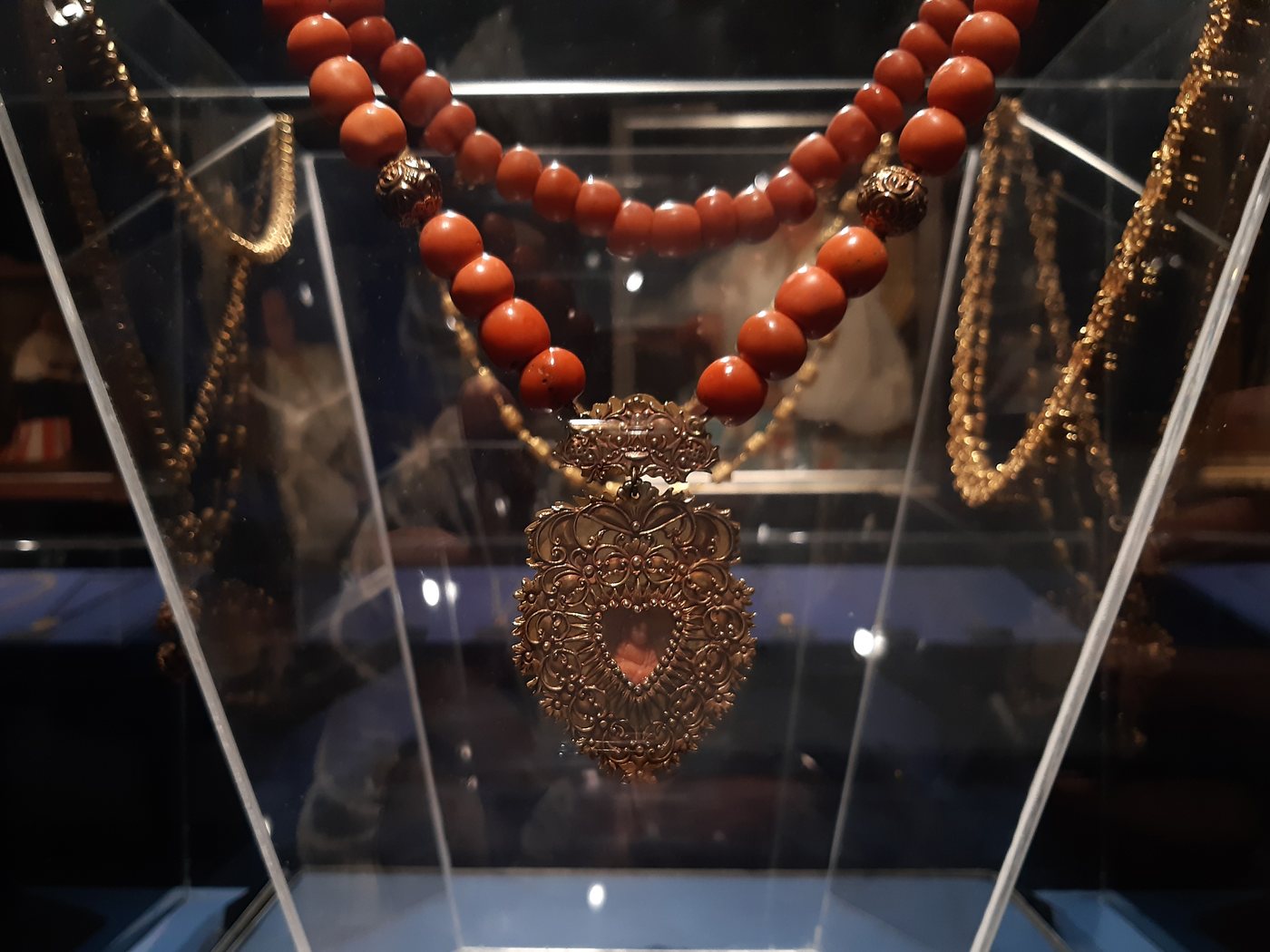
Coral - the pink-to-red skeletal material produced by certain marine organisms - has a long history as a jewellery material, carved into beads, cameos and figural ornaments or set with little alteration in its natural branching form.
What Coral Is
Precious coral used in jewellery is the hard skeleton, made of calcium carbonate, secreted by colonies of tiny marine animals, in shades from pale pink to deep red. The coral of historical European jewellery is almost all Corallium rubrum, the red coral of the Mediterranean, which grows in small branching trees on rocky seabeds. Its structure allows it to be carved, polished and drilled like other organic gem materials, taking a smooth, glossy finish that shows its colour well.
Ovid’s Metamorphoses gave coral a classical origin story: when Perseus laid the severed head of Medusa on seaweed, the plants hardened and turned red. The story was well known to educated buyers and helps explain coral’s reputation as a protective, almost magical material.
Fishing and Trade
Coral was fished off Sardinia, Corsica, Sicily, Naples and the North African coast. The traditional method used a heavy wooden cross hung with tangled netting, known in Italy as the ingegno, which was dragged along the seabed from a boat so that coral branches broke off and caught in the nets. Coral-fishing boats spent months away on the banks, and the work was hard and dangerous.
Before 1800 the main coral-working centres were Genoa, Livorno, Marseille and Trapani in Sicily. Livorno merchants, many of them from the city’s Jewish community, shipped large quantities of coral beads to India, where coral was in high demand, in exchange for diamonds and other goods.
Torre del Greco and Naples
In the 19th century the industry moved to the Bay of Naples. Torre del Greco, a fishing town south-east of Naples, had long supplied coral-fishing boats, and in 1805 a Marseille merchant, Paolo Bartolomeo Martin, set up the first coral-working factory there. By the middle of the century Torre del Greco was the world’s leading centre of coral cutting and carving, with workshops of bead makers, polishers and carvers, and it remains a centre of coral and cameo carving today. Naples itself had retail jewellers and carvers selling coral to Grand Tour travellers alongside lava and shell cameos.
How It Was Worked
Coral was cut with saws and files, shaped on grinding wheels, drilled with bow drills for beads, carved with small steel gravers, and polished. Carvers produced several kinds of work:
- Beads. Round, oval, faceted and barrel-shaped beads, graded by size and colour for necklaces and bracelets.
- Carved work. Cameos of classical heads, Bacchantes crowned with vine leaves, flowers, leaves and cherubs, carved in a manner closely related to shell and hardstone cameo carving. Large, deeply carved brooches of roses and foliage are typical of the 1850s and 1860s.
- Branch coral. Natural branches, trimmed and polished with little alteration and mounted in gold, or strung as tassels and clusters - an approach that prized the material’s form as much as any carver’s skill.
- Amulets. In Naples, small coral horns (cornicelli) and hands making protective gestures were worn against the evil eye.
Coral in Fashion, 1840s-1870s
Coral became one of the most fashionable materials in mid-Victorian Britain and Second Empire France. In London, Robert Phillips of Cockspur Street was the leading dealer in coral jewellery from the 1850s, importing carved coral from Naples and setting it in his own gold mounts; he was decorated by the King of Italy for his services to the Italian coral trade.
Fashion favoured deep red coral in the middle of the century. By the late 19th and early 20th centuries the pale pink coral called “angel skin” (pelle d’angelo) became more sought after, and coral from Japan and Taiwan entered the market. In the 1920s and 1930s coral returned in Art Deco jewellery by Cartier, Boucheron and others, set as beads and carved plaques against black onyx, jade and diamonds.
Coral and the Protection of Children
One of coral’s more distinctive historical associations is with infants and children. Small coral ornaments, and coral teething rings in particular, were a long-standing custom in Europe, tied to old folk beliefs that coral held protective properties, particularly for the young. In Renaissance paintings the infant Christ is sometimes shown wearing a branch or necklace of coral, as in Piero della Francesca’s Montefeltro Altarpiece in the Pinacoteca di Brera, Milan. In the 18th and 19th centuries a silver or gold rattle fitted with bells and a smooth coral stick for teething was a common christening present, and children were often painted wearing coral bead necklaces. This association reflects historical folk belief and material culture rather than any medical basis, and it is presented here purely as a documented custom of the period rather than as guidance relevant to how infants are cared for today.
A Note on Modern Restrictions
Coral is an animal-derived material, and many coral species are now subject to conservation concern, with international and national rules restricting the sale, import and export of coral, particularly certain protected species, in many jurisdictions today. This is a genuine and relevant consideration for anyone handling coral jewellery in the present day, though the details of current legal restrictions vary by species, jurisdiction and circumstance and are best confirmed through current official guidance; this page discusses coral purely in its historical context.
Period of Popularity
Coral jewellery appears across the Georgian and Victorian periods. In the 18th and early 19th centuries it was used mainly for beads, children’s jewellery and small mounted pieces; the great fashion for carved coral came in the 1840s to 1870s, followed by a decline in the 1880s and revivals in the early 20th century. It was worn in everything from simple beads to carved brooches and parures, and remained a familiar, moderately priced material through much of the 19th century.
How to Recognise It
Genuine coral typically shows a fine, slightly fibrous or striated grain under close inspection, a result of its natural growth structure, along with a colour that can vary somewhat across a single piece rather than being perfectly uniform. Common imitations include red glass, moulded plastics, dyed bone and dyed porous coral species; glass may show bubbles, and moulded pieces may show seams. These are general observations rather than certain tests, and confirming whether a piece is genuine coral, a treated or dyed substitute, or an imitation material generally requires assessment by a specialist experienced with organic gemstone materials.
Frequently Asked Questions
Was all historical coral jewellery carved? No - alongside carved cameos, beads and figural pieces, natural branch-form coral was also set with little alteration, valued for its own organic shape rather than for carved detail.
Can antique coral jewellery be bought and sold today? This depends on the coral species involved, its age, and the specific jurisdiction’s current wildlife and trade rules, which can restrict sale, import or export of coral even for historical items; current official guidance should always be consulted rather than assuming an antique piece is automatically exempt.
Read next
Eras
Georgian Jewellery
A guide to Georgian jewellery (1714-1837): Brazilian diamonds, closed-back foiled settings, rococo and Neoclassical styles, paste, cut steel and pinchbeck, sentimental miniatures, girandoles, rivières and Sévigné bows.
Eras
Victorian Jewellery
A guide to Victorian jewellery (1837-1901): the Romantic, Grand and Aesthetic periods, the Great Exhibition, gold rushes and 9ct gold, mourning and Whitby jet, archaeological revival, Scottish jewellery, and how to recognise each phase.
Gemstones
Garnets in Victorian Jewellery
Why Bohemian pyrope garnets from Třebenice, cut and set in Turnov and Prague, became a hallmark of Victorian jewellery, with carbuncles, demantoids, cluster settings and their meanings.

Gemstones
Pearls in Jewellery History
Natural pearls from the Gulf and Ceylon, seed-pearl work, Edwardian chokers and ropes, Mikimoto's cultured pearls of the 1910s-20s, imitation pearls, and pearls' bridal and mourning meanings.

Jewellery
What Is a Cameo?
What a cameo is, how it differs from an intaglio, and how carved shell and hardstone cameos moved from Grand Tour souvenirs to mass-produced Victorian jewellery.
Mourning & Sentimental
History of Wedding Rings
The plain gold band as the Western wedding ring: the Book of Common Prayer, the vena amoris tradition, 22ct Victorian bands, men's rings and wartime Utility rings in Britain.