What Is Chasing?
What chasing is, the punches, hammer and pitch bowl a chaser used, matted gold and 18th-century chased gold, and how chasing works alongside repoussé and differs from engraving.
Chasing is a metalworking technique in which small punches struck with a light hammer are used to refine, define and add fine surface detail to a design, working from the front of the metal.

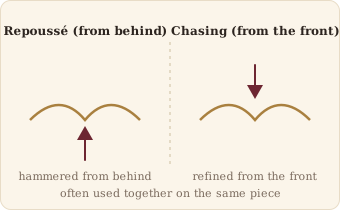
What Chasing Is Structurally
Chasing uses a range of small steel punches - shaped for lines, texture, or tight curves - struck with a light hammer to push and smooth the metal directly beneath the tool. Unlike engraving, which cuts away a sliver of metal, chasing removes no material; it moves and compresses the surface, sharpening edges, deepening lines and adding texture without piercing or thinning the sheet. Because it works the surface, chasing usually refines a design that already has some form - most often one raised in relief or cast - rather than building that form from nothing.
The Chaser’s Tools
A chaser kept a large set of punches, often made in the workshop from steel rod, and grouped them by purpose:
- Tracers (or liners) - blunt chisel-shaped punches that are walked along to make continuous lines and outlines.
- Modelling punches - rounded or flat-faced punches for shaping and smoothing the relief.
- Planishers - flat, polished punches that leave a smooth, bright surface.
- Matting tools - punches with a textured face, cut with fine dots or lines, that leave a grainy surface.
The chasing hammer has a broad, flat face for striking the punch and a slender, springy handle that usually ends in a rounded knob. The work was held on a bed of pitch - a mixture of pitch or resin with a filler such as plaster or brick dust and a little tallow or oil - in a heavy round-bottomed iron pitch bowl that sat on a leather or rope ring so that it could be tilted and turned. Pitch is firm enough to support the metal but yields slightly under the punch, and it can be warmed to release the work.
Chasing and Repoussé Together
Chasing is most often discussed alongside repoussé, the technique of hammering a design into relief from the reverse of a sheet of metal. Repoussé establishes the basic raised form, and chasing then works the front surface to sharpen edges and define fine detail such as the veins of a leaf or the features of a face. Because repoussé alone does not produce fine definition and chasing alone cannot raise a design from a flat sheet, the finest relief metalwork depended on both, even where only “repoussé” is mentioned as shorthand for the whole process.
How Chasing Was Executed
The chaser worked systematically across a design with a sequence of differently shaped punches, moving from broad forms to fine detail and periodically annealing the metal - softening it by heating - as repeated hammering hardened it. On cast work, chasing was used to clean up the rough surface left by the mould and to recut detail the casting had blurred, which is why 18th- and 19th-century catalogues often describe pieces as “cast and chased”.
Chasing in Jewellery, 1700-1950
- 18th century. London was an important centre of chased gold, particularly for watch cases, boxes and étuis decorated with figures and scrolls in high relief. The Swiss-born chaser and enameller George Michael Moser (1706-1783), who worked in London, was among the most admired; he became the first Keeper of the Royal Academy on its foundation in 1768.
- Regency and early Victorian, c.1820-1860. Chased and matted gold is one of the most characteristic surfaces of the period. Brooches, bracelets and seals in thin gold, often in two or more colours of gold, were worked with chased scrolls, flowers and shells against a matted, grainy ground that contrasts with the bright, planished high points.
- Mid-Victorian. Chasing finished much of the naturalistic gold and silver jewellery of the 1840s-1860s, from flower sprays to the scales of serpent bracelets.
- Arts and Crafts and Art Nouveau. Around 1900 designers who valued visible handwork, including the Guild of Handicraft and many Arts and Crafts silversmiths, used chasing and repoussé freely, often leaving tool marks visible.
Typical Jewellery Applications
Chasing appears as the finishing technique on repoussé lockets, brooches, buckles and similar pieces, adding petals, feathers, drapery folds and facial features to a raised design. It was also used alone on flat or cast metal, since a skilled chaser could produce lines and textures resembling engraving without cutting any metal.
How to Recognise It
Chased detail generally shows smooth-bottomed, slightly rounded lines and textures sitting on or within a relief form, with a burnished quality to the displaced metal rather than the sharp-edged, V-shaped groove of engraving. Under magnification, chased lines often show small overlapping steps where the tracer was moved along, and matting shows a regular repeated texture from the same punch face. On a repoussé piece, chasing gives sharp definition on the front while the hollow reverse shows a softer form - the two sides of a hand-finished piece should show markedly different levels of detail. Die-stamped imitations show the same detail, in reverse, on the back.
Frequently Asked Questions
Is chasing the same as engraving? No - engraving removes metal with a cutting tool, while chasing displaces existing metal with punches and a hammer; the two can produce visually similar linear effects but are different processes.
Can a piece be chased without ever having been worked in repoussé? Yes - chasing can be applied directly to flat, cast or simply formed metal to add surface detail and texture, though the two techniques are very often found together on relief jewellery.
Read next
Eras
Georgian Jewellery
A guide to Georgian jewellery (1714-1837): Brazilian diamonds, closed-back foiled settings, rococo and Neoclassical styles, paste, cut steel and pinchbeck, sentimental miniatures, girandoles, rivières and Sévigné bows.
Eras
Victorian Jewellery
A guide to Victorian jewellery (1837-1901): the Romantic, Grand and Aesthetic periods, the Great Exhibition, gold rushes and 9ct gold, mourning and Whitby jet, archaeological revival, Scottish jewellery, and how to recognise each phase.
Techniques
What Is Filigree?
What filigree is, how the wire was drawn and soldered, cannetille c.1815-40, Genoese, Maltese and Portuguese filigree, Castellani revival work and die-struck 1920s 'filigree' rings.
Techniques
What Is Granulation?
What granulation is, how granules were made and fixed, its Etruscan origins, the Castellani and Giuliano revival, and Littledale's 1930s reconstruction of the ancient method.

Techniques
What Is Repoussé?
What repoussé is, how it is hammered into relief from the reverse of a metal sheet, its use from Georgian watch cases to Arts and Crafts silver, and how it differs from stamping and casting.