What Is Repoussé?
What repoussé is, how it is hammered into relief from the reverse of a metal sheet, its use from Georgian watch cases to Arts and Crafts silver, and how it differs from stamping and casting.
Repoussé is a metalworking technique in which a design is hammered into relief from the reverse side of a sheet of metal, pushing the design outward so that it stands raised on the front. The name is French for “pushed back” or “pushed up”.

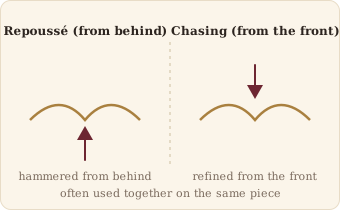
What Repoussé Is Structurally
A repoussé design begins as a flat, comparatively thin sheet of metal, usually gold, silver or a base metal intended for gilding. Working from behind, the metalworker uses hammers and rounded punches to push sections of the sheet outward, building a design in relief without removing or adding any metal - the sheet is displaced and stretched into a new form. The sheet is supported during this process on a bed of pitch, which holds it firm while allowing it to deform under the hammer, and it is annealed (softened by controlled heating) whenever the working hardens it.
How Repoussé Was Executed
The design was first drawn or scratched onto the sheet and outlined with a tracer from the front, so that the line showed on the back. The sheet was then set face-down in pitch, and the areas to be raised were punched out from behind with rounded embossing punches. When the relief was high enough, the pitch was warmed, the sheet removed and cleaned, and it was set face-up - often with the hollows filled with pitch to support them - so the background could be pushed back and the forms refined from the front. Workers often turned the piece several times, since pushing too hard at one point risked tearing or thinning the sheet.
Because repoussé alone tends to produce soft, rounded forms, fine repoussé work was very commonly finished by chasing, refining and sharpening the design from the front. The two techniques are so often used in sequence that they are frequently discussed as a pair, even though they work the metal from opposite sides.
Typical Jewellery Applications
Repoussé appears on lockets and brooches with raised floral, foliate or figural fronts, on buckles and clasps with bold relief ornament, and on the backs and borders of larger pieces where a raised pattern adds interest without weight. Because it can be done in thin sheet, it suited jewellery intended to look substantial while remaining light to wear and economical to make.
Repoussé Through the Period
- 18th century. The outer cases of English pair-cased watches were often decorated with repoussé and chased scenes from mythology and the Bible, in gold or gilt metal, and the same workshops made chatelaines and étuis in a similar style. London repoussé chasers of this kind were highly regarded across Europe.
- c.1820-1850. Thin sheet gold, worked in repoussé and chased, formed the large, hollow, lightweight brooches, bracelet clasps and cannetille-decorated parures of the late Georgian and early Victorian years, at a time when gold was expensive and fashion favoured large ornaments.
- Archaeological revival. The Castellani and Giuliano workshops used repoussé for the gold sheet elements of their ancient-style jewellery, following Greek and Etruscan practice; see Archaeological Revival Jewellery.
- Arts and Crafts, c.1890-1914. Designers who rejected machine production revived hand repoussé in silver and copper. C.R. Ashbee’s Guild of Handicraft, founded in London in 1888, and later the partnership of Omar Ramsden and Alwyn Carr made repoussé silver in which hammer and punch marks were deliberately left visible as evidence of handwork; see Arts and Crafts Jewellery.
Repoussé Versus Stamping
From the late 18th century the effect of repoussé was increasingly imitated by die-stamping. Matthew Boulton’s Soho Manufactory in Birmingham, opened in the 1760s, stamped buttons, buckles and small metal “toys” in steel dies, and by the mid-19th century Birmingham manufacturers were producing large quantities of stamped gold and gilt jewellery. A stamping press forced thin sheet between a pair of steel dies in a single blow, producing identical raised designs far faster than hand repoussé. Stamped work was often finished with a little hand chasing, which can make the two hard to tell apart from the front.
Repoussé Versus Casting
A cast design is formed by pouring molten metal into a mould, where it solidifies in its finished raised shape; a repoussé design starts as flat sheet metal and is hammered into relief afterward. Cast pieces are typically solid or heavier for their apparent size and can be reproduced from the same mould, while repoussé pieces are hollow-backed, light, and each bears the individual variation of having been hammered up separately.
How to Recognise It
Look for a raised front design paired with a hollow, often irregular reverse, which may still show individual punch marks. Hand repoussé shows small differences between repeated motifs and a back that does not exactly mirror the front, because the front has been refined by chasing. Stamped work tends to show a back that is a smooth, exact reverse of the front, with repeated motifs identical, and its relief is usually shallower and softer. Fine repoussé with crisp chased detail is generally associated with higher-quality work.
Frequently Asked Questions
Is repoussé the same as embossing? The terms are related and sometimes used loosely, but “repoussé” generally refers to the hand-hammered technique described here, while “embossing” is often used more broadly, including for stamped or pressed relief.
Can repoussé be identified without examining the back of a piece? Not reliably - the hollow, hand-worked reverse is one of the clearest indicators of repoussé, so a full assessment needs access to both sides.
Read next
Eras
Georgian Jewellery
A guide to Georgian jewellery (1714-1837): Brazilian diamonds, closed-back foiled settings, rococo and Neoclassical styles, paste, cut steel and pinchbeck, sentimental miniatures, girandoles, rivières and Sévigné bows.
Eras
Victorian Jewellery
A guide to Victorian jewellery (1837-1901): the Romantic, Grand and Aesthetic periods, the Great Exhibition, gold rushes and 9ct gold, mourning and Whitby jet, archaeological revival, Scottish jewellery, and how to recognise each phase.

Techniques
What Is Chasing?
What chasing is, the punches, hammer and pitch bowl a chaser used, matted gold and 18th-century chased gold, and how chasing works alongside repoussé and differs from engraving.
Techniques
What Is Filigree?
What filigree is, how the wire was drawn and soldered, cannetille c.1815-40, Genoese, Maltese and Portuguese filigree, Castellani revival work and die-struck 1920s 'filigree' rings.
Techniques
What Is Granulation?
What granulation is, how granules were made and fixed, its Etruscan origins, the Castellani and Giuliano revival, and Littledale's 1930s reconstruction of the ancient method.