What Is Piercing?
What piercing is, how openwork was sawn by hand or struck with a fly press, its use from Georgian galleries to Edwardian platinum and Victorian name brooches, and how it compares with filigree.
Piercing is a metalworking technique in which openwork patterns or shapes are cut all the way through a sheet of metal, removing material to leave open spaces within the design rather than a continuous solid surface.

What Piercing Is Structurally
Piercing works on a flat or gently shaped sheet of metal, from which sections are cut away entirely, leaving open gaps wherever the design calls for them. In fine work the cutting was done with a very fine saw guided around the outline of each opening. Simpler openings were made by drilling, by cutting with small chisels and files, or, from the late 18th century, by striking the sheet with a shaped steel punch in a press. Whatever the method, the result is a design with light passing through the metal itself rather than merely reflecting off a textured surface.
How Piercing Was Executed
Hand-sawing. The jeweller’s piercing saw is a U-shaped steel frame holding a very fine, toothed blade under tension. To cut an internal opening, the jeweller drilled a small starting hole inside it, unclamped one end of the blade, threaded it through, re-tensioned it and sawed around the outline, with the sheet supported on a wooden bench pin with a V-shaped notch. The saw cuts on the down-stroke and is kept upright so the edge is square. Cut edges were then cleaned with fine needle files and polished. The work was slow, and thin bridges of metal between openings could easily be bent or broken.
Press piercing. From around the 1770s, silversmiths in Sheffield, Birmingham and London adopted the fly press - a screw press turned by a weighted arm - fitted with hardened steel punches and matching dies, which could cut a whole row of identical openings in a single stroke. It was first used mainly for silver baskets, coasters and Sheffield plate, but the same method was applied to buckles, brooch frames and other small metalwork. Press piercing made repeated patterns cheap, and by the 19th century most inexpensive pierced jewellery was made this way.
Typical Jewellery Applications
Piercing appears in openwork brooches and pendants, where scrollwork, foliage or a figural or geometric motif is cut through a metal plate so that the background shows through. It was used for galleries and settings, where a pierced framework lets light reach a gemstone, and for pierced borders and panels that lighten a larger piece. Characteristic uses include:
- Georgian settings. The galleries beneath 18th- and early 19th-century collets, and the frames of shoe buckles set with paste or cut steel, were often pierced with simple scroll or lattice patterns.
- Victorian name and message brooches. Silver brooches of the 1880s and 1890s often carried a woman’s name - “Mary”, “Ada”, “Florence” - or a word such as “Mizpah” or “Baby”, either cut out of the sheet by piercing or applied over a pierced ground.
- Edwardian platinum. Around 1900-1914 platinum’s strength allowed jewellers to saw-pierce very fine lace-like patterns in thin sheet for brooches, pendants, tiaras and the plaques of dog-collar necklaces, the pierced openwork forming the background to millegrain-edged diamond settings. Cartier and other Paris and London houses used this technique extensively in the garland style.
- Art Nouveau and Arts and Crafts. Around 1900 designers used pierced silver and gold to make the outline and negative space part of the design - whiplash curves, foliage and figures cut through the sheet - in work by Liberty & Co. and many Art Nouveau jewellers.
- 1920s-1930s rings. The heads and sides of many Art Deco engagement rings were pierced with geometric openwork, either sawn by hand or, especially in American mass-produced rings, die-struck.
Piercing Versus Filigree
Piercing is frequently compared with filigree, since both produce an airy, openwork effect. Filigree builds a design up from fine wire, twisted, coiled and soldered into a framework where the open spaces are the gaps between the wire elements. Piercing starts from a solid sheet and removes material from it. The two were often combined - a pierced sheet providing structure, with filigree or other wirework added as decoration - so a piece showing both is not unusual.
How to Recognise It
Look for gaps cut through the metal itself, with the surrounding solid areas forming the pattern, as distinct from a solid surface textured, engraved or chased to suggest depth. Hand-sawn piercing typically shows slightly varied openings and, under magnification, fine vertical saw or file marks on the inner edges. Press-pierced and die-struck work tends to show identical, perfectly repeated openings, edges with a slight burr or rounding on one face where the punch broke through, and simpler shapes.
Frequently Asked Questions
Is all pierced jewellery also filigree? No - piercing and filigree are distinct techniques that happen to produce a similar open appearance; a piece can be pierced without any wirework, and filigree pieces are not pierced in this sense, since they have no solid sheet to cut through.
Does piercing weaken a piece of jewellery? It can, since removing metal reduces the material available to bear stress, which is why heavily pierced designs were often given a solid frame or border to maintain their strength. Platinum’s strength is one reason Edwardian jewellers could pierce so finely.
Read next
Eras
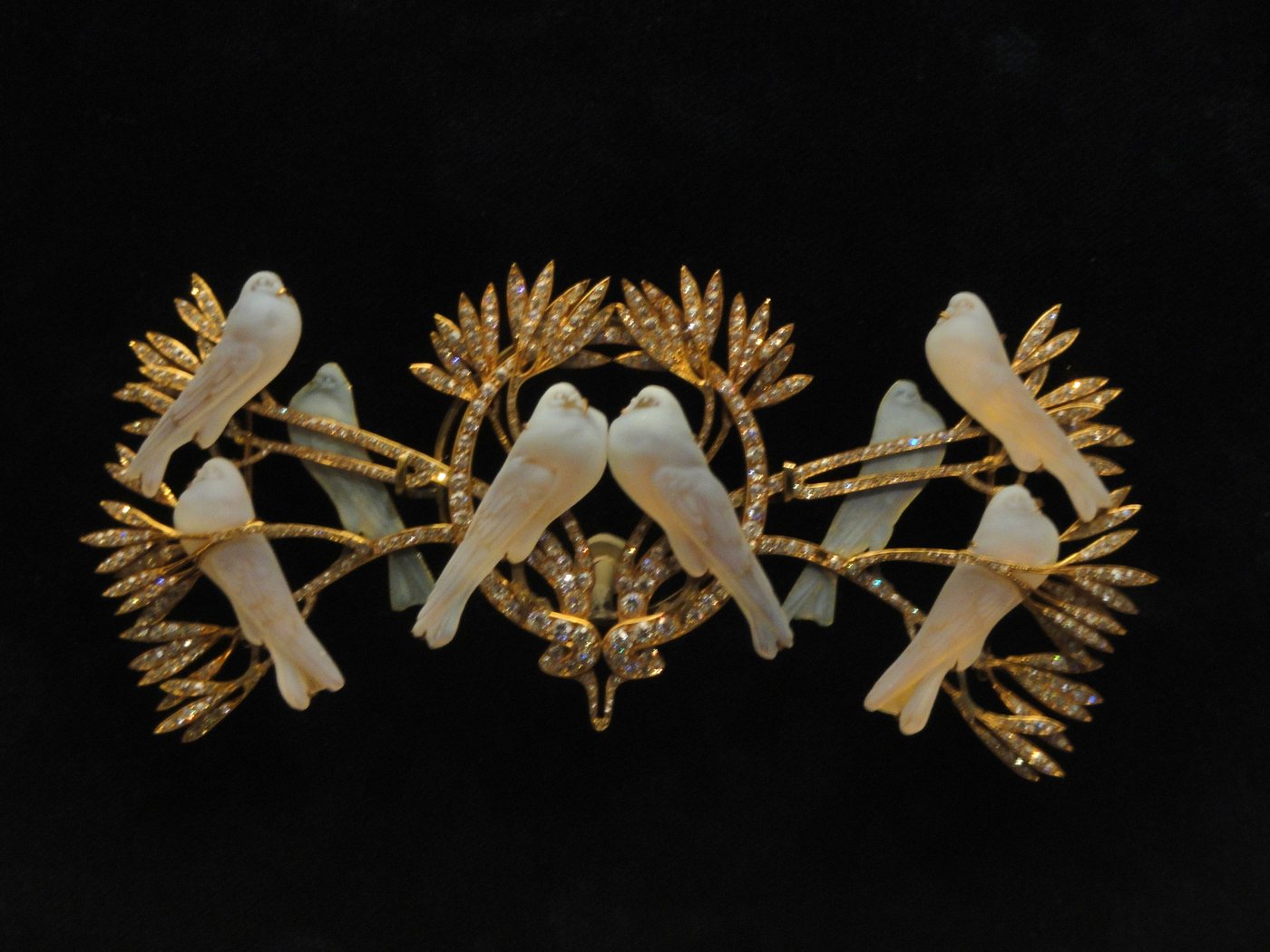
Art Nouveau Jewellery
A guide to Art Nouveau jewellery (c.1890-1910): René Lalique and Gulbenkian, Fouquet and Mucha, Vever and Gaillard, plique-à-jour and horn, Jugendstil, Liberty's Cymric range, Tiffany, and the mass-produced silver that spread the style.
Eras
Georgian Jewellery
A guide to Georgian jewellery (1714-1837): Brazilian diamonds, closed-back foiled settings, rococo and Neoclassical styles, paste, cut steel and pinchbeck, sentimental miniatures, girandoles, rivières and Sévigné bows.
Eras
Victorian Jewellery
A guide to Victorian jewellery (1837-1901): the Romantic, Grand and Aesthetic periods, the Great Exhibition, gold rushes and 9ct gold, mourning and Whitby jet, archaeological revival, Scottish jewellery, and how to recognise each phase.
Techniques
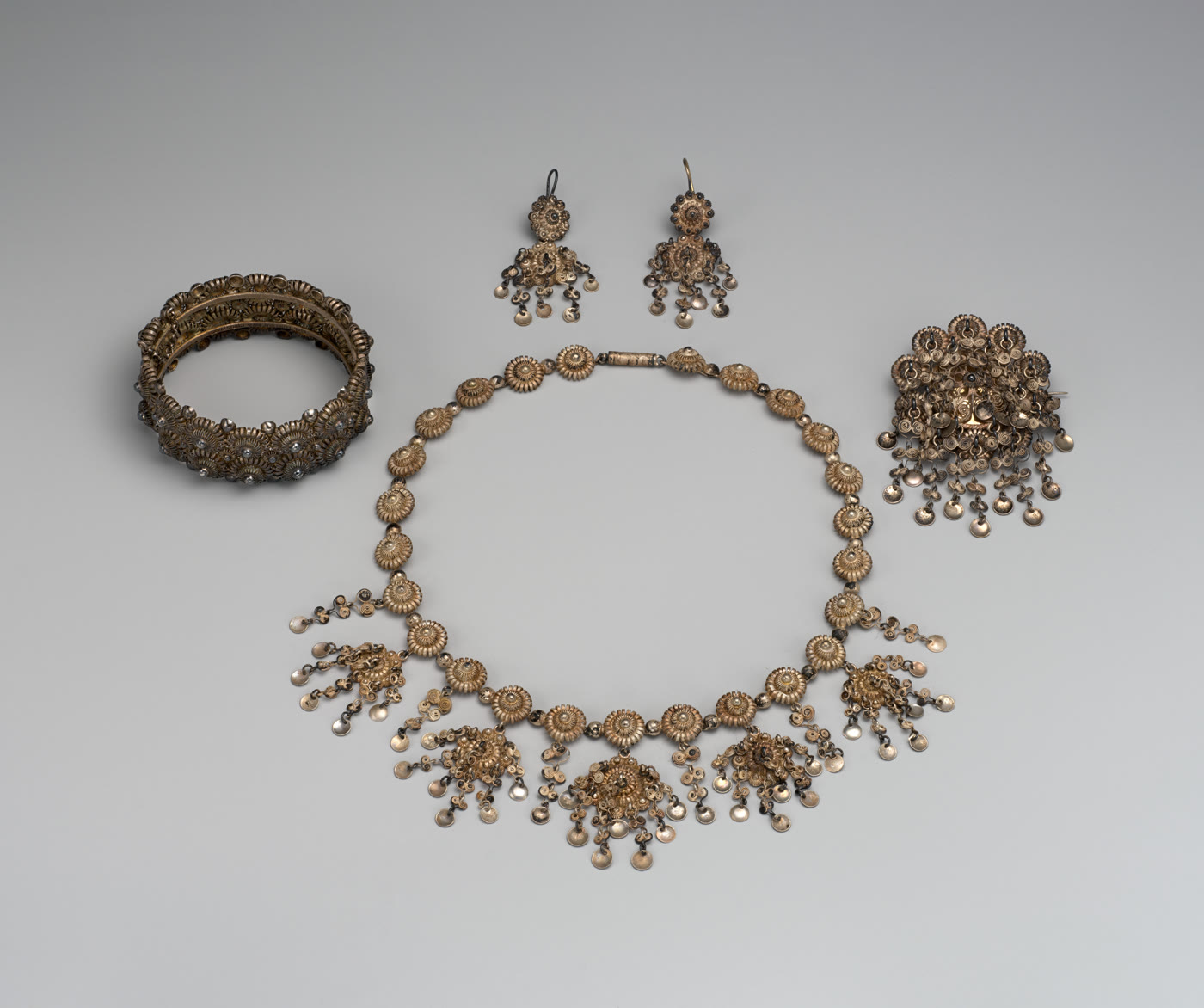
What Is Filigree?
What filigree is, how the wire was drawn and soldered, cannetille c.1815-40, Genoese, Maltese and Portuguese filigree, Castellani revival work and die-struck 1920s 'filigree' rings.
Techniques
What Is Granulation?
What granulation is, how granules were made and fixed, its Etruscan origins, the Castellani and Giuliano revival, and Littledale's 1930s reconstruction of the ancient method.