What Is Champlevé?
What champlevé enamelling is, from Limoges and Mosan medieval work to Georgian mourning rings, Gothic and Renaissance revival jewellery and Liberty silver, and how it differs from cloisonné.
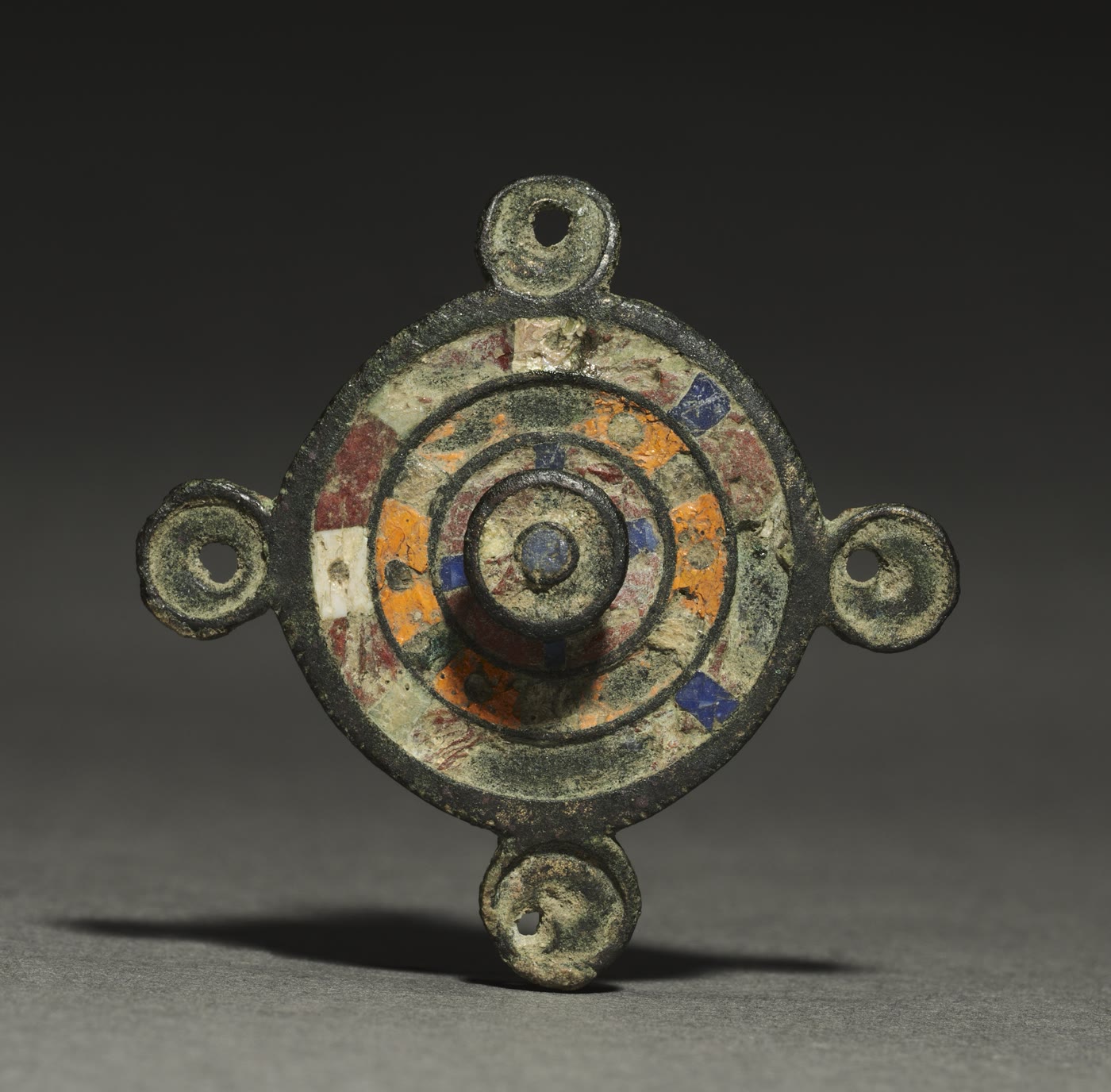
Champlevé is an enamelling technique in which recessed cells are carved, engraved or etched directly into a solid metal base and then filled with enamel and fired, leaving the surrounding uncarved metal surface visible between the enamelled areas. The name is French for “raised field”, referring to the metal left standing around the cells.
What Champlevé Is Structurally
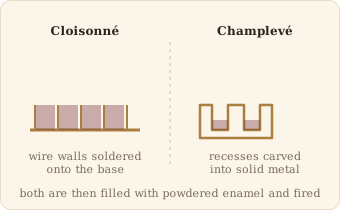
Unlike enamelling methods that build up a cell structure on top of a metal surface, champlevé forms its cells by removing metal from a solid base - carving, engraving, chasing or etching out recessed channels and hollows that follow the design. Powdered enamel is then packed into these recesses and fired until it fuses into a smooth, glassy fill. Because the surrounding metal is left at its original level, it remains visible as a border around each enamelled area, and it often carries its own engraved, gilded or textured detail.
How Champlevé Was Made
The goldsmith cut the recesses with gravers and scorpers (chisel-like cutting tools), leaving them slightly roughened or undercut so that the enamel would key into the metal. From the 19th century, recesses were often etched with acid instead: the areas to remain raised were protected with an acid-resistant varnish, and the exposed metal was eaten away. Die-stamping could also produce the recesses in quantity on thin sheet. Enamel, ground to a fine powder and washed, was laid in with a small spatula or quill, dried and fired; because enamel shrinks as it fuses, several fillings and firings were usually needed before the surface was ground level with the metal and polished.
Champlevé enamel is usually opaque. When translucent enamel is fired over a recess whose floor has been engraved or chased in low relief, so that the design shows through in varying depths of colour, the technique is called basse-taille, a related method developed in Italy in the late 13th century and widely used in Italy and France in the 14th.
Champlevé Versus Cloisonné
Champlevé is most often discussed alongside cloisonné, another cell-based enamelling technique with a broadly similar compartmentalised appearance. Champlevé’s cells are carved or etched into a solid base, so the walls between colours are the uncarved metal left standing, whereas cloisonné’s cells are built up from thin wire or metal strips fixed onto the surface. See the cloisonné page for a side-by-side comparison.
History in European Enamelwork
Champlevé was used on Celtic and Roman-period bronze brooches and harness fittings, including the enamelled bronze brooches of Roman Britain. Its great medieval centres were the Meuse and Rhine valleys, where the goldsmith Nicholas of Verdun completed the enamelled panels of a pulpit at Klosterneuburg Abbey near Vienna in 1181 (remade as the Verdun Altar in the 1330s), and Limoges in central France, whose workshops produced large numbers of enamelled gilt-copper reliquaries, caskets and crosiers in the 12th and 13th centuries. The Victoria and Albert Museum and the British Museum both hold substantial collections of Limoges champlevé.
In jewellery after 1700, champlevé was used in several distinct ways:
- Georgian mourning rings. The inscriptions on 18th-century mourning rings - the name, date of death and age of the deceased - were often cut into the gold and filled with black enamel, or white enamel for an unmarried person. Bands of black enamel with gold lettering continued on Victorian memorial rings and brooches.
- Gothic Revival. From the 1840s, designers working in a medieval manner revived enamelled gold. Jewellery designed by A.W.N. Pugin and made by John Hardman & Co. of Birmingham was shown in the Medieval Court at the Great Exhibition of 1851.
- Renaissance Revival. In the 1860s-1890s, London and Paris jewellers including Carlo Giuliano used champlevé alongside painted enamel in jewels based on 16th-century designs, often in white, black, blue and green.
- Liberty & Co. The “Cymric” silver and gold jewellery launched by Liberty & Co. in London in 1899, much of it designed by Archibald Knox, used blue-green champlevé enamel within Celtic-inspired interlace.
- Art Deco. Thin lines and borders of black enamel framing diamonds and coloured stones, characteristic of Art Deco jewellery by Cartier and other Paris houses in the 1920s, were usually set into recesses in the platinum or gold.
How to Recognise It
Look for broader, solid-metal borders between areas of colour, generally wider and less uniformly fine than the wire outlines typical of cloisonné, with the uncarved metal sometimes carrying its own engraved detail. Under magnification, the metal separating champlevé’s cells reads as a continuous carved surface rather than as a separately applied wire on top of the base. Wear is often a further clue: on rings and much-handled pieces, enamel tends to survive in the recesses while the raised metal is polished smooth around it.
Frequently Asked Questions
Can champlevé and cloisonné appear on the same piece? It is possible for a piece to combine carved and wire-built cells, and some medieval work does so, though most jewellery uses one method consistently across a design.
Is champlevé older than cloisonné? Both techniques have very long histories and neither can be reliably said to predate the other in general terms; champlevé is particularly associated with Celtic, Roman and medieval European enamelwork, while cloisonné has an even broader and more geographically dispersed history.
Read next
Eras
Georgian Jewellery
A guide to Georgian jewellery (1714-1837): Brazilian diamonds, closed-back foiled settings, rococo and Neoclassical styles, paste, cut steel and pinchbeck, sentimental miniatures, girandoles, rivières and Sévigné bows.
Eras
Victorian Jewellery
A guide to Victorian jewellery (1837-1901): the Romantic, Grand and Aesthetic periods, the Great Exhibition, gold rushes and 9ct gold, mourning and Whitby jet, archaeological revival, Scottish jewellery, and how to recognise each phase.
Techniques
What Is Cloisonné?
What cloisonné enamelling is, from Byzantine and Chinese work to Falize's Japanese-style jewellery, Meiji Japan and Russian silver, plus plique-à-jour, and how it differs from champlevé.
Techniques
What Is Filigree?
What filigree is, how the wire was drawn and soldered, cannetille c.1815-40, Genoese, Maltese and Portuguese filigree, Castellani revival work and die-struck 1920s 'filigree' rings.

Techniques
What Is Guilloché Enamel?
What guilloché enamel is, how the rose engine and straight-line engine cut the ground, Fabergé and its workmasters, Edwardian and 1920s use, and how it differs from cloisonné and champlevé.

Eras
Gothic Revival Jewellery
How medieval architecture and romance shaped 19th-century jewellery: French 'cathedral style' of the 1820s-30s, Berlin iron tracery, A.W.N. Pugin's jewellery for the 1851 Great Exhibition, and the quatrefoils, crosses and black-letter inscriptions to look for.