Gothic Revival Jewellery
How medieval architecture and romance shaped 19th-century jewellery: French 'cathedral style' of the 1820s-30s, Berlin iron tracery, A.W.N. Pugin's jewellery for the 1851 Great Exhibition, and the quatrefoils, crosses and black-letter inscriptions to look for.
Gothic revival jewellery took its forms from medieval architecture and metalwork - pointed arches, tracery, quatrefoils, crosses and heraldry - and its mood from the 19th century’s romance with the Middle Ages. It flourished from the 1820s to the 1870s, overlapping with Victorian naturalism and the archaeological revival.

Romance and the Middle Ages
The novels of Sir Walter Scott, beginning with Waverley in 1814 and Ivanhoe in 1819, made the medieval past fashionable across Europe. In France, the taste known as the style troubadour and later the style cathédrale brought Gothic ornament into furniture, bookbinding and jewellery in the 1820s and 1830s: brooches and bracelets with pointed arches, tracery and small figures in niches, often in gold, enamel and gem-set cabochons. The Paris goldsmith François-Désiré Froment-Meurice became the best-known maker of jewellery in a romantic Gothic and Renaissance manner, much admired by writers including Victor Hugo.
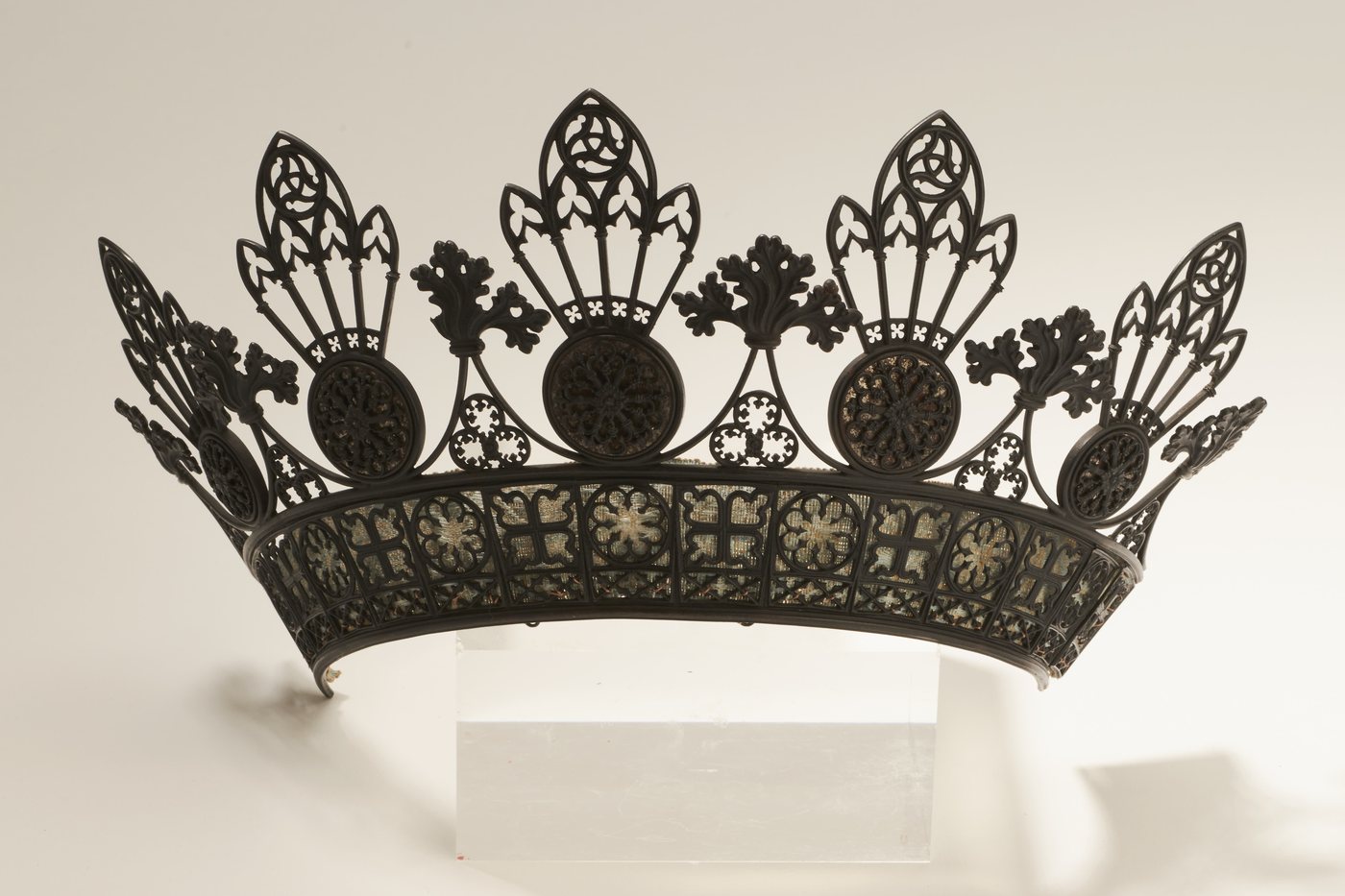
In Prussia, the Berlin iron foundries cast delicate jewellery with Gothic tracery from the 1820s, and the architect Karl Friedrich Schinkel designed Gothic work for them.
Pugin and the 1851 Great Exhibition
In Britain, the architect A.W.N. Pugin, designer of much of the interior of the new Palace of Westminster, argued that Gothic was the only truly Christian architecture. Pugin designed jewellery as well as buildings: a set of jewels first intended for his fiancée Helen Lumsdaine and given instead to his bride, Jane Knill, in 1848, made by John Hardman & Co. of Birmingham, with enamelled gold, gems and pearls in Gothic forms. Pugin’s jewellery was shown in the Medieval Court that he organised at the Great Exhibition of 1851, which helped spread the style. See Victorian Jewellery.
Ecclesiastical and Heraldic Jewellery
Gothic revival jewellery often carried religious meaning: crosses, sacred monograms, quatrefoils and inscriptions in black-letter (Gothic) script. Heraldic jewellery - brooches and lockets with coats of arms, crests and mottoes in enamel - fitted the same taste for chivalry and ancestry. Later in the century, the architect William Burges designed jewellery and metalwork in an exuberant medieval style.
Techniques
The revival encouraged a return to medieval techniques, especially champlevé and painted enamel, cabochon stones in high collets, and pierced and engraved gold. Black-letter inscriptions were often enamelled into the surface.
How to Recognise Gothic Revival Jewellery
- Pointed arches, tracery, trefoils and quatrefoils.
- Crosses, sacred monograms and black-letter inscriptions.
- Bright champlevé enamel in blue, red, green and white.
- Cabochon stones and pearls in raised settings, rather than faceted stones.
- Heraldic devices.
Gothic revival details continued to appear in mourning and religious jewellery long after the main fashion had passed, so a cross or black-letter inscription alone is not enough to date a piece.
Read next
Eras
Regency Jewellery
A guide to Regency jewellery (c.1795-1837): Empire fashion, cameos and Neoclassical parures at Napoleon's court, coloured gold and cannetille, Berlin iron and cut steel, acrostic rings, and memorial jewellery for Nelson and Princess Charlotte.
Eras
Victorian Jewellery
A guide to Victorian jewellery (1837-1901): the Romantic, Grand and Aesthetic periods, the Great Exhibition, gold rushes and 9ct gold, mourning and Whitby jet, archaeological revival, Scottish jewellery, and how to recognise each phase.

Materials
Enamel in Jewellery
What enamel is, how it was fired, and how cloisonné, champlevé, guilloché, painted enamel and plique-à-jour relate - with the makers and fashions of enamel jewellery from 1700 to the 1930s.
Techniques
What Is Champlevé?
What champlevé enamelling is, from Limoges and Mosan medieval work to Georgian mourning rings, Gothic and Renaissance revival jewellery and Liberty silver, and how it differs from cloisonné.

Eras
Archaeological Revival Jewellery
How the Castellani of Rome, Carlo Giuliano in London and others revived Etruscan, Greek and Roman goldwork in the 19th century - granulation, filigree, mounted coins and scarabs - and how to recognise revival jewellery and its mass-produced imitations.

Materials
What Is Berlin Iron Jewellery?
How the Royal Prussian Iron Foundry cast delicate black iron jewellery in the early 19th century, the 1813 'Gold gab ich für Eisen' campaign, Neoclassical and Gothic designs, and how to recognise Berlin iron today.