What Is Cloisonné?
What cloisonné enamelling is, from Byzantine and Chinese work to Falize's Japanese-style jewellery, Meiji Japan and Russian silver, plus plique-à-jour, and how it differs from champlevé.
Cloisonné is an enamelling technique in which thin metal wires or strips are fixed onto a base to form small compartments, called cloisons, which are then filled with different colours of enamel and fired, leaving the wire framework visible in the finished design.
What Cloisonné Is Structurally
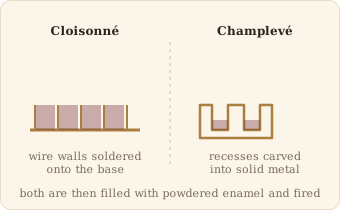
A cloisonné piece begins with a metal base, typically gold, silver or copper, onto which fine wire or thin flattened strips of metal are bent to shape and set on edge, forming a network of small compartments - cloisons, from the French for “compartments” - that follow the outline of the design. Powdered enamel of different colours is packed into each cell and fired until it fuses into a smooth, glassy fill. The wire walls stay visible in the finished piece as fine metal outlines between each area of colour.
How Cloisonné Was Made
The wire was usually flattened into a thin ribbon so that it would stand on edge. The enameller bent it with tweezers and pliers to follow a drawing transferred to the base, then fixed it in place. In Western and much Chinese work the wires were soldered to the base; in much Japanese work they were held with a vegetable glue and fixed by the first firing of enamel. The base was often given a thin coat of enamel first, both to hold the wires and to stop the metal warping.
Enamel was ground, washed and packed into each cell with a fine spatula or brush. Because enamel shrinks as it fuses, several fillings and firings were needed to build up a level surface. The piece was then ground flat with abrasive stones so that the top edges of the wires and the enamel sat flush, and the exposed wire edges were polished and, on copper, often gilded.
History
Cloisonné enamel developed in the eastern Mediterranean in antiquity and reached its first great flowering in the Byzantine Empire, where gold cloisonné plaques with very fine gold strips decorated icons, crowns and reliquaries; many are set into the Pala d’Oro altarpiece in St Mark’s, Venice. In Anglo-Saxon England, the 9th-century Alfred Jewel in the Ashmolean Museum, Oxford, has a cloisonné enamel figure under rock crystal. A related early technique set flat-cut garnets in gold cells rather than enamel, as in the 7th-century Sutton Hoo ship burial finds, discovered in 1939 and now in the British Museum.
Chinese cloisonné, on copper, flourished from the 15th century, and Chinese export cloisonné was well known in Europe by the 19th century. In Japan, cloisonné (shippō) was transformed in the Meiji period (1868-1912); Namikawa Yasuyuki in Kyoto made very fine wired work, while Namikawa Sōsuke in Tokyo developed a “wireless” technique in which most of the wires were removed before firing, so that colours blend like a painting.
Cloisonné in 19th- and Early 20th-Century Jewellery
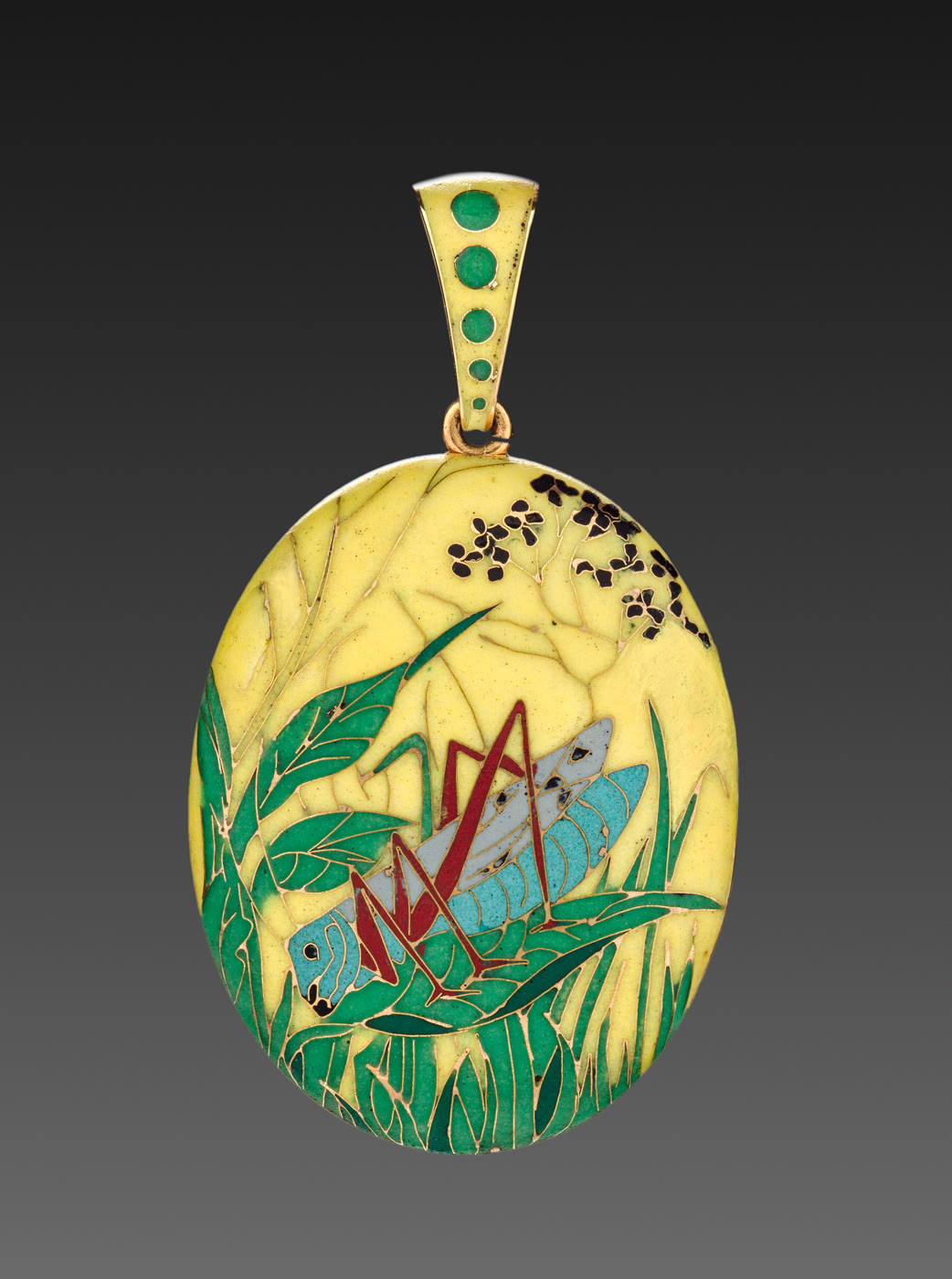
- Paris and Japonisme. After Japanese art was shown at the international exhibitions of the 1860s, the Paris goldsmith Alexis Falize, working with the enameller Antoine Tard, made gold cloisonné jewellery in a Japanese and Chinese manner from the late 1860s, with birds, flowers and insects in small bright cells. The silversmiths Christofle also produced cloisonné in this period.
- Revival styles. Byzantine- and medieval-style cloisonné appeared in Victorian revival jewellery, part of the period’s broader interest in historical and foreign decoration.
- Russia. Moscow silversmiths including Pavel Ovchinnikov and Ivan Khlebnikov, and Feodor Rückert, who supplied Fabergé, made silver-gilt cloisonné in the Old Russian style from the 1870s to 1917, often filling the spaces with dense twisted-wire scrolls and shaded enamel colours.
- Souvenir and costume pieces. From the late 19th century inexpensive cloisonné brooches, buttons and pendants on copper or silver were made in quantity in China and Japan for export.
Plique-à-Jour
Plique-à-jour is cloisonné without a back. The cells are built on a temporary base, or pierced through a sheet of metal, and filled with translucent enamel; the base is then removed, so that light passes through the enamel like a stained-glass window. It requires very careful control, since the enamel is held only by the cell walls. It was used by René Lalique and other Art Nouveau jewellers around 1900 for insect wings, leaves and flowers, and by Norwegian silversmiths such as David Andersen and J. Tostrup on spoons, bowls and brooches.
Cloisonné Versus Champlevé
The technique most often confused with cloisonné is champlevé, another cell-based enamelling method with a broadly similar appearance. The two differ in how their cells are formed, as the table below sets out.
| Property | Cloisonné | Champlevé |
|---|---|---|
| How cells are formed | Wire or metal strips soldered onto a base, built up on top of the surface | Recesses carved, engraved or etched directly into a solid metal base |
| Cell walls | Thin applied wire, visible as fine soldered outlines | The base metal itself, left standing between carved-out recesses |
| Typical wall appearance | Delicate, even, wire-like lines | Broader, can vary more in width with the carving |
| Underlying requirement | A soldering step to build the cell framework | A carving or engraving step to remove metal for the cells |
How to Recognise It
Look for fine, even, wire-like metal outlines separating each area of colour, with the wire generally consistent in width and following the design closely. Under magnification, cloisonné wire sits flush with or slightly proud of the enamel surface as a distinct line, rather than appearing as a broader carved channel of bare metal, which would suggest champlevé. Small pits and bubbles in the enamel are common in cheaper export work.
Frequently Asked Questions
Is cloisonné the same as micromosaic? No - micromosaic is built from many tiny individually set pieces of coloured glass, while cloisonné uses fired enamel held within a wire framework; the two can look related but use different materials and methods.
Does visible wire always mean genuine cloisonné? Not necessarily on its own - printed, moulded and resin imitations of the cloisonné look were also produced, particularly on later and lower-cost pieces, so a full assessment of construction generally benefits from close examination.
Read next
Eras
Victorian Jewellery
A guide to Victorian jewellery (1837-1901): the Romantic, Grand and Aesthetic periods, the Great Exhibition, gold rushes and 9ct gold, mourning and Whitby jet, archaeological revival, Scottish jewellery, and how to recognise each phase.
Techniques
What Is Champlevé?
What champlevé enamelling is, from Limoges and Mosan medieval work to Georgian mourning rings, Gothic and Renaissance revival jewellery and Liberty silver, and how it differs from cloisonné.
Techniques
What Is Filigree?
What filigree is, how the wire was drawn and soldered, cannetille c.1815-40, Genoese, Maltese and Portuguese filigree, Castellani revival work and die-struck 1920s 'filigree' rings.
Techniques
What Is Granulation?
What granulation is, how granules were made and fixed, its Etruscan origins, the Castellani and Giuliano revival, and Littledale's 1930s reconstruction of the ancient method.

Techniques
What Is Guilloché Enamel?
What guilloché enamel is, how the rose engine and straight-line engine cut the ground, Fabergé and its workmasters, Edwardian and 1920s use, and how it differs from cloisonné and champlevé.