Ivory in Historical Jewellery
How ivory was used in jewellery - miniatures on ivory, Dieppe and Erbach carving, Canton export work, Art Nouveau ivory - how to tell it from bone and celluloid, and why its trade is restricted today.
Ivory - the hard, fine-grained dentine that forms the tusks and teeth of certain animals - was worked into beads, small carved ornaments and miniature portrait supports between 1700 and 1950, valued for its warm colour, its capacity to take a smooth polish, and the fine detail it allowed a skilled carver to achieve.

What Ivory Is
Ivory is a dense organic material, structurally related to tooth and bone, distinguished by a fine, close grain that takes carving, engraving and polishing exceptionally well. Elephant ivory, from Africa and Asia, was the main source for European jewellery, but walrus, hippopotamus and sperm-whale teeth, narwhal tusk and fossil mammoth ivory from Siberia were also used. Freshly worked ivory has a warm, creamy white tone that tends to deepen to a richer yellow or honey colour with age and handling, a characteristic patina that collectors and specialists often look for on old pieces.
How It Was Worked
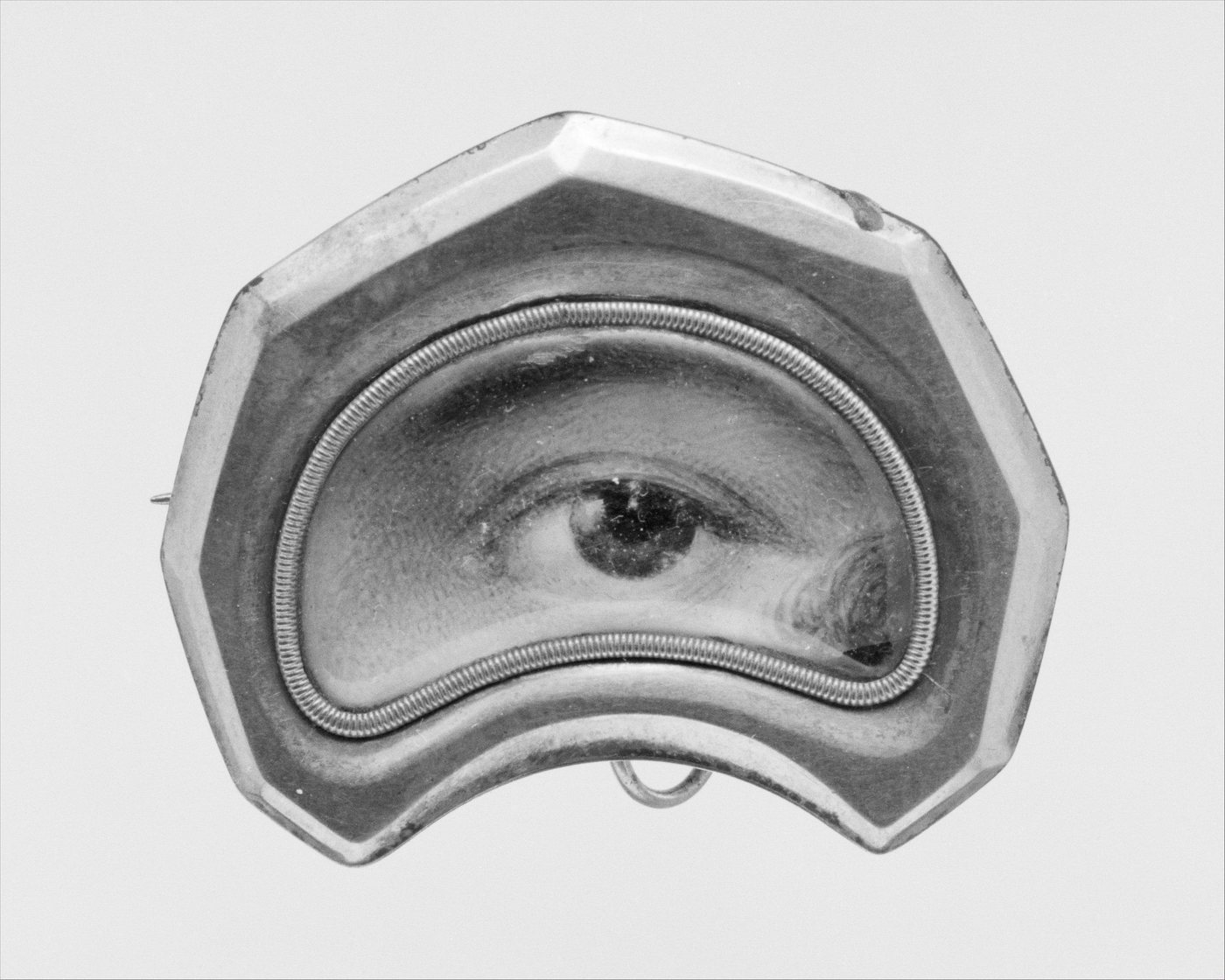
Ivory’s fine, even grain made it a favoured material for detailed carving, and period craftsmen used it for beads, small figural ornaments, and thin, precisely shaped plaques and sheets. Because it can be sawn and worked into very thin, smooth sections, ivory was also used structurally in some comb and hair-ornament construction, alongside tortoiseshell, another organic material favoured for the same purpose - see What Is a Comb?. Ivory’s smooth, light-reflecting surface also made it the standard support for painted portrait miniatures. The Venetian painter Rosalba Carriera is credited with popularising ivory in place of vellum or card around 1700, and by the mid-18th century miniatures in Britain and France were almost always painted in watercolour on thin ivory sheets, shaved to translucency so that light passing through the ivory gave the flesh a glow. Miniaturists such as Richard Cosway and George Engleheart worked on ivory, and it was the support for most of the small eye portraits of lover’s-eye jewellery between the 1780s and 1830s.
Where It Was Carved
- Dieppe, Normandy. The port of Dieppe, which imported African ivory, was a centre of ivory carving from the 17th century. In the 19th century its carvers made brooches of roses, sprays of flowers and figures, as well as fans and small objects, sold to visitors and through Paris shops.
- Erbach, Germany. Count Franz I of Erbach-Erbach introduced ivory carving to his small town in the Odenwald in the 1780s. In the 19th century Erbach became known for brooches carved with roses, edelweiss, stags and woodland scenes.
- Canton (Guangzhou), China. Chinese carvers made finely pierced ivory brooches, beads, fans and card cases for export to Europe and America in the 19th century.
- Belgium and France, c.1895-1910. After the colonial exhibition at Tervuren in 1897 promoted ivory from the Congo Free State, Philippe Wolfers in Brussels and Art Nouveau jewellers in Paris, including René Lalique, carved ivory into female faces, flowers and plaques set in gold and enamel. The Viennese designer Dagobert Peche’s carved ivory diadem of 1915, shown above, belongs to the same taste for ivory as a sculptural material.
Typical Jewellery Applications
Beyond its use as a miniature-painting support, carved ivory appears in beads and strung necklaces, small carved brooches and pendants, and decorative elements combined with other materials in a single piece. Carved ivory brooches of roses and hands holding flowers were especially popular in Britain from the 1860s to the 1880s. Its light weight relative to its size made it practical for larger ornamental forms, including combs and hair ornaments, where a heavier material would have been less comfortable to wear.
A Note on Modern Restrictions
Ivory is an animal-derived material, and elephant populations in particular have been the subject of extensive international and national conservation efforts. As a result, the sale, import and export of ivory - including in antique and historical jewellery - is heavily restricted under trade and wildlife protection law in most jurisdictions today, with rules that vary by country, by the material’s age, and by the specific animal source involved. This is a genuine and significant legal consideration for anyone handling ivory jewellery in the present day; the details are complex and vary by jurisdiction, so current official guidance should always be consulted; this page discusses ivory purely in its historical context. In the United Kingdom, the Ivory Act 2018, in force since 2022, bans most dealing in elephant ivory, with narrow exemptions - including, for example, certain portrait miniatures and items with a low ivory content made before set dates - that require registration or certification before sale.
How to Recognise It
Genuine ivory typically shows a fine natural grain under close inspection - in cross-section, elephant ivory in particular can show a faint, crosshatched pattern sometimes described as engine-turned or “Schreger lines,” a natural growth feature rather than a tool mark - along with a smooth, slightly warm surface that develops a mellow, yellowed patina with age. Common substitutes have their own signs: bone shows small dark pits and streaks where blood vessels ran through it; celluloid “French ivory” or “ivorine”, made from the 1870s, often has regular, evenly spaced imitation grain lines; and vegetable ivory, the hard nut of the tagua palm, was used for buttons and small carvings from the mid-19th century. These are general observations rather than certain tests; distinguishing genuine ivory from bone, other substitute materials, or early plastic imitations reliably requires assessment by a specialist experienced with organic materials.
Frequently Asked Questions
Was all antique ivory jewellery carved? No - alongside carved beads and figural ornaments, ivory was also used in thin, comparatively plain sheet form, particularly as a support for painted miniatures and in comb and hair-ornament construction.
Can antique ivory jewellery be bought and sold today? This depends on the jurisdiction, the item’s age, and the specific rules that apply there, which can restrict sale, import or export of ivory even for historical items; current official guidance should always be consulted rather than assuming an antique piece is automatically exempt.
Read next
Eras
Georgian Jewellery
A guide to Georgian jewellery (1714-1837): Brazilian diamonds, closed-back foiled settings, rococo and Neoclassical styles, paste, cut steel and pinchbeck, sentimental miniatures, girandoles, rivières and Sévigné bows.
Eras
Victorian Jewellery
A guide to Victorian jewellery (1837-1901): the Romantic, Grand and Aesthetic periods, the Great Exhibition, gold rushes and 9ct gold, mourning and Whitby jet, archaeological revival, Scottish jewellery, and how to recognise each phase.
Jewellery
What Is a Hair Comb?
What a decorative hair comb is, its close association with elaborate upswept Victorian and Edwardian hairstyles and Art Nouveau design, and its decline with 1920s bobbed hair.
Materials
Coral in Historical Jewellery
How Mediterranean red coral was fished, carved at Torre del Greco and Naples, sold by firms such as Phillips of London, worn in mid-Victorian fashion, and given to children as protection.

Materials
Tortoiseshell in Historical Jewellery
How hawksbill tortoiseshell was heated, moulded and inlaid as Neapolitan and Birmingham piqué, Spanish and Argentine combs and Victorian jewellery, its imitations, and why its trade is restricted today.
Mourning & Sentimental
What Is Lover's Eye Jewellery?
What lover's eye jewellery is, the Prince of Wales, Maria Fitzherbert and Richard Cosway story behind it, how eye miniatures were painted and mounted c.1785-1830, and why they are rare.