What Is an Intaglio?
What an intaglio is, why its recessed carving made it a working seal rather than just an ornament, and how it differs from a cameo carved in relief.
An intaglio is a gemstone or hardstone carved with its design cut below the surface, recessed into the stone rather than raised from it, historically valued above all for its practical use as a seal.
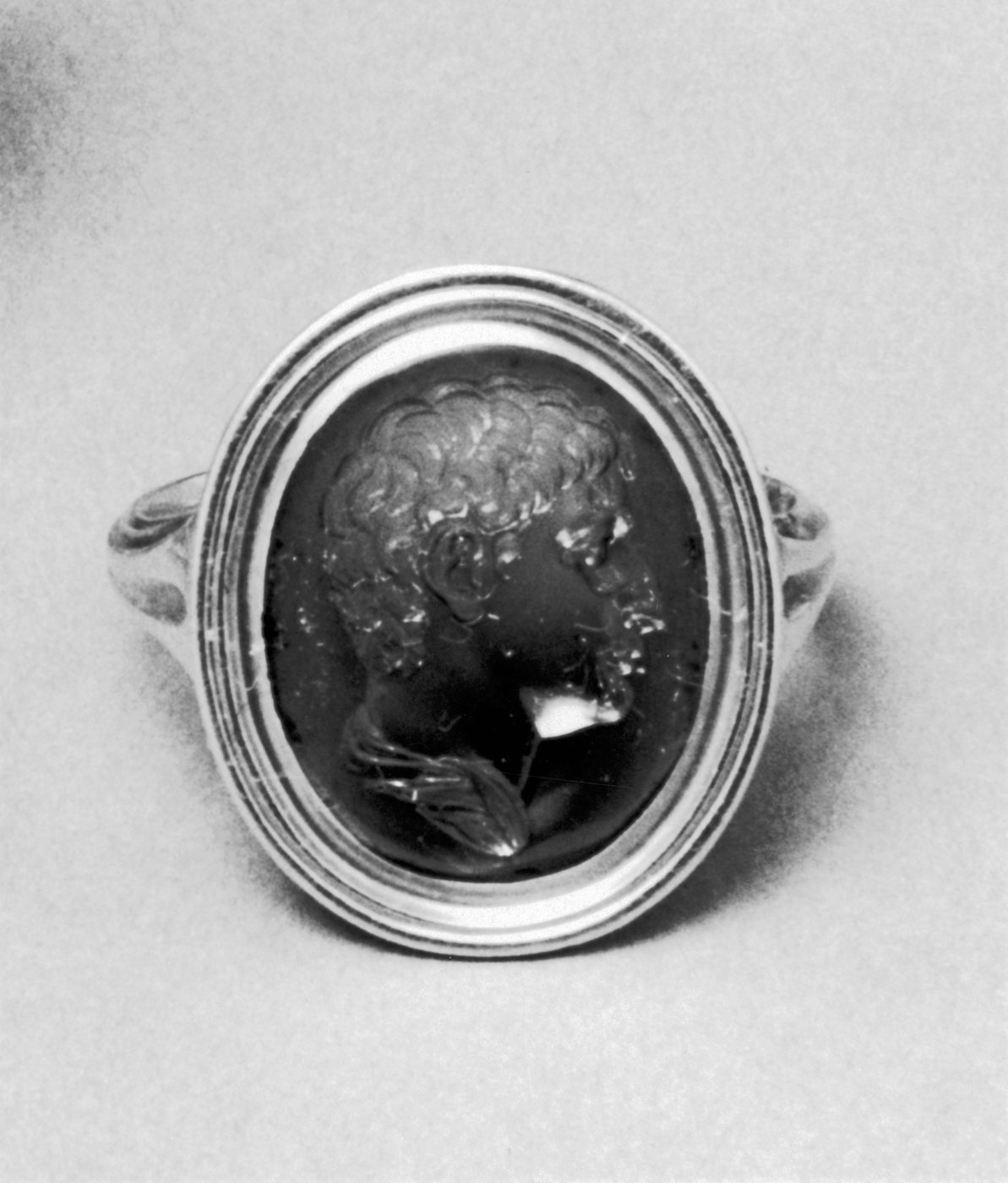
What Is an Intaglio?
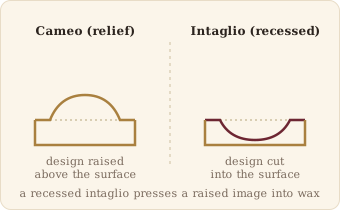
An intaglio’s defining feature is that its design sits below the surrounding surface of the stone, incised into it rather than standing proud of it as a cameo’s design does. This recessed carving is not simply a different aesthetic choice - it is functional. Pressed into warm sealing wax, a recessed intaglio design produces a raised, legible impression, letters and images reading the correct way round, which made the intaglio a working signature and seal in a way a cameo, carved in relief, cannot be.
How to Recognise It
Look at the carved surface itself: an intaglio’s design sits below the stone’s polished surface, so running a fingertip or a raking light across it reveals a recessed image rather than a raised one. Many intaglios were cut specifically to be used as seals and so carry a monogram, crest, coat of arms or classical figure designed to be read in reverse on the stone and correctly on a wax impression - a mirrored or “backwards” design on the stone itself is a strong indicator that a piece was intended for sealing rather than purely for display.
When Was It Worn?
Intaglios were worn from 1700 to 1950, most often set into signet rings and fob seals, and were in everyday practical use for sealing letters and documents well into the 19th century, alongside their role as fashionable ornament.
Origins
Intaglio carving is ancient, with engraved gemstone seals produced in classical Greek, Roman and earlier Near Eastern contexts long before the jewellery forms covered here, valued in antiquity for exactly the same sealing function they retained into the 18th and 19th centuries. The technique, like cameo carving, was studied and revived during the Renaissance as a mark of classical learning and connoisseurship.
How It Changed Over Time
Intaglios gained particular popularity in Britain and elsewhere in the second half of the 18th century and into the Regency period, driven substantially by the Grand Tour, when wealthy travellers returned from Italy and the wider classical world with engraved gems and, increasingly, with cast glass or paste reproductions of famous ancient examples. Neoclassical taste favoured intaglio seals cut with classical deities, mythological scenes and portrait heads, set into rings or suspended from a watch chain as a fob seal. Through the Victorian period, the intaglio’s role as a working seal gradually declined as sealing wax fell out of everyday use, and it survived more as a decorative and family-heraldic form - a signet ring engraved with a crest or initial - than as a practical necessity.
Materials
Hardstones were the traditional material for a fine intaglio, particularly carnelian (traditionally said not to stick to sealing wax), bloodstone, sardonyx and other banded or single-colour chalcedony varieties. Glass paste intaglios, cast rather than hand-carved, offered a far cheaper alternative that reproduced popular classical designs and museum-quality originals for a broader market. Mounts were typically gold for finer pieces, with silver used for less expensive settings.
Construction
A true intaglio is cut into the stone using a rotating wheel and abrasive, traditionally hand-guided by the engraver, removing material to leave the design recessed below the surrounding polished surface. A cast glass intaglio, by contrast, is pressed or moulded from a mould taken from a carved original, reproducing the recessed design far more cheaply but without the individual variation of hand engraving.
How It Was Worn
Most often set into a signet ring worn on the finger, or into a fob seal hung from a watch chain or chatelaine, where it remained close at hand for actually sealing letters and documents; also set into brooches, pendants and other jewellery purely as ornament, without necessarily being used as a seal at all.
Who Wore It?
Intaglios, particularly seal rings and fob seals, were worn by both men and women, though the seal ring in particular was a common and practical accessory for men across the period, engraved with a personal or family crest, monogram or motto.
Notable Variations
- Signet Ring - a ring set with an engraved intaglio, typically a crest, monogram or initial, used both as a seal and as a mark of family identity.
- Fob seal - a separate intaglio-set seal hung from a watch chain or chatelaine rather than mounted in a ring.
- Grand Tour intaglio - an intaglio, in hardstone or cast glass, engraved with a classical subject and sold or acquired as a souvenir of continental travel.
Terminology
“Intaglio” and “engraved gem” are often used interchangeably in jewellery-history writing; “seal” more specifically describes the intaglio’s practical use rather than its carving method, and a single engraved stone can properly be called all three at once.
Similar Jewellery
An intaglio is most often confused with a cameo, since both are carved gemstones or hardstones used in similar jewellery settings; the key difference is that a cameo’s design is raised in relief while an intaglio’s is recessed below the surface, which also explains why only an intaglio produces a legible, raised impression in wax. See Cameo vs Intaglio for a closer look at telling the two apart.
Examples in Museum Collections
- Ring with a sardonyx intaglio bust of Paris, late 18th to early 19th century, attributed to Luigi Pichler, after Antonio Canova. Victoria and Albert Museum, London, M.336-1977. A gold ring set with a neoclassical intaglio copied from Canova’s statue - the carved-gem ring of the Grand Tour era.
- Seal with the arms of Hutchinson, English, 1770-1800. Victoria and Albert Museum, London, 689-1864. Gold with a carnelian intaglio cut with a coat of arms: the intaglio doing its working job as a seal. See What Is a Fob Seal?.
- A cow, Edward Burch, 1775-1810. Victoria and Albert Museum, London, A.30-1934. An unmounted carnelian intaglio signed “BURCH R.A.”. Burch was one of the most celebrated English gem engravers of the 18th century, and the loose stone shows the recessed carving clearly.
Read next
Compare
Cameo vs Intaglio: What's the Difference?
The structural difference between a cameo, carved in relief, and an intaglio, carved into the surface - and why that difference mattered for seals.
Compare
Georgian vs Victorian Jewellery
How Georgian and Victorian jewellery differ in settings, techniques and motifs, and why Victorian jewellery itself spans several distinct phases.

Jewellery
What Is a Cameo?
What a cameo is, how it differs from an intaglio, and how carved shell and hardstone cameos moved from Grand Tour souvenirs to mass-produced Victorian jewellery.
Jewellery
What Is a Signet Ring?
What a signet ring is, how its engraved bezel was historically used to seal documents in wax, and how it became a largely decorative, strongly male-associated accessory.

Materials
Glass in Historical Jewellery
The roles of glass in jewellery 1700-1950: paste, Tassie's glass gems, French jet, Venetian and Bohemian beads, micromosaic, Lalique and pâte de verre - and why glass is not simply a synonym for fake.