Cameo vs Intaglio: What's the Difference?
The structural difference between a cameo, carved in relief, and an intaglio, carved into the surface - and why that difference mattered for seals.
Cameo and intaglio are both carved gem or hardstone forms that were especially fashionable from the mid-18th century onward, and both were popular Grand Tour souvenirs - but they are carved in opposite directions, and that difference is functional, not just visual.
Short Answer
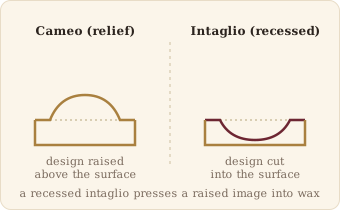
A cameo is carved in relief, so its design stands up above the surrounding surface; an intaglio is carved in reverse, so its design is recessed below the surface - a distinction that mattered enormously in practice, because a recessed intaglio design pressed into wax or another soft material produces a raised, readable impression, while a raised cameo design does not.
What Is a Cameo?
A cameo is an image, usually a portrait profile or figural scene, carved so that it stands proud of its background, typically from a material layered in two or more contrasting colours - most often shell or banded hardstone such as sardonyx or agate - so the raised figure reads as one colour against a differently coloured ground. Cameos are overwhelmingly decorative, mounted as brooches, pendants and rings and worn to be looked at directly.
What Is an Intaglio?
An intaglio is an image carved into the surface of a gemstone, hardstone or glass, so the design sits below the surface as a recessed negative. Intaglios do not require a layered material the way cameos do, since the effect depends on depth and carved line rather than colour contrast, and they were traditionally cut into hardstones such as carnelian, bloodstone, agate and rock crystal, or into glass as a cheaper alternative. Historically, the intaglio’s primary function was practical rather than purely decorative: pressed into a stick of sealing wax, a recessed intaglio design leaves a raised, legible impression, which made intaglios the standard form for personal and official seals for centuries before jewellery fashion adopted them more broadly.
Key Differences
| Property | Cameo | Intaglio |
|---|---|---|
| Carving direction | Relief - design raised above the surface | Incised - design recessed below the surface |
| Typical material | Layered material for colour contrast, especially shell or banded hardstone | Single-colour hardstone (carnelian, bloodstone, agate) or glass |
| Primary historical function | Decorative - worn to be seen directly | Functional - pressed into wax to leave a raised, readable seal impression |
| Common settings | Brooch, pendant, ring | Signet ring, seal fob, watch fob |
| Wax impression result | Not designed to leave a usable impression | Leaves a raised, legible impression when pressed into wax |
Historical Usage
Both carving styles are ancient, used in classical Greek and Roman gem-engraving long before the 18th- and 19th-century jewellery this site covers, and both were revived enthusiastically as marks of connoisseurship and classical learning from the Renaissance onward. Intaglios kept a strong practical role throughout this earlier history because of their sealing function - a gentleman’s signet ring, cut with an intaglio device such as a family crest, monogram or classical figure, was a working tool for authenticating letters and documents, not merely an ornament. Cameos, lacking that functional use, developed instead as a primarily decorative and often narrative or classicising art form, especially popular as a Grand Tour souvenir from the mid-18th century and, later, as an affordable shell-carved fashion staple through the Victorian period.
Where the Terms Overlap
The line between the two is structurally clear - relief versus recess - but usage around them is not always tidy. Both forms were cut into similar hardstones and by similar workshops, sometimes by the same carvers, and both were popular as rings, pendants and Grand Tour souvenirs, so the same collection or dealer’s stock will often mix the two under a general heading like “carved gems” or “engraved gems.” Some pieces also combine both techniques on different faces of the same stone. As stone-cutting quality and mechanical assistance improved through the 19th century, cheaper cameo and intaglio imitations in moulded glass or paste further blurred the picture, since a moulded design can mimic either a raised or a recessed effect without true carving in either direction.
Related Reading
See What Is a Cameo? for a fuller look at cameo materials and construction, and Micromosaic for a related but technically distinct Grand Tour souvenir form.
Read next
Compare
Georgian vs Victorian Jewellery
How Georgian and Victorian jewellery differ in settings, techniques and motifs, and why Victorian jewellery itself spans several distinct phases.

Jewellery
What Is a Cameo?
What a cameo is, how it differs from an intaglio, and how carved shell and hardstone cameos moved from Grand Tour souvenirs to mass-produced Victorian jewellery.

Jewellery
What Is a Posy Ring?
What a posy ring is, why its short engraved verse was often hidden on the inside of the band, and how the form declined from a common love token to a rarer survival by the Victorian era.

Materials
What Is Pinchbeck?
What pinchbeck is, how Christopher Pinchbeck's gold-coloured alloy imitated gold in Georgian jewellery and watch cases, why it declined after 1854, and how it is collected today.

Techniques
What Is Micromosaic Jewellery?
How Roman micromosaic was made from smalti filati, its roots in the Vatican Mosaic Studio, the makers who led it, and how it became a Grand Tour souvenir from the 1770s to the 1870s.