What Is a Hairpin?
What a hairpin is, the difference between a plain functional hairpin and a decorative jewelled hairpin, and why elaborate Victorian and Edwardian hairstyles needed so many of them.
A hairpin is a slender pin used to secure hair in place, made both as a purely functional item meant to disappear into the hairstyle and as a decoratively headed ornament meant to be seen.
What Is a Hairpin?
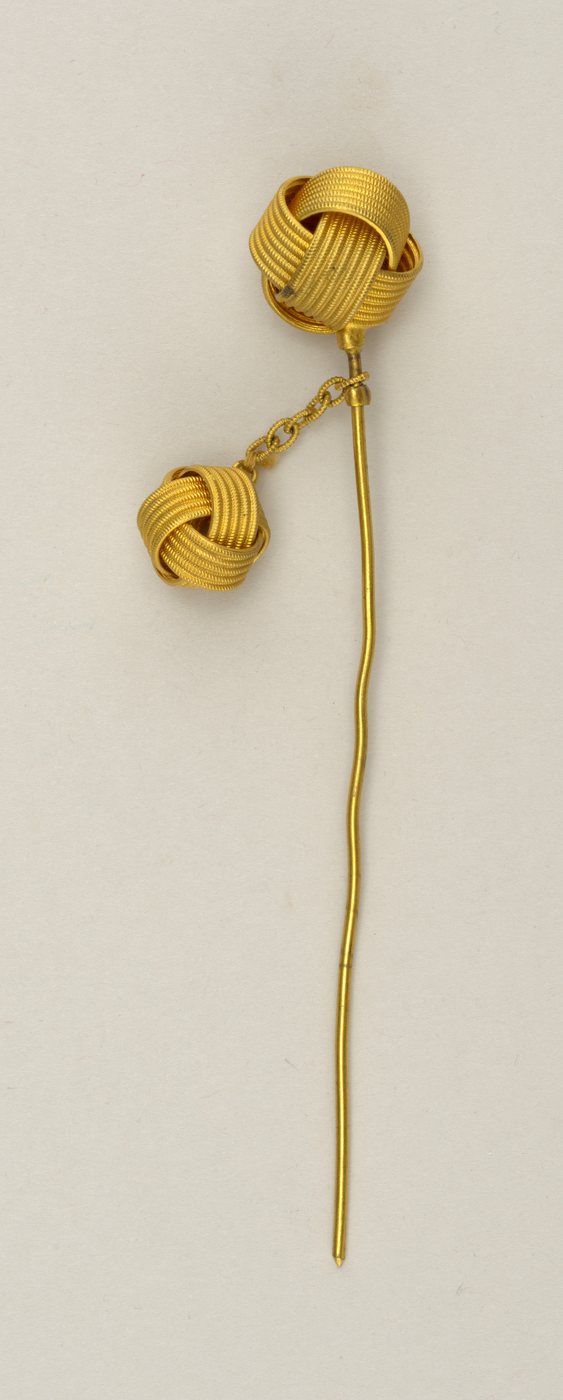
At its simplest, a hairpin is a bent or looped length of wire, sharpened or rounded at the ends, pushed into a section of hair to hold it in place. That plain, functional form sits at one end of a spectrum; at the other end is the decorative hairpin, fitted with a visible ornamental head - a bead, a small motif, or a jewelled setting - designed to be seen as part of the finished hairstyle rather than hidden within it.
How to Recognise It
A functional hairpin is typically plain, made from a single piece of bent wire with no separate decorative element, and was never intended to be noticed once in place. A decorative hairpin, by contrast, has a distinct head fixed to one end of the shaft - set with paste, gemstones, enamel, or shaped into a motif - and its shaft is generally shorter than a hatpin’s, since it is meant to be worked into the hair itself rather than pass through a hat brim as well.
When Was It Worn?
Hairpins, in their plain functional form, were used constantly wherever hair was pinned up, which covered most fashionable adult hairstyles through the 19th and into the early 20th century. Decorative hairpins were worn more selectively, for occasions where the hairstyle itself was on display.
Origins
Pins used to arrange and secure hair are ancient and found across many cultures. The hairpin as a mass-produced, largely interchangeable item developed alongside the elaborate, heavily pinned hairstyles fashionable through the second half of the 19th century, while the decorative hairpin developed in parallel as jewellers recognised an opportunity to make an everyday necessity into a visible ornament.
How It Changed Over Time
Mid-Victorian hairstyles, with their coiled and looped arrangements, required numerous plain hairpins to hold securely, and simple steel or brass pins were produced in enormous quantities to meet that demand. As hairstyles grew taller and more elaborate through the later Victorian period, decorative hairpins - with heads in gold, silver, paste or gemstones - became a genuine, if secondary, category of jewellery, worn as a visible accent within an otherwise functionally pinned style. The Edwardian period’s full, wide hairstyles continued to demand large numbers of pins, both plain and decorative. The form declined through the 1910s and especially the 1920s, as shorter bobbed hairstyles required far fewer pins of any kind.
Materials
Plain functional hairpins were most commonly made in steel or other inexpensive base metal, produced cheaply and in bulk. Decorative hairpins used finer materials in proportion to their ornamental ambitions - gold and silver, sometimes set with paste or gemstones, or finished with enamel - though even decorative examples were generally more modest in scale and cost than a comparable comb, brooch or aigrette.
Construction
A functional hairpin was typically formed from a single length of bent wire, its two prongs providing enough friction against the hair to hold it in place. A decorative hairpin added a separate head, fixed to one end of a similar wire shaft by a soldered or wrapped fitting, so that the visible ornament sat above the hairline while the plain shaft did the actual securing work below it.
How It Was Worn
Pushed into a pinned or coiled section of hair, with plain hairpins used in quantity to build and hold the underlying hairstyle and any decorative hairpins positioned deliberately so their heads remained visible once the style was finished.
Who Wore It?
Hairpins, in their plain functional form, were used by essentially all women with hair long enough to pin up, across every level of society; decorative hairpins were a more discretionary purchase, worn by those who chose to treat an everyday necessity as an additional piece of jewellery.
Terminology
“Hairpin” is sometimes used loosely to cover any small pin worn in the hair, including forms that overlap functionally with a small comb, aigrette mount or hat ornament; where a piece is toothed it is better described as a comb, and where it is designed to hold a feather it is closer to an aigrette.
Similar Jewellery
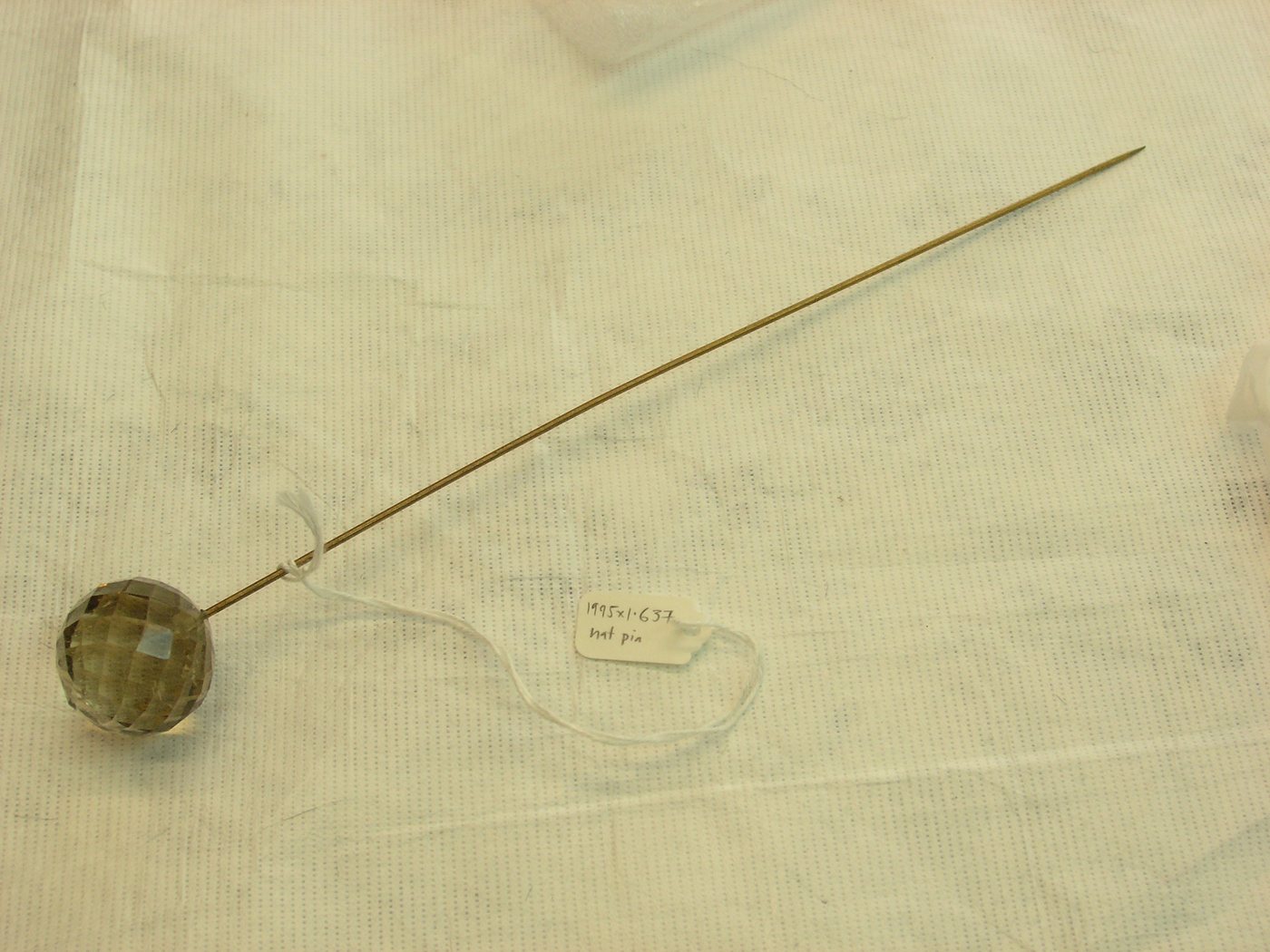
Hairpins are easily confused with the hatpin, which serves a related but distinct purpose - securing a hat rather than the hair alone - and is generally longer, with a more substantial protective point needed to pass through a hat brim as well as the hair beneath it.
Examples in Museum Collections
- Pin, Giacinto Melillo, Naples, 1880-1900. Victoria and Albert Museum, London, M.11:1, 2-2010. Gold with applied wirework, in its original case. The museum records that it was worn in the hair and that its decorative cresting unscrews so the berries can be set at different angles.
- Hair pin, English, 1880-90. Victoria and Albert Museum, London, CIRC.11-1936. Cut and faceted steel - an inexpensive decorative hairpin. See What Is Cut Steel Jewellery?.
- Pair of hair ornaments, English, 1870-99. Victoria and Albert Museum, London, T.61&A-1980. Hollow stamped gilt-metal ball heads with smaller balls on chains: the modest, mass-produced pins worn in pairs or groups in upswept hair.
Read next

Eras
Edwardian Jewellery
A guide to Edwardian jewellery (1901-1915): platinum and the garland style, Queen Alexandra's dog collars, Cartier, Boucheron and Fabergé in London, the Cullinan diamond, lavaliers, milgrain settings and day jewellery.
Eras
Victorian Jewellery
A guide to Victorian jewellery (1837-1901): the Romantic, Grand and Aesthetic periods, the Great Exhibition, gold rushes and 9ct gold, mourning and Whitby jet, archaeological revival, Scottish jewellery, and how to recognise each phase.
Jewellery
What Is an Aigrette?
What an aigrette is, how it held a spray of feathers in the hair or on a headdress, and why the plume trade behind it became a documented early conservation issue.
Jewellery
What Is a Hair Comb?
What a decorative hair comb is, its close association with elaborate upswept Victorian and Edwardian hairstyles and Art Nouveau design, and its decline with 1920s bobbed hair.
Jewellery
What Is a Hatpin?
What a hatpin is, how its decorative head ranged from simple to elaborate, and the surprising documented history of hatpins as a means of self-defence before their Edwardian-era decline.