What Is a Hair Comb?
What a decorative hair comb is, its close association with elaborate upswept Victorian and Edwardian hairstyles and Art Nouveau design, and its decline with 1920s bobbed hair.
A hair comb is a toothed ornament worn in the hair, made to help secure an elaborate hairstyle in place as well as to serve as a piece of jewellery in its own right.
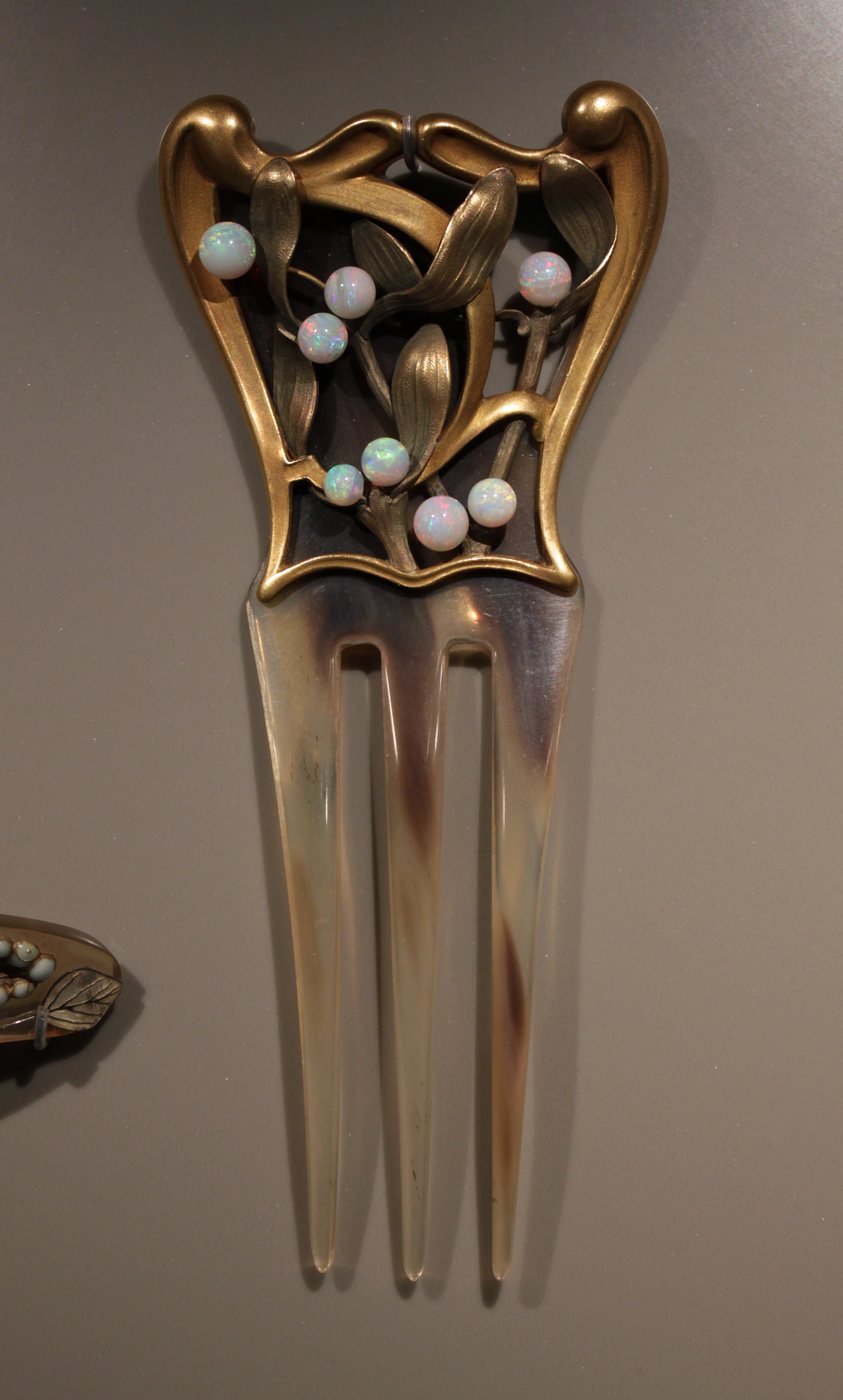
What Is a Hair Comb?
A decorative hair comb consists of a row of teeth, sized to grip a section of hair, topped by a wider decorative section that could be left plain, carved, pierced, or elaborately jewelled. Unlike a purely functional comb used for grooming, the decorative hair comb was designed to remain visible once in place, with its ornamental top doing most of the work of holding hair while also being seen.
How to Recognise It
Look at the teeth first - a genuine dress comb typically has relatively few, sturdy teeth designed to anchor a section of hair rather than the many fine teeth of a grooming comb. The decorative top varies enormously, from a plain curved band of tortoiseshell or horn to an elaborately pierced, carved or gem-set panel, and its style and material can help narrow a likely period, though construction alone cannot confirm an exact date.
When Was It Worn?
Combs were worn whenever a hairstyle called for structural support or decorative height, and were especially prominent from the 1830s through the 1910s, when elaborate upswept hairstyles created real demand for both functional and decorative combs.
Origins
Combs used to dress and secure hair are ancient and found across many cultures, but the decorative dress comb as a distinct fashion accessory - meant to be seen rather than hidden within the hairstyle - developed strongly over the course of the 19th century, alongside increasingly elaborate upswept hairstyles that gave a large decorative comb both a practical role and a prominent place to be admired.
How It Changed Over Time
Earlier and mid-Victorian combs tended toward relatively simple carved tortoiseshell or horn forms, sized to anchor a bun or coil of hair. As hairstyles grew taller and more elaborate through the later 19th century, combs grew correspondingly larger and more decorative, sometimes worn in pairs or sets to support a full upswept style. The Art Nouveau period, spanning roughly the 1890s to 1910s, treated the comb as a favoured vehicle for its characteristic flowing, naturalistic design - carved and moulded tortoiseshell and horn combs featuring insects, flowers and sinuous female forms became especially prized, closely associated with designers working in the Lalique tradition. Through the Edwardian period, combs remained an important part of the elaborate, full-volume hairstyles then fashionable. The form declined sharply from the 1920s onward, as shorter, simpler bobbed hairstyles needed little or no structural hair ornament of this kind.
Materials
Tortoiseshell was the classic material for fine dress combs through much of the period, prized for its warm colour and the way it could be carved and pierced; see Tortoiseshell in Historical Jewellery for a fuller discussion of the material and the modern restrictions now affecting its sale. Carved horn served as a related, more affordable alternative with a broadly similar appearance. Gilt metal was common for lower-cost combs, while the finest examples were made in gold, sometimes set with diamonds, pearls or other gemstones, particularly for combs intended as genuine fine jewellery rather than purely functional hair furniture.
Construction
The teeth were typically cut or carved from a single piece of tortoiseshell, horn, or moulded composition, sized and spaced to grip hair securely without being so fine as to break easily. The decorative top was either carved from the same piece as the teeth or made separately, in metal or a different material, and fixed to the tooth section - allowing a jewelled metal top to be combined with a more practical tortoiseshell or horn base.
How It Was Worn
Pushed into a section of upswept or coiled hair, typically at the back or crown of the head, where its decorative top remained visible above the hairline; larger examples sometimes served as the principal ornament of an elaborate hairstyle rather than a purely supporting element.
Who Wore It?
Combs were worn almost exclusively by women, across every level of society, with the material and decoration varying accordingly from plain horn to fine gold and gemstones.
Notable Variations
- Tortoiseshell dress comb - a carved or pierced comb in genuine tortoiseshell, the classic 19th-century form.
- Art Nouveau comb - a carved or moulded horn or tortoiseshell comb featuring the era’s characteristic naturalistic motifs.
- Tiara comb - a tall, elaborate comb worn as the centrepiece of a formal hairstyle, sometimes gem-set.
Similar Jewellery
Combs are sometimes confused with the hairpin or the aigrette, both of which shared the task of decorating and securing an elaborate hairstyle; a comb is distinguished from either by its row of teeth, which the other two forms lack.
Examples in Museum Collections
- Hair comb, India Rubber Comb Company, c.1851. Metropolitan Museum of Art, New York, 2000.561. Moulded vulcanite - an early example of the cheap, mass-produced composition comb.
- Comb, French, c.1900. Victoria and Albert Museum, London, T.263-1958. Five-toothed tortoiseshell with a fan-shaped openwork top studded with paste.
- Lily of the Valley Comb, René Lalique, c.1900. Cleveland Museum of Art, 1981.49. Carved horn, enamel and gold, acquired after the 1900 Exposition Universelle - the comb at its height as Art Nouveau art jewellery.
Read next
Eras
Art Nouveau Jewellery
A guide to Art Nouveau jewellery (c.1890-1910): René Lalique and Gulbenkian, Fouquet and Mucha, Vever and Gaillard, plique-à-jour and horn, Jugendstil, Liberty's Cymric range, Tiffany, and the mass-produced silver that spread the style.
Eras
Victorian Jewellery
A guide to Victorian jewellery (1837-1901): the Romantic, Grand and Aesthetic periods, the Great Exhibition, gold rushes and 9ct gold, mourning and Whitby jet, archaeological revival, Scottish jewellery, and how to recognise each phase.
Jewellery
What Is an Aigrette?
What an aigrette is, how it held a spray of feathers in the hair or on a headdress, and why the plume trade behind it became a documented early conservation issue.
Jewellery
What Is a Hairpin?
What a hairpin is, the difference between a plain functional hairpin and a decorative jewelled hairpin, and why elaborate Victorian and Edwardian hairstyles needed so many of them.

Materials
Tortoiseshell in Historical Jewellery
How hawksbill tortoiseshell was heated, moulded and inlaid as Neapolitan and Birmingham piqué, Spanish and Argentine combs and Victorian jewellery, its imitations, and why its trade is restricted today.