What Does 18ct Mean?
What an 18ct or 750 gold mark means, when the British 18 carat standard was introduced in 1798, how it was marked before and after 1975, and why 18ct dominated fine jewellery.
An “18ct” mark means the piece is 18 carat gold: 18 parts pure gold out of 24, or 75%. In modern British hallmarks it appears as “750”. Across Europe, 18ct has been the standard for fine gold jewellery for centuries, and in France it was effectively the only standard for gold jewellery for most of the period from 1700 to 1950.
When 18ct Became a British Standard
For most of the 18th century the only legal gold standard in Britain was 22 carat, marked with the same lion passant as sterling silver. In 1798 an 18 carat standard was introduced, marked with a crown and the figure “18”. The change recognised that 18ct gold is considerably harder than 22ct - better for holding stones securely and for fine, crisp detail - while still being rich in colour.
Through the 19th century, 18ct became the usual standard for good British gem-set jewellery, while 22ct was increasingly reserved for wedding rings and mourning rings. After 1854 the lower 15ct standard took over much of the middle market, but 18ct stayed the material of choice for the finest work.
How 18ct Is Marked
| Period | How the standard appears |
|---|---|
| 1798-1975 (hallmarked) | A crown and “18” |
| From 1975 | A crown and “750” in a shield |
| Unassayed pieces | “18ct”, “18c” or “18” stamped by the maker |
| Continental and American pieces | “750” or “18K”, often with a national mark (the French eagle’s head, for example) |
As with all gold standards, the form of the mark helps with dating: a crown with “18” belongs to 1798-1975, while “750” in a shield with a crown is 1975 or later. See British Gold Hallmarks Explained for the full set of standards.
What 18ct Looks and Feels Like
Yellow 18ct gold is a warm, rich yellow - noticeably deeper than 9ct, slightly less buttery than 22ct - and it feels dense for its size. Because 25% of the alloy is other metal, its colour can be adjusted: copper produces red or rose 18ct, silver produces greenish 18ct, and nickel or palladium produce white gold. White gold was developed in the early 20th century as a cheaper alternative to platinum, and became common in the 1920s and 1930s.
Where You’ll Find 18ct in Antique Jewellery
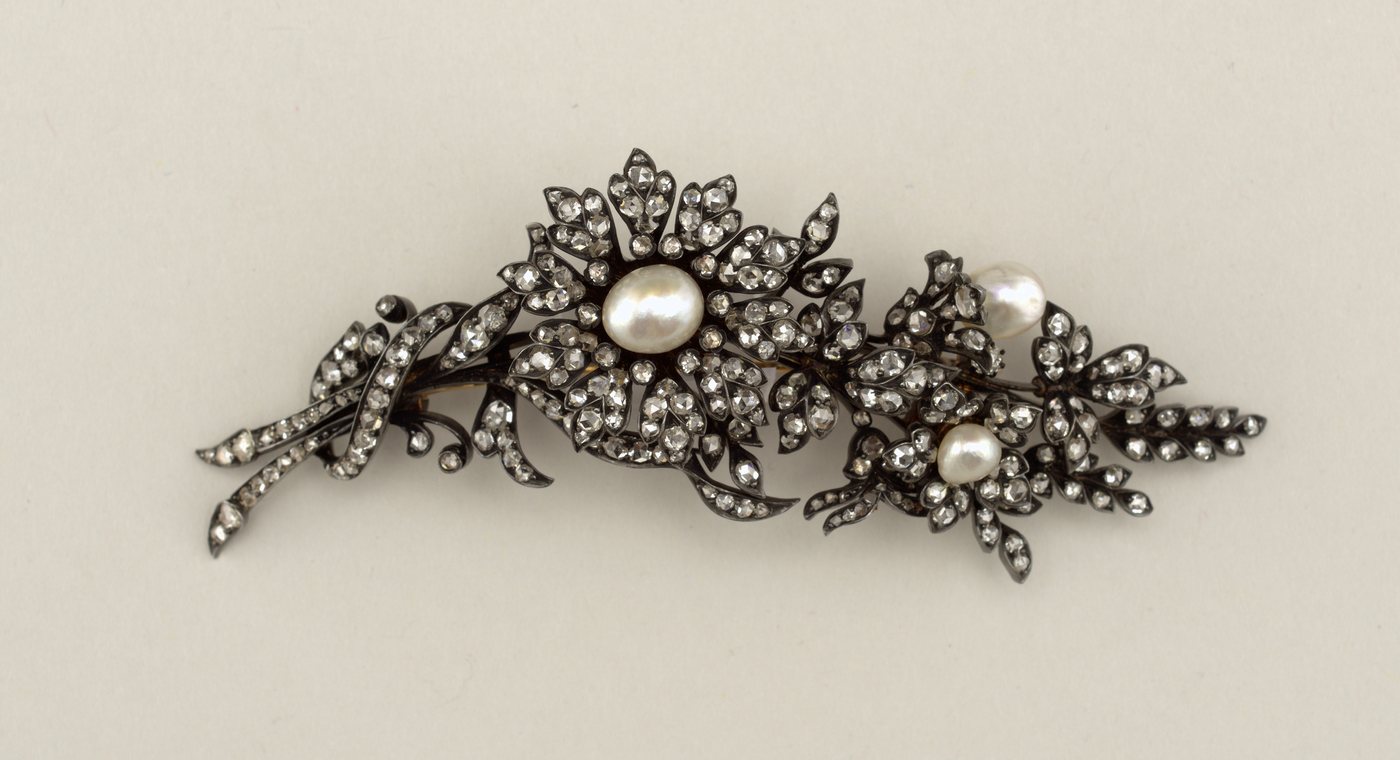
- Georgian and Victorian gem-set jewellery - often in 18ct gold with silver-topped settings for diamonds; see Georgian Jewellery.
- French jewellery of every period, almost always 18ct.
- Edwardian and Art Deco rings - typically an 18ct shank with a platinum head, so that diamonds sat in white metal; see Edwardian Jewellery.
- Mourning rings - frequently 18ct or 22ct, and among the more often hallmarked items of antique jewellery.
What 18ct Doesn’t Tell You
The mark describes the alloy of the marked part. On an Edwardian ring stamped “18ct & Plat”, it describes the shank, not the platinum setting or the stones. A hallmark is strong evidence of metal content, but date, origin and originality still have to be read from the rest of the hallmark and the piece itself.
Read next

Eras
Edwardian Jewellery
A guide to Edwardian jewellery (1901-1915): platinum and the garland style, Queen Alexandra's dog collars, Cartier, Boucheron and Fabergé in London, the Cullinan diamond, lavaliers, milgrain settings and day jewellery.
Eras
Georgian Jewellery
A guide to Georgian jewellery (1714-1837): Brazilian diamonds, closed-back foiled settings, rococo and Neoclassical styles, paste, cut steel and pinchbeck, sentimental miniatures, girandoles, rivières and Sévigné bows.
Identify
British Gold Hallmarks Explained
Every British gold standard from 22ct to 9ct, when each was legal, how each was marked before and after 1975, and how to read a gold standard mark as a dating clue.
Identify
What Does 9ct Mean?
What a 9ct or 375 gold mark means, why the 1854 introduction of 9 carat gold transformed British jewellery, how 9ct marks changed over time, and what 9ct looks and feels like.
Identify
What Is a Hallmark?
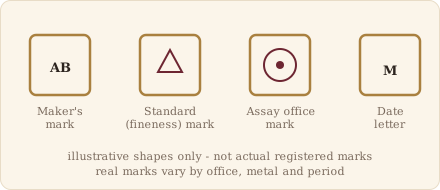
What a British hallmark is, the four marks that make up a traditional set, how the system developed from 1300 to the 1973 Hallmarking Act, and why so much antique jewellery is unmarked.

Materials
Gold in Historical Jewellery
How gold standards, supply, colour and working methods changed from Georgian to 1940s jewellery - the 1854 standards, the gold rushes, bloomed and coloured gold, rolled gold - and gold's imitations.