What Is a Stomacher?
What a jewelled stomacher is, how it covered the front of an 18th-century bodice, and why so few survive intact once dress styles changed.
A stomacher is a large, typically triangular or inverted-V-shaped panel of jewelled or embroidered ornament worn over the front of a woman’s bodice, one of the most substantial and status-displaying jewellery forms of the 18th century.
What Is a Stomacher?
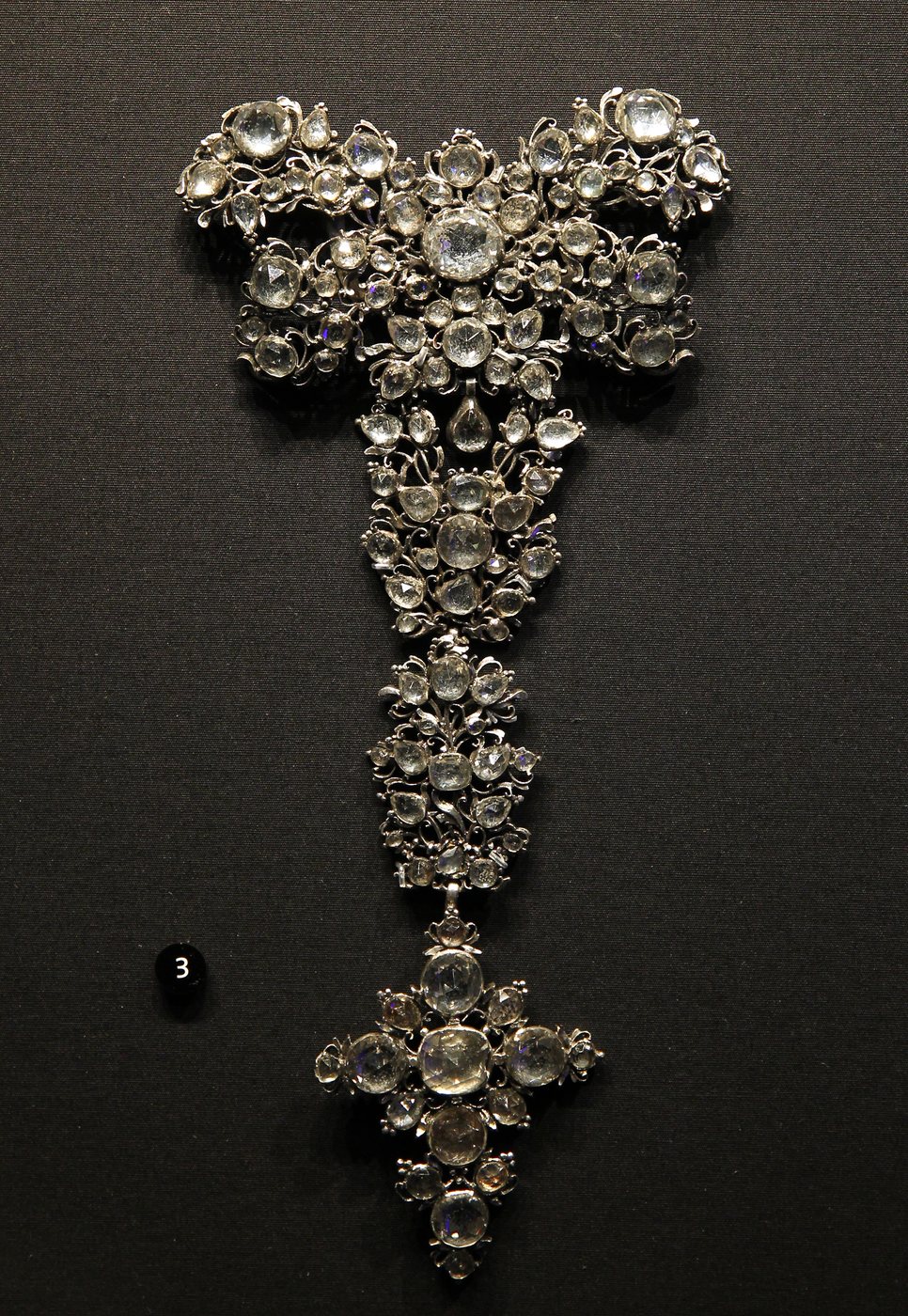
A stomacher’s defining feature is both its scale and its placement: tapering from the shoulders or upper chest down to a point at the waist, it was designed to cover the front opening or lacing of a fitted 18th-century bodice, turning a purely structural feature of the dress into the visual centrepiece of the whole outfit. Unlike a single brooch or pendant, a jewelled stomacher was typically built from a series of linked gem-set elements, graduated in size down its length, amounting to a substantial suite of jewellery in a single piece.
How to Recognise It
Look for a large, tapering triangular panel of gem-set or embroidered ornament, generally proportioned to run from roughly the shoulder or upper chest down to the waist, with a graduated pattern of linked decorative elements rather than a single unified design. Because many stomachers were built from separable sections, individual elements removed from a dismantled stomacher can closely resemble brooches or other jewellery of the period, so context and proportion are important clues to the original form.
When Was It Worn?
The stomacher was worn as part of formal 18th-century dress, closely tied to the fitted, front-laced or front-opening bodice construction fashionable through roughly the first three-quarters of the century, and fell out of common use as that dress construction itself changed in the later 18th century.
Origins
The stomacher developed directly out of 18th-century dress construction: a fitted bodice of the period was typically laced or pinned at the front, and covering that practical opening with a decorative panel - plain fabric and embroidery for everyday wear, elaborate jewelled versions for formal and court dress - became an established convention across fashionable Georgian society in Britain and France.
How It Changed Over Time
Through the early and mid-18th century, the jewelled stomacher was among the most prestigious and expensive forms of jewellery a wealthy woman could own, often set with a substantial quantity of diamonds or other gemstones in a graduated bow, ribbon or floral pattern running down the front of the bodice. As dress styles changed in the later 18th century, moving away from the fitted, front-laced bodice the stomacher was designed to cover, the form fell out of fashionable use. Because a fine stomacher represented a very large investment in gemstones and precious metal, many were not kept intact once out of fashion but were instead broken down, their linked, often detachable elements reset into smaller and more wearable pieces - brooches, a necklace, or other jewellery better suited to changing taste - which is a major reason complete 18th-century stomachers are rare survivals today.
Materials
Diamonds were the most prestigious stomacher stone, set in silver (and, later in the century, silver-topped gold), whose white colour flattered them better than yellow gold, following standard 18th-century diamond-setting practice. Coloured gemstones and paste were also used, particularly for less costly versions aimed at a broader market seeking the same fashionable silhouette at lower expense.
Construction
A jewelled stomacher was typically built from a series of separate, linked gem-set elements - bows, ribbon motifs, floral sprays or graduated clusters - joined together to form the overall tapering panel, with many designed so individual sections could be detached and worn separately. This sectional construction, prized at the time for its versatility, is also the main reason so many stomachers were later dismantled entirely once the form itself fell out of fashion.
How It Was Worn
Pinned or otherwise secured over the front of a fitted 18th-century bodice, covering its front opening or lacing and running from roughly the upper chest down to a point at the waist, as the visual centrepiece of formal dress.
Who Wore It?
The stomacher was women’s jewellery, and a fine jewelled example was among the clearest and most expensive displays of status available to a wealthy 18th-century woman, worn for court presentations and other formal occasions.
Terminology
Because so few complete 18th-century stomachers survive, and because later, smaller jewelled dress ornaments sometimes echo the same tapering, front-of-bodice placement, the term “stomacher” is occasionally applied loosely to later pieces that are not true survivals of the full-scale 18th-century form; a genuine period stomacher should be understood in the context of the fitted, front-laced bodice construction it was specifically designed to cover.
Similar Jewellery
A stomacher is most often confused with a large 18th-century brooch or a matched suite of smaller brooches, particularly once a stomacher’s original linked elements have been separated; scale and the presence of a clearly graduated, tapering overall design are the best remaining clues to a piece’s original form, though this site does not offer authentication of any specific piece.
Examples in Museum Collections
Museums usually catalogue jewelled stomachers as “bodice ornaments” and keep the word “stomacher” for the fabric panel - worth knowing when searching collections.
- Bodice ornament, c.1760. Victoria and Albert Museum, London, M.134:1 to 3-1975. Rock crystals and paste in foiled silver settings, made in sections - a bow, two intermediate units and a cross. The museum’s record notes that it decorated the bodice from neckline to just below the waist and “was known as a stomacher”.
- Bodice ornament, Spanish, 1700-20. Victoria and Albert Museum, London, 320-1870. Nearly 300 diamonds in gold scrolling openwork, fastened with two hooks at the top of the bodice - a measure of the scale and cost of an early 18th-century jewelled stomacher, though from outside the British and French tradition.
- Stomacher, British, 1720-40. Victoria and Albert Museum, London, T.99-1962. A triangular silk panel embroidered with chinoiserie flowers, birds and a figure, with decorative silver lacing - the fabric stomacher that jewelled versions were designed to cover or imitate.
Read next
Compare
Georgian vs Victorian Jewellery
How Georgian and Victorian jewellery differ in settings, techniques and motifs, and why Victorian jewellery itself spans several distinct phases.
Jewellery
What Is a Brooch?
What a brooch is, how its pin-and-catch fastening works, and how brooch styles moved from naturalistic Victorian sprays through mourning brooches to Art Deco geometry.

Jewellery
What Is a Festoon Necklace?
What a festoon necklace is, how its draping swagged strands differ from a riviere's unbroken line of stones, and why it stayed popular from the Georgian through the Victorian period.

Materials
Gold in Historical Jewellery
How gold standards, supply, colour and working methods changed from Georgian to 1940s jewellery - the 1854 standards, the gold rushes, bloomed and coloured gold, rolled gold - and gold's imitations.
Materials
What Is Paste Jewellery?
What paste jewellery is, from English lead glass and Georges Frédéric Strass in Paris to foiled closed settings, black-dot culets and later Bohemian stones, and why fine paste is collected today.