Mourning Ring vs Memorial Brooch: What's the Difference?
How the centuries-old, often bequeathed mourning ring compares with the more elaborate, personally chosen Victorian memorial brooch.
A mourning ring and a memorial brooch are both jewellery made to commemorate a specific death, but they come from different points in a long tradition of memorial jewellery, and they were typically acquired in quite different ways - one often distributed as a funeral keepsake following a will’s instructions, the other more often chosen or commissioned individually.
Short Answer
A mourning ring has a documented history reaching back at least to the 17th century, and was historically often given out to family, friends and mourners at a funeral, sometimes following instructions left in the deceased’s will. A memorial brooch is generally the more elaborate, more personalised form that reached its height in the Victorian period, often built around a hair compartment, photographic portrait or engraved inscription, and was typically worn visibly rather than distributed as a keepsake to a wide circle of mourners.
What Is a Mourning Ring?
A mourning ring is a ring made or given to commemorate a death, most often carrying an inscription giving the deceased’s name or initials and date of death. Its history is unusually well documented because the custom was frequently written into wills, with a testator specifying that rings be made and distributed to mourners at the funeral. Earlier examples, from the 17th and 18th centuries, are typically gold bands finished in black (or sometimes white, for an unmarried person or child) enamel, occasionally with a memento mori motif such as a skull; the tradition continued into the Victorian period, absorbing materials such as jet and hair compartments along the way.
What Is a Memorial Brooch?
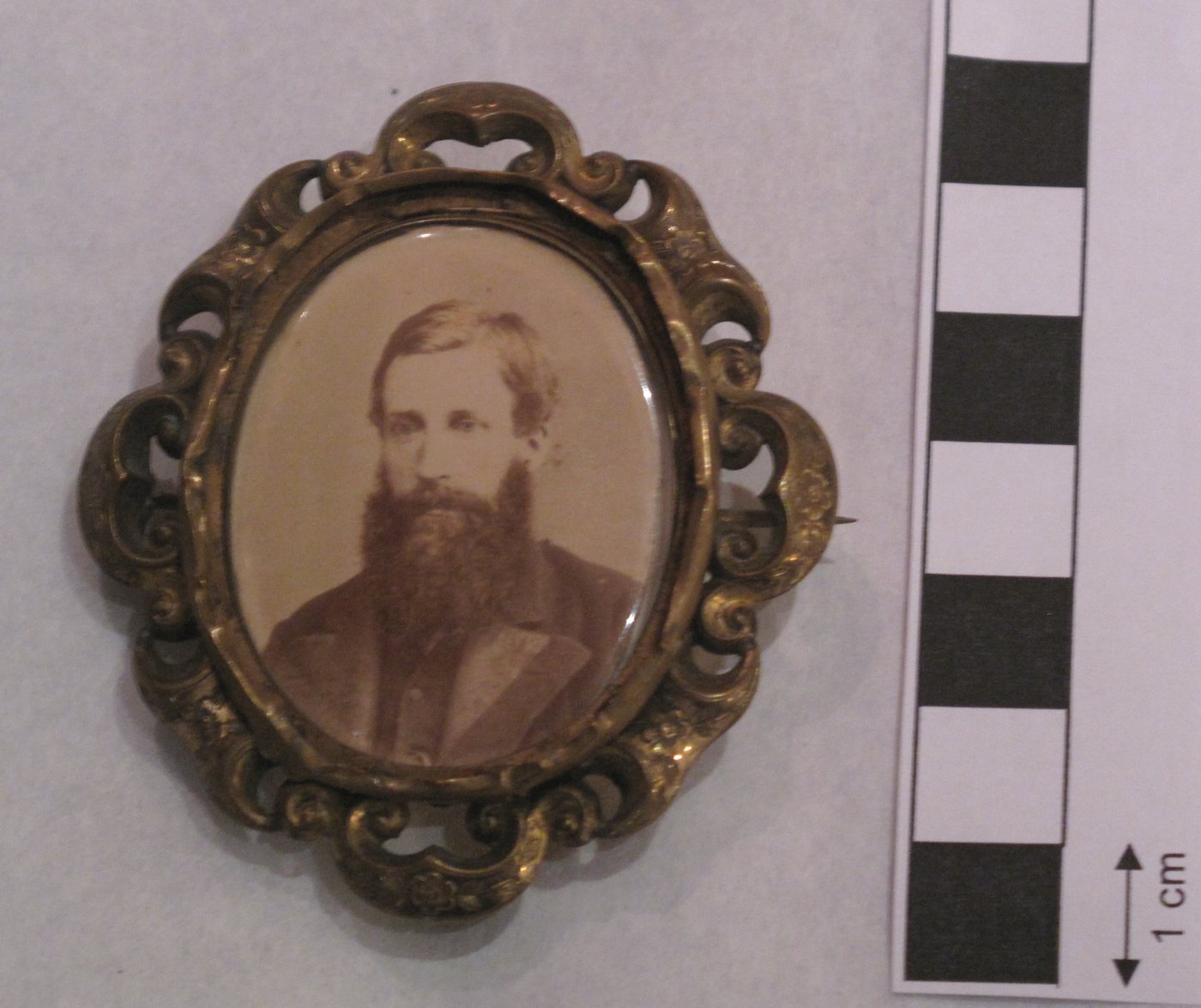
A memorial brooch is a brooch made or adapted to commemorate a specific individual’s death, distinguished from general Victorian mourning jewellery by the presence of a name, date, hair compartment or portrait rather than simply signalling that the wearer was in mourning. It commonly combines a jet, black-enamelled gold or gilt-metal setting with a glazed hair compartment, an engraved or enamelled inscription, and mourning motifs such as an urn or willow, and it reached its greatest popularity in the mid-Victorian period following Prince Albert’s death in 1861.
Key Differences
| Property | Mourning Ring | Memorial Brooch |
|---|---|---|
| Typical construction | Plain or lightly enamelled gold band, often with an engraved name and date | More elaborate assembly: hair compartment, inscription, portrait and mourning motifs |
| Period of greatest popularity | Documented from at least the 17th century, continuing through the 18th and 19th | Chiefly the mid-to-late Victorian period, especially after 1861 |
| Typical means of acquisition | Often bequeathed and distributed to mourners, sometimes per instructions in a will | Generally chosen or commissioned individually by one person for one death |
| Typical wearer relationship to the deceased | Could be a wide circle - family, friends, colleagues, funeral attendees | Typically close family or a partner, given the personalised construction |
| How it was worn | As an everyday ring, indistinguishable at a glance from a plain band unless inscribed visibly | Worn visibly, often incorporating a portrait or hair as a deliberate outward memorial |
Historical Usage
The mourning ring’s distinctive documented history comes from its close ties to the will and the funeral itself. A testator could specify the sum to be spent per ring, the number of rings to be made, and sometimes their design, meaning a mourning ring’s origin can occasionally be traced to a specific bequest. This made the ring as much a social obligation - fulfilling the wishes of the deceased and marking the recipient’s place among the mourners - as it was a piece of jewellery chosen freely by any one wearer. Because rings were often produced in some quantity for a single funeral, a mourning ring’s connection to a particular wearer is sometimes weaker than that of a more personalised piece.
The memorial brooch, by contrast, developed as a more individually meaningful object, generally acquired by a single person - most often close family or a partner - specifically to commemorate one death, incorporating relics such as hair or a photograph that made the piece unmistakably about that one individual. Its rise as the dominant personalised mourning form coincides with the mid-Victorian mourning culture, when jet and its imitations became widely available and hair work and early photography offered new ways to personalise a piece beyond an engraved inscription alone.
Where the Forms Overlap
The distinction is not absolute. Mourning rings themselves increasingly incorporated hair compartments by the Victorian period, narrowing some of the construction gap with memorial brooches, and a personalised, individually commissioned mourning ring for a specific death is not unusual within the wider mourning-ring tradition. Conversely, not every Victorian brooch called “mourning” is a memorial brooch in the strict sense - a plain jet brooch worn simply because etiquette called for black jewellery during a mourning period, without any name, date or hair compartment tied to a specific individual, is general mourning jewellery rather than a memorial piece. The clearest markers to look for on either object are the same: an inscription naming a specific person and date, a hair compartment, or a portrait - features that mark a piece as commemorating one individual rather than simply signalling mourning in general.
Related Reading
For the fuller entries on each form, see What Is a Mourning Ring? and What Is a Memorial Brooch?. For the broader category both belong to, see Mourning Jewellery and Hair Jewellery.
Read next
Eras
Victorian Jewellery
A guide to Victorian jewellery (1837-1901): the Romantic, Grand and Aesthetic periods, the Great Exhibition, gold rushes and 9ct gold, mourning and Whitby jet, archaeological revival, Scottish jewellery, and how to recognise each phase.

Materials
What Is Jet Jewellery?
What jet is, where it came from - Whitby, Asturias, southern France - its use from the Bronze Age to the Victorian mourning boom, and how to tell genuine jet from vulcanite and French jet.

Mourning & Sentimental
What Is Hair Jewellery?
What hair jewellery is, how table-work and palette-work hairwork were made, the hairworkers and manuals behind the craft, and why it served sentimental as well as mourning purposes.

Mourning & Sentimental
What Is a Memorial Brooch?
What a memorial brooch is, how its design changed from Georgian sepia-and-hair brooches to Victorian black-enamel and photographic brooches, and how it differs from general mourning jewellery.
Mourning & Sentimental
What Is Mourning Jewellery?
What mourning jewellery is, how it developed from Stuart and Georgian memorial rings, why it peaked in Victorian Britain after Prince Albert's death in 1861, and the etiquette and materials behind it.

Mourning & Sentimental
What Is a Mourning Ring?
What a mourning ring is, the custom of bequeathing them in wills from Shakespeare to Pepys, enamelled name-and-date inscriptions, and how their design changed from 1650 to the Victorian period.