Earring Fittings Through History
How pierced wire hooks, screw-backs and clip-backs rose and fell in prominence, and why fitting type is a useful but replaceable clue to an earring's age.
The mechanism by which an earring attaches to the ear changed noticeably between 1700 and 1950, driven less by pure fashion than by a genuine, well-documented shift in how many Western women actually had pierced ears at any given time - which makes fitting type a useful, if never conclusive, clue toward a piece’s likely date.
What to Look At
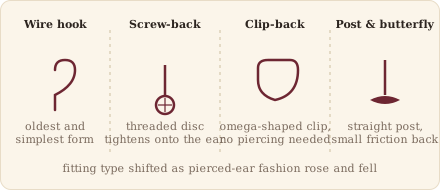
Look closely at the fitting itself rather than the earring’s decorative body: whether it passes through a pierced hole via a simple wire hook, clamps onto the earlobe mechanically via a screw or spring clip, and whether the fitting appears original to the piece or shows signs of having been added, adapted or replaced. Fittings are small, functional, mechanically stressed parts, and - much like a brooch’s catch - they are among the components most likely to have been swapped out at some point in an earring’s working life.
The Pierced Wire Hook
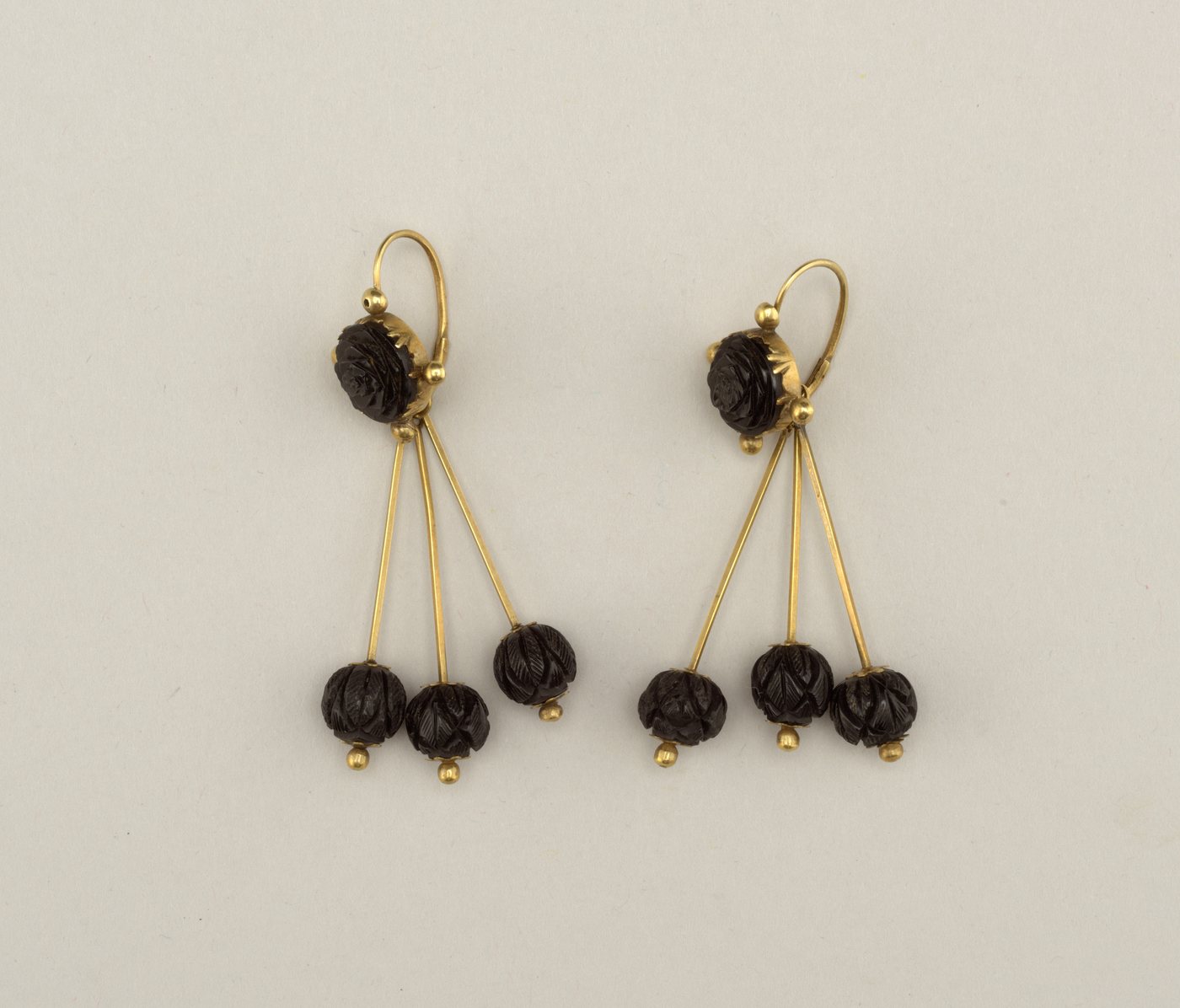
A simple hook or wire fitting, passed through a pierced earlobe, is the oldest and most straightforward earring fitting used from 1700 to 1950, and indeed across a much longer span of jewellery history generally. It requires the least mechanical complexity - little more than a shaped length of wire - and appears throughout the Georgian, Regency and much of the Victorian period, when pierced ears were the ordinary, unremarkable norm for a woman wearing earrings at all.
The Screw-Back Fitting
From the later Victorian period, and increasingly from the late 19th century into the early-to-mid 20th century, a documented shift in fashion saw pierced ears fall out of favour across significant parts of Western society for several decades, for reasons connected to changing ideas about propriety and the perceived permanence of piercing. In response, jewellers developed non-piercing fittings that could clamp directly onto an unpierced earlobe, and the screw-back - a small threaded post and disc mechanism that tightens against the lobe - became a well-documented, prominent alternative during this period. Because the screw-back rose specifically to serve buyers without pierced ears, its presence as an original fitting is a useful clue pointing toward this later span, roughly late Victorian and Edwardian through the early-to-mid 20th century, rather than the earlier Georgian or Regency period.
The Clip-Back Fitting
The clip-back, a spring-tensioned mechanical clip that grips the lobe without any screw mechanism, is a related non-piercing fitting that generally became prominent somewhat later than the screw-back, gaining particular ground through the 1930s and 1940s. Like the screw-back, its presence suggests a piece made for an unpierced-ear market, and its comparatively later general prominence can help distinguish an Art Deco or 1930s-to-1940s piece from an earlier Edwardian screw-back example, though the two fitting types overlapped in use for a considerable stretch and neither disappeared abruptly in favour of the other.
The Return of Pierced Ears
Pierced-ear fashion returned broadly to Western society later in the 20th century, well beyond this site’s core historical focus, and wire hook and post fittings became common again alongside the older non-piercing types, which have never entirely disappeared. This later resurgence sits outside the period this site primarily covers, but it matters for identification purposes because it means a pierced fitting alone, without other supporting evidence, cannot safely distinguish an early piece from a considerably later one.
Where to Go From Here
Compare a fitting’s apparent type and condition against the earring’s decorative style and materials, and against this site’s era guides, to see whether the two point toward a consistent period. Where they seem to conflict - a decoratively Georgian-style earring with a screw-back fitting, for instance - that is itself a useful clue that some alteration has likely taken place. For a firmer opinion on any specific piece, consult a qualified antique jewellery dealer, appraiser or auction house specialist.
Read next
Eras
Jewellery in the 1930s
A guide to 1930s jewellery: all-white diamond and platinum, dress clips and double clips, Van Cleef & Arpels' Mystery Set, Belperron and Boivin, Chanel and Schiaparelli, Hollywood, Bakelite and marcasite, and the move towards Retro.

Eras
Jewellery in the 1940s
A guide to 1940s jewellery: wartime platinum bans and the rose-gold Retro style, Cartier's caged bird, Van Cleef & Arpels and Verdura in New York, American costume jewellery in sterling and Lucite, British Utility rings, sweetheart badges and the New Look.

Eras
Edwardian Jewellery
A guide to Edwardian jewellery (1901-1915): platinum and the garland style, Queen Alexandra's dog collars, Cartier, Boucheron and Fabergé in London, the Cullinan diamond, lavaliers, milgrain settings and day jewellery.
Eras
Victorian Jewellery
A guide to Victorian jewellery (1837-1901): the Romantic, Grand and Aesthetic periods, the Great Exhibition, gold rushes and 9ct gold, mourning and Whitby jet, archaeological revival, Scottish jewellery, and how to recognise each phase.
Identify
How to Date an Antique Brooch by Its Clasp
What clasp and catch styles can suggest about a brooch's likely period, and why the catch alone can never confirm a date.
Jewellery
What Are Earrings?
An overview of earrings as a jewellery category, how earring fashion tracked hairstyle and headwear, and how fitting types shifted between pierced wire hooks and screw or clip backs.