History of Wedding Rings
The plain gold band as the Western wedding ring: the Book of Common Prayer, the vena amoris tradition, 22ct Victorian bands, men's rings and wartime Utility rings in Britain.
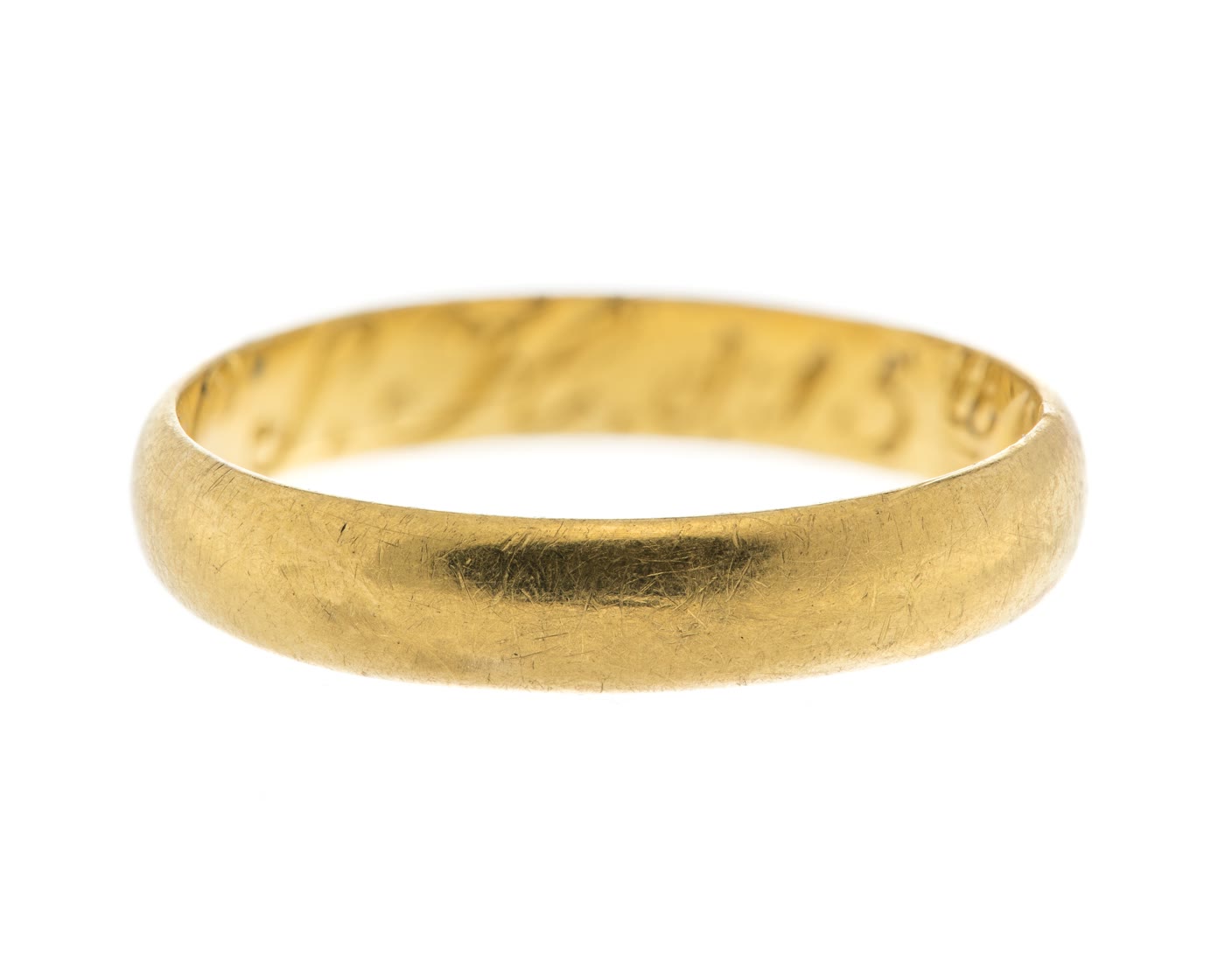
Between 1700 and 1950 the Western wedding ring was a deliberately plain object - a simple gold band, worn in clear visual contrast to the more decorative engagement ring given beforehand. That plainness, more than any single design, defines the wedding ring’s history through the 18th, 19th and early 20th centuries.
The Ring in the Marriage Service
In England the ring’s place in the wedding was fixed by the Church of England’s Book of Common Prayer. The first prayer book of 1549 kept the giving of a ring from the medieval service, and the 1662 version, used in English parish churches for the next three centuries, directed the bridegroom to place the ring on the fourth finger of the bride’s left hand while saying the words “With this ring I thee wed”. In the medieval Sarum rite that preceded it, the priest or groom is said to have moved the ring across the thumb and first fingers in turn, naming the Trinity, before leaving it on the fourth.
Not everyone accepted the ring. Many 17th-century Puritans objected to it as a relic of Catholic ceremony, and the Directory for Public Worship that replaced the prayer book from 1645, through the Civil War and the Commonwealth, made no provision for one. The ring returned with the 1662 prayer book and was not seriously challenged again. Civil marriages, introduced in England and Wales in 1837, had no required ring, but couples almost always used one.
The Plain Gold Band as Convention
Where an engagement ring might carry a gemstone cluster, a symbolic stone sequence or an elaborate setting, the wedding ring itself was conventionally restrained: a plain or lightly worked gold band, without a prominent central stone. The wedding ring needed to be worn constantly, including through daily domestic and manual work, so a low-profile band that would not catch or snag was the sensible everyday choice. Some plain bands carried a discreet inscription on the inner surface, continuing the older tradition seen in the posy ring, but this was a matter of private sentiment rather than outward display.
How the Band Changed
- 18th century: narrow, light bands of high-carat gold, often with a flat or slightly rounded section; posy inscriptions inside remained common into the mid-century.
- Victorian: British wedding rings were usually made in 22ct gold, and bands became wider and heavier as the century went on, with a rounded “D-shaped” section. A heavy 22ct band was a sign of respectability, and many working families saved for one.
- Edwardian to 1930s: bands narrowed again. 18ct gold and, for wealthier buyers, platinum became more common; engraved or chased patterns, including orange blossom (the traditional bridal flower), were fashionable, particularly in the United States.
- 1940s: in Britain, wartime controls on gold restricted wedding rings to plain 9ct bands of regulated weight under the government’s Utility scheme, introduced during the Second World War and lifted in the early 1950s; see 1940s Jewellery.
The specific carat and width varied by what a couple could afford and by country; continental European wedding rings were often 18ct, and customs about which hand carried the ring also differed.
Men’s Wedding Rings
For most of the 19th century, in Britain and the United States, a wedding ring was worn by the wife alone. Men’s wedding rings became common during the Second World War, when servicemen overseas wore them as a reminder of home, and the “double-ring” ceremony, in which both partners give a ring, spread widely in the United States in the 1940s and afterwards. Men’s rings were typically heavier, plain bands in the same gold as the bride’s.
The Ring Finger and the “Vena Amoris” Tradition
The convention of wearing the wedding ring on the fourth finger of the left hand carries one of the most widely repeated pieces of ring folklore: the belief that a vein - in Latin the “vena amoris,” or “vein of love” - runs directly from that finger to the heart. A version of the idea appears in classical writing: the 2nd-century Roman author Aulus Gellius reported an Egyptian belief in a fine nerve running from that finger to the heart. The Latin phrase itself was popularised much later, in English writing on marriage law in the late 17th century. It should be understood as a traditional belief passed down through popular and romantic writing rather than an anatomical fact; no such distinct vein exists, and the actual origin of the ring-finger custom is better explained by long-standing convention, reinforced by the prayer-book rubric, than by any feature of human anatomy.
The Gimmel Ring as an Earlier Combined Form
Before the plain single-band wedding ring became the unchallenged norm, the gimmel ring - two or three hoops that pivot and interlock into a single ring - served as a betrothal and wedding ring, especially in 16th- and 17th-century Germany and England. A tradition that the hoops were divided at betrothal and rejoined at the wedding is often repeated, though evidence for it is limited. See History of Engagement Rings for the betrothal side of that tradition, and hand jewellery symbolism for the clasped-hands fede rings often combined with it.
Keeper Rings
Plain wedding bands were often protected from loss or wear by a keeper ring - a guard ring worn on the same finger, above the wedding band, to hold it securely in place. Victorian keepers were frequently heavier and more decorative than the wedding ring they guarded, often wide 18ct bands with chased or engraved patterns, and a matching wedding ring and keeper were sometimes bought together.
Frequently Asked Questions
Did Georgian and Victorian wedding rings ever carry gemstones? Rarely, by convention - gemstones were far more strongly associated with the engagement ring, while the wedding band itself was conventionally plain, though exceptions exist.
Is the “vena amoris” story actually true? No - it is a long-standing traditional belief with classical roots, not an anatomical fact, and it is best read as folklore explaining a custom rather than a physiological claim.
Read next
Compare
Engagement Ring vs Wedding Ring: What's the Difference?
The direct historical comparison between the engagement ring, which varied widely by era, and the wedding ring, which stayed a plain gold band for most of the 1700-1950 period.
Eras
Georgian Jewellery
A guide to Georgian jewellery (1714-1837): Brazilian diamonds, closed-back foiled settings, rococo and Neoclassical styles, paste, cut steel and pinchbeck, sentimental miniatures, girandoles, rivières and Sévigné bows.
Eras
Victorian Jewellery
A guide to Victorian jewellery (1837-1901): the Romantic, Grand and Aesthetic periods, the Great Exhibition, gold rushes and 9ct gold, mourning and Whitby jet, archaeological revival, Scottish jewellery, and how to recognise each phase.
Jewellery
What Is a Keeper Ring?
What a keeper ring is, how it was worn alongside a more valuable ring to help hold it securely on the finger, and its relationship to the modern guard ring.

Jewellery
What Is a Posy Ring?
What a posy ring is, why its short engraved verse was often hidden on the inside of the band, and how the form declined from a common love token to a rarer survival by the Victorian era.
Jewellery
What Is a Regard Ring?
What a regard ring is, how its row of gemstones spells out the word REGARD through their first letters, and how it relates to the wider acrostic jewellery tradition.