Engagement Ring vs Wedding Ring: What's the Difference?
The direct historical comparison between the engagement ring, which varied widely by era, and the wedding ring, which stayed a plain gold band for most of the 1700-1950 period.
An engagement ring and a wedding ring mark two different moments in the same relationship - a promise of marriage and the marriage itself - and across most of the period from 1700 to 1950, they diverged sharply in how consistent their form was: the wedding ring stayed a plain gold band with remarkable consistency, while the engagement ring’s form shifted considerably by era and personal choice before the diamond solitaire became the expected default.
Short Answer
The engagement ring traditionally marks a promise or betrothal, and historically took many different forms from 1700 to 1950 - posy rings, regard rings and other acrostic jewellery, coloured gemstone clusters - before the diamond solitaire became the dominant convention by the early-to-mid 20th century. The wedding ring traditionally marks the marriage ceremony itself, and was, with far greater historical consistency, a plain gold band, deliberately restrained so it could be worn constantly through everyday and manual work.
What Is an Engagement Ring?
The engagement ring, covered in full in History of Engagement Rings, is given to mark a promise of marriage. Its form varied considerably across the Georgian, Victorian and early 20th-century periods: early betrothal rings included plain inscribed posy rings and interlocking gimmel rings, the Georgian period produced its own coded sentimental forms such as the regard ring, and it was only from the later 19th century onward, driven by increased diamond supply and sustained marketing, that a single large diamond became the expected engagement-ring stone.
What Is a Wedding Ring?
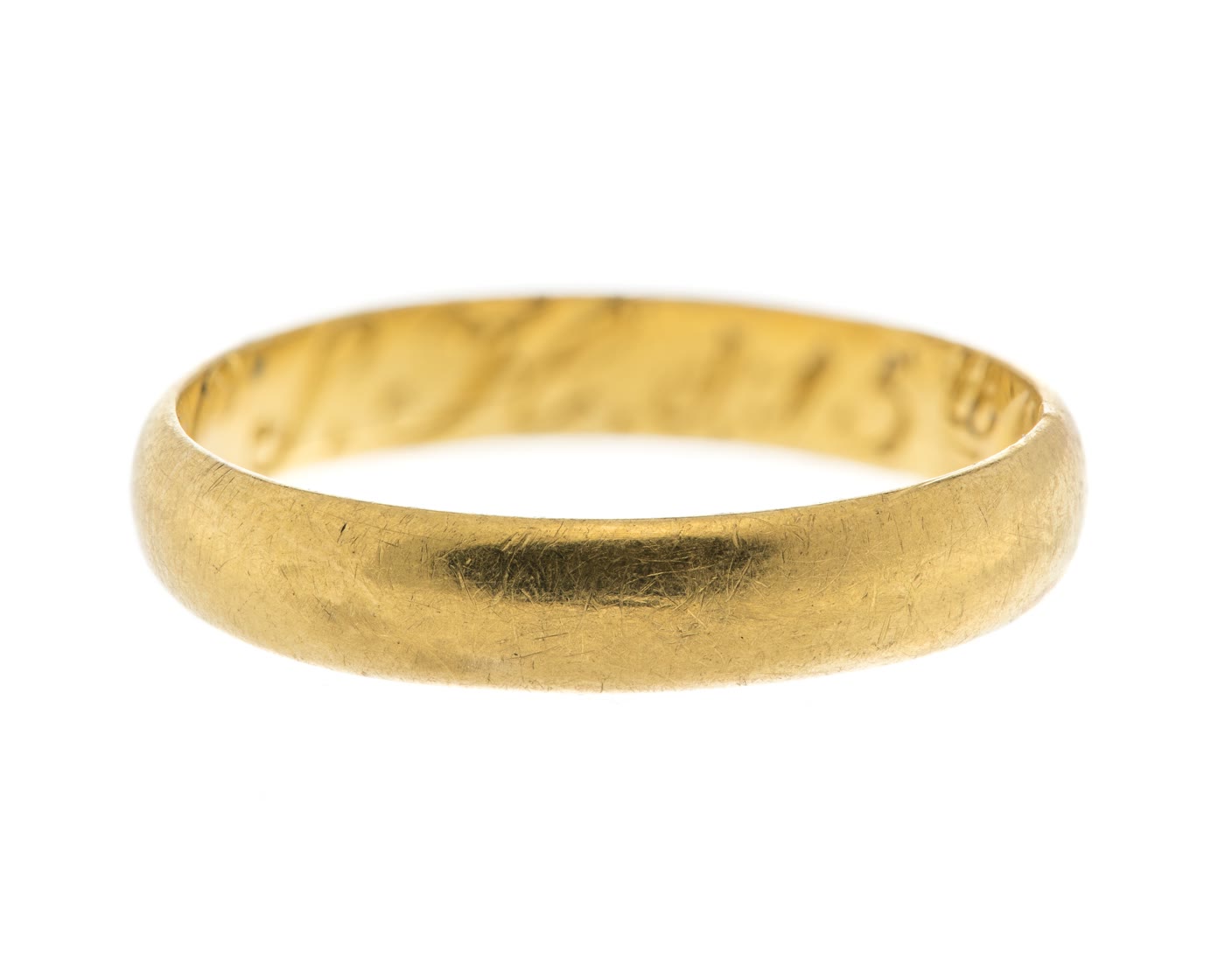
The wedding ring, covered in full in History of Wedding Rings, is worn to mark the marriage itself, exchanged during or given as part of the wedding ceremony. For most of the 1700-1950 period it was, by strong convention, a plain or only lightly worked gold band, worn in deliberate visual contrast to a more decorative engagement ring, and chosen for its low profile since it needed to be worn constantly, including through daily domestic and manual work.
Key Differences
| Property | Engagement Ring | Wedding Ring |
|---|---|---|
| What it marks | A promise or betrothal, given in advance of marriage | The marriage ceremony itself |
| Typical form, historically | Varied considerably - posy rings, regard and acrostic rings, gemstone clusters, later a diamond solitaire | Plain or lightly worked gold band with far less variation |
| Timing of wearing | Worn from betrothal onward, often for a period of months or years before marriage | Worn from the wedding ceremony itself, typically as a permanent, unremoved fixture |
| Historical consistency of convention | Varied strongly by era, region and personal or family choice | Comparatively uniform across the 18th, 19th and early 20th centuries |
| Typical prominence of gemstones | Central to the form once the diamond solitaire convention took hold | Rare by convention - gemstones were associated with the engagement ring, not the band |
Historical Consistency Compared
The most useful way to compare the two rings is not by appearance alone but by how much their form actually changed over time. The wedding ring’s plainness was remarkably stable: a gold band, narrow by later standards in the Georgian and early Victorian periods and generally becoming wider and heavier as the 19th century progressed, but consistently restrained rather than gem-set. That stability reflected the ring’s practical role - worn every day, indefinitely, it needed to withstand daily wear without catching or snagging.
The engagement ring’s form, by contrast, was far less settled across the same span. Georgian and early Victorian betrothal rings drew on posy rings and acrostic forms such as the regard ring, all of which prized personal or coded meaning over a standardised gemstone display. The shift toward the diamond solitaire as the default engagement-ring choice was a gradual development through the later 19th and into the 20th century, driven by increased diamond supply following major discoveries from 1867 onward, improved cutting technology, and sustained trade marketing - not a single dated turning point. As a result, an engagement ring from the Georgian or early Victorian period can look entirely unlike the diamond solitaire most people picture today, while a wedding ring from the same period generally looks recognisably similar to later examples.
Where the Two Forms Overlap
The clearest point of overlap is the gimmel ring, a ring made of two or three separate hoops that interlock into one band. According to a widely repeated tradition, though direct evidence for it is limited, the hoops were separated at betrothal, worn individually by each partner, and rejoined at the wedding to form the completed ring - meaning the same physical object could serve as both the engagement ring and the wedding ring in sequence, rather than the two being distinct pieces. More generally, both ring types could carry a private engraved inscription on the inner band, a custom with roots in the posy ring tradition, regardless of which of the two roles the ring served.
Related Reading
For the full history of each, see History of Engagement Rings and History of Wedding Rings. For related ring forms discussed on those pages, see Posy Ring, Regard Ring and Keeper Ring.
Read next
Eras
Georgian Jewellery
A guide to Georgian jewellery (1714-1837): Brazilian diamonds, closed-back foiled settings, rococo and Neoclassical styles, paste, cut steel and pinchbeck, sentimental miniatures, girandoles, rivières and Sévigné bows.
Jewellery
What Is a Keeper Ring?
What a keeper ring is, how it was worn alongside a more valuable ring to help hold it securely on the finger, and its relationship to the modern guard ring.

Jewellery
What Is a Posy Ring?
What a posy ring is, why its short engraved verse was often hidden on the inside of the band, and how the form declined from a common love token to a rarer survival by the Victorian era.
Jewellery
What Is a Regard Ring?
What a regard ring is, how its row of gemstones spells out the word REGARD through their first letters, and how it relates to the wider acrostic jewellery tradition.

Mourning & Sentimental
History of Engagement Rings
How the engagement ring moved from posy and gimmel rings through Georgian regard rings to the diamond solitaire - Kimberley, the Tiffany setting and De Beers' 1947 slogan.
Mourning & Sentimental
History of Wedding Rings
The plain gold band as the Western wedding ring: the Book of Common Prayer, the vena amoris tradition, 22ct Victorian bands, men's rings and wartime Utility rings in Britain.