Insect Jewellery
Insect jewellery from the Napoleonic bee to Victorian diamond flies and Lalique's Dragonfly Woman: naturalistic and Art Nouveau traditions, scarabs and real beetle wings.
Insects - beetles, bees, flies, dragonflies and butterflies especially - are a recurring jewellery motif between 1800 and 1950, but “insect jewellery” spans two quite different traditions: a naturalistic Victorian approach that rendered insects in close, literal detail, and a stylised Art Nouveau treatment that used insect forms as a vehicle for flowing line and translucent colour.
The Napoleonic Bee and the Scarab
Two insects carried specific meanings before the Victorian naturalistic fashion began. The bee was adopted by Napoleon as an imperial emblem in 1804, in place of the Bourbon fleur-de-lis; gold bees were embroidered on his coronation robes, and bee motifs appear in French First Empire jewellery; Napoleon III revived the emblem under the Second Empire (1852-70). The scarab beetle, the ancient Egyptian emblem of renewal, came into European jewellery with the Egyptian-revival fashions that followed Napoleon’s Egyptian campaign of 1798-1801, again after the opening of the Suez Canal in 1869, and most strongly after the discovery of Tutankhamun’s tomb in 1922. Ancient carved scarabs were mounted in gold rings and bracelets, and new ones were carved in hardstone or moulded in faience and glass for Egyptian-revival jewellery of the 1920s.
Naturalistic Victorian Insect Jewellery
Victorian insect jewellery aimed at close observation and literal representation, following the period’s wider taste for jewellery modelled on real plants and animals. Beetles, butterflies, dragonflies, bees, flies and spiders were rendered in gold, enamel and gemstones with attention to their anatomy - segmented bodies, veined wings, articulated legs - and set with small diamonds, coloured stones or seed pearls to pick out markings or catch the light.
The fashion peaked in the 1870s to 1890s. The new supply of South African diamonds made small diamond-set brooches affordable, and jewellers in London and Paris produced large numbers of bees, flies, butterflies and dragonflies in old-cut diamonds set in silver-topped gold, often with ruby or garnet eyes, a pearl or opal body, and wings sometimes mounted en tremblant on fine springs so that they quivered as the wearer moved. They were worn several at a time, scattered across a bodice, on a lace collar or in the hair, as if the insects had landed there. Many had a detachable brooch fitting so that they could also be worn as hair ornaments or pendants.
Real Insect Material
A less common but documented Victorian practice used real insects rather than metal and stone. The iridescent green wing-cases (elytra) of jewel beetles from India and South-East Asia were sewn onto embroidered muslin and dresses in large numbers; the best-known example is the green gown, covered with beetle wings, designed by Alice Comyns Carr for Ellen Terry to wear as Lady Macbeth in 1888, now at Smallhythe Place in Kent. From the 1860s into the 1880s, whole iridescent beetles, many of them from Brazil, were also mounted in gold as earrings, necklaces and brooches. These are historical curiosities, described here as part of the record of naturalistic decoration rather than as a recommendation.
Art Nouveau Insects: Lalique and the Dragonfly
A different treatment emerged with Art Nouveau jewellery around 1895-1910, when the dragonfly, butterfly, wasp and grasshopper became favourite subjects. Rather than pursuing anatomical accuracy, designers stylised and elongated insect forms, exaggerating wings in scale and curve or merging a woman’s body with an insect’s wings in hybrid compositions.
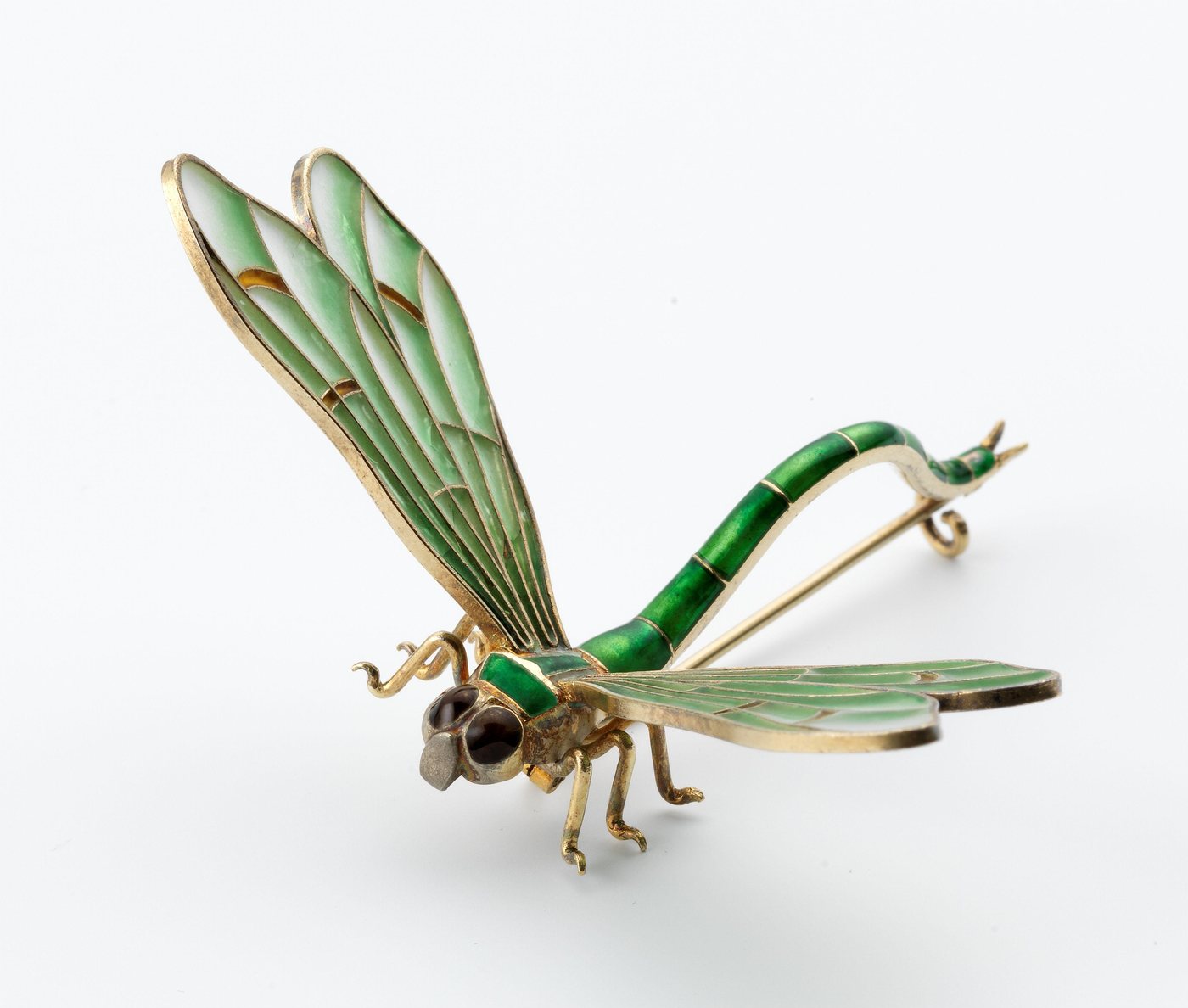
The most famous example is René Lalique’s “Dragonfly Woman” corsage ornament of about 1897-98, a woman’s torso emerging from a dragonfly’s body, with great articulated wings of plique-à-jour enamel. It was shown at the Paris Exposition Universelle of 1900, where Lalique’s display made his international reputation, and it is now in the Calouste Gulbenkian Museum in Lisbon, whose founder, Calouste Gulbenkian, bought a large group of jewellery directly from Lalique. Other designers who used insects include Philippe Wolfers in Brussels and Gustav Gaudernack at the firm of David-Andersen in Oslo, whose plique-à-jour dragonfly is shown above.
Why Insects Suited Plique-à-Jour
The dragonfly’s and butterfly’s wings - broad, thin, veined and naturally translucent - were ideally suited to plique-à-jour, in which enamel is fired within an open metal framework with no backing, so that light passes through the finished piece as through a real wing. To make it, the enameller fills the cells of a pierced or wire framework with enamel while it rests on a temporary backing of copper or mica, which is removed after firing. This technical fit between subject and process is a large part of why the dragonfly became the emblem of Art Nouveau jewellery. See enamel in jewellery for plique-à-jour and related techniques.
Two Traditions, Not One
The two insect traditions, though related in subject, reflect different decades, design ideas and techniques. Victorian insect jewellery prized observational accuracy and worked mainly in gold, gemstones and opaque enamel; Art Nouveau insect jewellery prized expressive stylisation and worked through translucent enamel, horn, glass and sculptural, often asymmetric metalwork. The degree of naturalism and the use of transparent or opaque enamel are useful indicators of which tradition a piece belongs to. In the 1930s and 1940s, insects returned as large gold and gem-set “clip” brooches, bolder and more stylised than their Victorian forebears.
Typical Forms
Across both traditions, insects appear most often as brooches and pendants, where the wingspan could be displayed, though smaller insects also appear on rings, earrings, stickpins and hatpins. Dragonflies and butterflies, with their symmetrical wings, suited pendant and brooch compositions in both eras.
Reading Insect Motifs Today
Close anatomical detail, opaque enamel or gem-set colouring, and a symmetrical composition point toward the Victorian naturalistic tradition; old-cut diamonds in silver-topped gold point to the 1870s-1890s. Elongated, stylised silhouettes, asymmetric composition and translucent plique-à-jour enamel point toward Art Nouveau, particularly in combination with materials such as horn, glass and moonstone. A crowned or heraldic bee suggests Napoleonic imagery, and a scarab suggests Egyptian revival.
Read next
Eras
Art Nouveau Jewellery
A guide to Art Nouveau jewellery (c.1890-1910): René Lalique and Gulbenkian, Fouquet and Mucha, Vever and Gaillard, plique-à-jour and horn, Jugendstil, Liberty's Cymric range, Tiffany, and the mass-produced silver that spread the style.
Eras
Victorian Jewellery
A guide to Victorian jewellery (1837-1901): the Romantic, Grand and Aesthetic periods, the Great Exhibition, gold rushes and 9ct gold, mourning and Whitby jet, archaeological revival, Scottish jewellery, and how to recognise each phase.
Gemstones
Moonstone in Art Nouveau Jewellery
Why Ceylon moonstone's glowing sheen suited René Lalique, Arts and Crafts makers, Georg Jensen and Edwardian jewellers c.1890-1930, with its cabochon cutting, carved faces and settings.
Jewellery
What Is a Brooch?
What a brooch is, how its pin-and-catch fastening works, and how brooch styles moved from naturalistic Victorian sprays through mourning brooches to Art Deco geometry.
Jewellery
What Is a Pendant?
What a pendant is, how it differs from an integrated necklace centrepiece, and how forms like the locket, lavalier and negligee pendant developed within the broader category.

Materials
Enamel in Jewellery
What enamel is, how it was fired, and how cloisonné, champlevé, guilloché, painted enamel and plique-à-jour relate - with the makers and fashions of enamel jewellery from 1700 to the 1930s.